© Shutterstock
 Votre guide Ryo
St. Stephen's Basilica Budapest: Complete Visitor's Guide (2026)
Some buildings overwhelm, and others uplift. St. Stephen's Basilica Budapest belongs to the second category: its 96-meter dome has dominated flat Pest since 1905, yet inside it is an almost intimate light that greets you, filtered through golden mosaics and amber-colored stained glass. It is hard to believe that it took more than half a century of construction and the collapse of the first dome to arrive at this result.
This practical guide tells you everything you need to know before you go: exact opening hours by season, 2026 prices (including what is genuinely free), how to climb to the panoramic terrace, where to find the Holy Right Hand — the relic of Saint Stephen's hand that fascinates historians and pilgrims alike — and which concerts are truly worth the trip. To explore the city beyond the monument, the Ryo audio guide tour of Budapest takes you on a 3h30 journey across 8.5 km of the capital, with 24 audio stops between the Parliament and the Jewish Quarter. It remains your best companion for continuing your discovery once the visit is over.
History and Construction: Over 50 Years for an Extraordinary Building
The construction of this building is one of the most chaotic architectural sagas in 19th-century Europe. It all began in 1851, when József Hild, a Viennese neoclassical architect based in Pest, laid the first stones of a building commissioned by the archdiocese. The original plan called for a sober Latin nave, faithful to the taste of the era.
Hild died in 1867 without seeing his work completed. The direction of the project passed to Miklós Ybl, who made a radical architectural shift: he abandoned his predecessor's neoclassical style in favor of Neo-Renaissance, deemed more ambitious and more representative of the prestige of the rapidly expanding Hungarian capital. It is Ybl who designed the bulk of what you see today — the twin-towered façade, the dome inspired by that of St. Peter's in Rome, and the decorative richness of the interior.
On January 22, 1868, disaster struck: the provisional dome collapsed under the weight of snow and structural calculation errors. Part of the nave was destroyed. Ybl had to redraw the plans from scratch, reinforce the foundations, and completely rethink the structure of the drum that would support the final dome. This delay of several years weighed heavily on the budget and on the morale of Budapest's residents, who watched the construction site drag on endlessly.
Ybl died in turn in 1891, replaced by József Kauser, who finally completed the work. The basilica was consecrated on November 9, 1905 by the Primate of Hungary, in the presence of Emperor Franz Joseph I, both Emperor of Austria and King of Hungary. The wait had lasted fifty-four years. Today it is the largest church in Hungary, with a capacity of approximately 8,500 worshippers, and one of only two buildings in Budapest to reach exactly 96 meters — a symbolic figure recalling the year 896, the date of the Magyar conquest of the Carpathian Basin.
The sanctuary is dedicated to Saint Stephen I (Szent István tér 1, 1051 Budapest, rated 4.7/5 on Google with 77,734 reviews), Hungary's first Christian king, crowned on Christmas Day in the year 1000. His canonization in 1083 made him the country's patron saint, and his name was naturally given to the capital's most important building.
The Exterior Architecture: A Façade in Dialogue with the Square
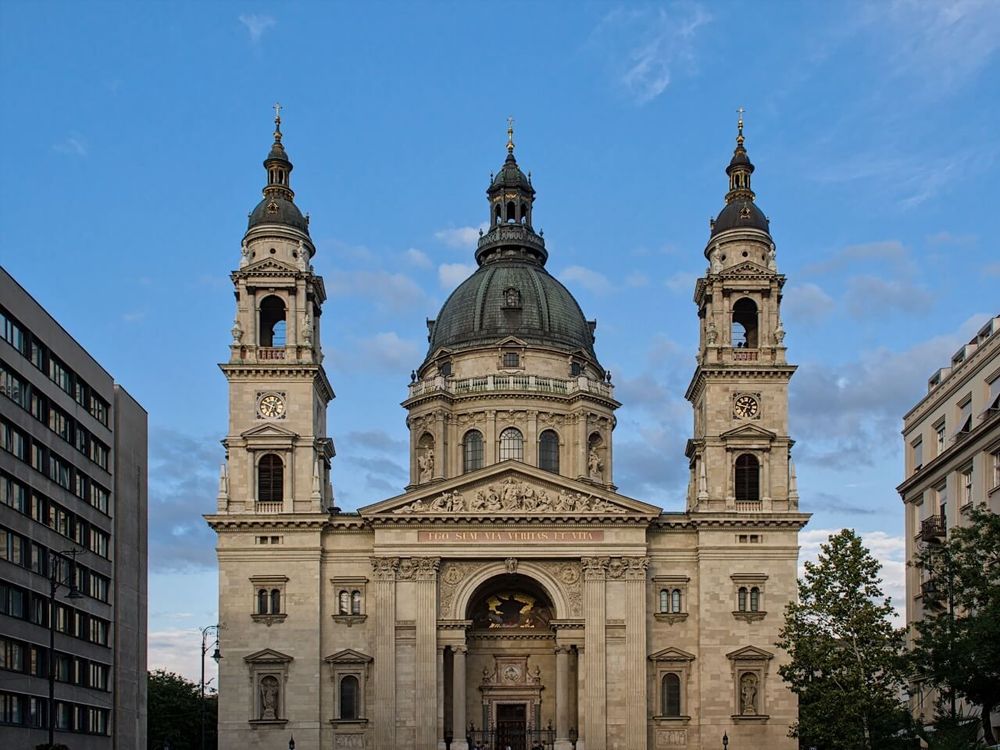
Before even going inside, take a moment to stand on Szent István Square (Szent István tér, 1051 Budapest, rated 4.7/5 on Google with 77,734 reviews) and observe the façade. It is organized into three vertical registers, framed by two massive 57-meter towers flanking the main portal. Between them, a sculpted tympanum depicts the Virgin and Child surrounded by angels — a classically legible iconographic program, but of remarkable fineness of execution, particularly the drapery of the outer angels.
The façade in Süttő limestone — the cream-colored stone characteristic of Hungary's great 19th-century building projects — was restored between 2000 and 2003, which explains its surprisingly clean appearance. Notice the contrast between the lower sections of the walls, slightly grey from urban pollution, and the higher areas, which have remained brighter: this gradation tells the story of a decade of automobile traffic around the square before it was finally pedestrianized.
The central dome rises to 96 meters. It is a lantern dome — meaning its summit is pierced by a glazed opening that injects light vertically into the nave. From the square, its true height is hard to gauge as it sits back from the façade; you need to move toward the Danube or climb Buda Castle Hill to truly appreciate its silhouette.
Around the square, a few details are worth your attention: the bas-relief on the architrave of the central portal depicts scenes from the life of Saint Stephen, in a narrative style that blends Byzantine and Italian Renaissance influences. The two symmetrical fountains on the square were added during the 2000 renovation; they are not part of the original project but blend seamlessly into the overall composition.
The Interior: The Nave, Altars, and Mosaics
Stepping through the main portal means entering a space whose proportions come as a surprise. The nave measures 87 meters long and 55 meters wide at the transept. The floor is laid in Carrara marble and Süttő stone, arranged in geometric patterns that draw the eye toward the high altar.
The Central Nave and Side Chapels
The main nave is flanked by two rows of columns in Hungarian red marble — a stone quarried from Süttő and the Eger basin — supporting the upper galleries. Between each column, niches house statues of saints, all in white marble, produced by Hungarian and Austrian sculptors in the late 19th century. The most remarkable are those of Saint Ladislaus (4th niche on the left) and Saint Stephen in Armor (last niche before the right transept).
There are six side chapels, three on each side. Each has its own altar and decorative program. The Chapel of the Sacred Heart (first on the left as you enter) preserves a wall fresco by painter Gyula Benczúr dating from 1898 — the same artist who created the famous painting of the Baptism of Vajk displayed at the Hungarian National Museum. The Chapel of Saint Margaret (second on the right) features Byzantine-style mosaics of exceptional quality, imported from the Salviati workshops in Murano.
The Mosaics and the Ceiling
It is the ceiling that stops visitors in their tracks. The vault of the central nave is entirely covered with mosaics on a gold background, made from Murano glass tesserae between 1890 and 1904. The central iconographic program shows Christ Pantocrator in the dome, surrounded by the four Evangelists in the pendentives. The palette — gold, azure, vermilion, Veronese green — is characteristic of the Byzantine-Venetian style that profoundly influenced Hungarian decorators of the period.
The High Altar
The main altar, in Carrara marble and gilded bronze, is dominated by a large mosaic depicting the Virgin and Child in a radiant glory, surrounded by angel musicians. The ensemble was designed by sculptor Alajos Stróbl, a central figure in Hungarian sculpture of the late 19th century, whose work you will also find in the decoration of the Parliament. The marble statue of Saint Stephen placed above the altar is the most venerated work in the choir, and the effigy of the saintly king is carried in procession every August 20, during Hungary's national holiday.
Beneath the main altar, a crypt houses the remains of several notable Hungarians, including footballer Ferenc Puskás, as well as ornaments connected to the history of the sanctuary.
The Holy Right Hand: Hungary's Most Precious Relic
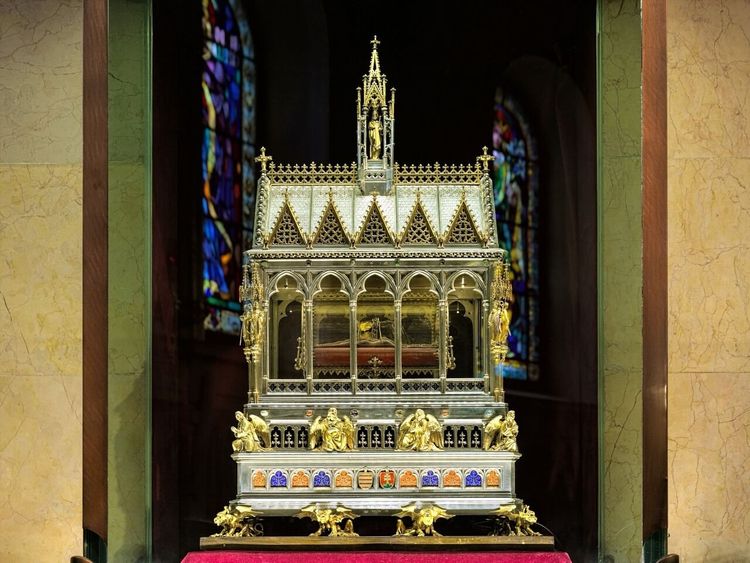
At the end of the right nave, behind a gilded grille, in a chapel whose walls are entirely clad in black and gold marble, lies what draws believers and curious visitors alike: the Holy Right Hand (Szent Jobb in Hungarian), the mummified right hand of King Saint Stephen I.
History of the Relic
The Holy Right Hand is the most venerated object in Hungary, and its history is almost as eventful as the construction of the sanctuary itself. After the king's death in 1038, his body was interred at Székesfehérvár, the ancient royal capital. In 1083, upon his canonization, the body was exhumed: according to the chronicles of the time, the king's right hand had resisted decomposition, a divine sign that immediately made it a first-rank relic.
Over the following centuries, the Holy Right Hand traveled widely. It was taken out of the country during the Ottoman invasions for safekeeping, then held in Ragusa (present-day Dubrovnik) for over a century. Empress Maria Theresa had it repatriated to Buda in 1771. After World War II, the relic was hidden for safekeeping and then returned, before being permanently placed in St. Stephen's Basilica in 1987, where it has been on display ever since.
Seeing the Relic Today
The Chapel of the Holy Right Hand is accessible from the right nave. The relic is displayed in an oval gold and crystal reliquary, resting on a plinth decorated with semi-precious stones. To illuminate it — a tradition that always delights visitors — insert a 200-forint coin into a metal box fixed to the chapel's grille: a light then turns on for a few seconds, revealing the hand inside its reliquary.
The Holy Right Hand leaves the sanctuary once a year, on August 20, for the national holiday procession. On that day, tens of thousands of people follow the reliquary through the streets of central Pest, in an atmosphere that blends sincere devotion with national celebration.
The Dome and the Panoramic Terrace
Climb to the top of the dome: it offers one of the best views over Budapest, and one of the least known among tourists who tend to focus on Buda Castle or the Parliament.
Access is from inside, via a spiral staircase of 302 steps, or by elevator up to the intermediate gallery (at approximately 40 meters), from which a short flight of steps leads to the outdoor terrace. The circular interior gallery, just below the lantern, looks down over the nave from above: this is where the true scale of the building really hits you, with worshippers far below reduced to tiny silhouettes.
The outdoor terrace opens at 65 meters above ground. From there, the panorama covers all of Pest to the east: you can make out the Parliament's dome, the towers of the Great Synagogue, the roof of the Opera House, and the Buda hills to the west, with the silhouette of the Castle and the Gellért Citadel. On clear days, the Hungarian plain stretches as far as the eye can see beyond the city's outermost districts.
Practically speaking, allow 20 to 30 minutes for the ascent and descent, plus time on the terrace. In the morning, the light is more favorable for photos on the east side. The elevator is accessible to people with reduced mobility up to the intermediate gallery, but the outdoor terrace requires climbing the final steps on foot. From the top, the Great Synagogue and Buda Castle stand out clearly, both stops on our audio-guided tour of the city.
The panorama ticket is sold separately from the entrance ticket. See the Prices section for 2026 rates.
Concerts at St. Stephen's Basilica
The sanctuary is a highly regarded concert venue throughout Central Europe. Its organ, an Angster inaugurated in the early 20th century and subsequently modernized, has five manuals and several dozen stops; it is considered one of the finest Hungarian instruments still in use. The nave's acoustics, with a long reverberation time, favor Baroque and Romantic repertoire, though careful interpretation is needed to prevent polyphonic lines from blurring.
The 2026 Program
Concerts take place several times a week, generally in the evening, and more frequently from April to October. The 2026 program alternates between:
- Solo organ concerts: repertoire by Bach, Buxtehude, and Liszt (including several pieces Liszt wrote during his stays in Budapest)
- Chamber music + organ concerts: string quartets or trumpet accompanying the organ
- Orchestral concerts: some Budapest ensembles schedule one or two annual performances here, often around the August 20 national holiday
Tickets can be purchased on-site at the cashier or through partner agencies in the city. Seats are numbered. Concerts generally last 45 to 60 minutes without an intermission. If you are planning your stay around a concert, book at least 2 weeks in advance in high season: seats sell out quickly.
Useful tip: evening concerts offer the rare opportunity to see the nave lit only by its interior chandeliers and the candles of the side altars, in an atmosphere very different from the tourist hours of the day. To place this ambiance within the broader story of the city, the Ryo audio-guided tour of Budapest devotes one of its stops to the basilica's neighborhood.
Opening Hours in 2026
The sanctuary is open every day of the year, including public holidays, but hours vary by season and depending on whether a mass is in progress.
| Period | Opening Hours | |---|---| | Monday–Saturday (low season, Nov.–Mar.) | 9 am–5 pm | | Monday–Saturday (high season, Apr.–Oct.) | 9 am–7 pm | | Sunday year-round | 1 pm–5 pm (mornings reserved for services) | | Catholic public holidays | 1 pm–5 pm |
The panoramic terrace generally closes 30 minutes before the nave closes. During masses — on Sunday mornings and Saturday late afternoons — tourist visits are suspended: you may attend the service but may not move freely through the nave.
In summer (July and August), access may remain possible until 9 pm on certain days. Always check the official website for up-to-date hours before your visit, as they may change for special events.
Prices and Tickets: What Is Free, What Is Paid

It is a question everyone asks: is entry really free?
The answer is nuanced. Access to the nave is free — you can enter, walk around, visit the side chapels, contemplate the altar and the Holy Right Hand without paying. However, several areas and services require an admission fee, and pricing policy has evolved in recent years: always confirm current amounts on the official website.
2026 Prices (Approximate)
Nave entry: free (but a recommended donation of 1,000 to 2,000 forints, approximately €2.50 to €5, is posted at the entrance)
Panoramic terrace (dome):
- Adult: from approximately 2,500 to 3,500 forints (around €7 to €9)
- Reduced rate for students/seniors: slightly lower
- Combined ticket (nave + panorama + treasury) available at a group rate
Treasury (collection of liturgical ornaments):
- Included in certain combined tickets, or available for a moderate additional fee
Concerts:
- Seats by category: approximately 3,500 to 8,000 forints (€9 to €21)
- Booking recommended (see concerts section)
Tickets are purchased at the on-site cashier; card payments are accepted. Beware of online resellers who charge high service fees for access you can purchase directly on-site.
If you are visiting Budapest with the Budapest Card, check your edition: some versions include a discount on the panorama, others do not. The city's travel guides specify the exact inclusions of the card.
How to Get to St. Stephen's Basilica
The sanctuary is located in the heart of Pest, a stone's throw from the pedestrian Váci Street and a few minutes' walk from the Parliament.
By metro: The closest station is Bajcsy-Zsilinszky út on the M3 line (blue), a 3-minute walk away. Arany János utca (also M3) is a 5-minute walk. From Deák Ferenc tér station (interchange for M1, M2, M3), allow 8 minutes on foot heading north.
By tram: Tram no. 2, which runs along the Danube on the Pest bank, stops at Széchenyi István tér, a 6-minute walk inland.
On foot: From the Great Synagogue (Dohány Street), allow 15 minutes. From Matthias Church (Buda side), allow 25 minutes on foot including the crossing of the Chain Bridge.
By car: Parking is virtually impossible around Szent István Square, which is pedestrianized. The nearest underground car parks are beneath Arany János Centre (5 min on foot) and beneath Párisi Udvar (7 min on foot). Metro or a taxi from your hotel is strongly recommended. Both drop you a few steps from the square, where our audio-guided tour of the city heads off towards the Great Synagogue.
Practical Tips for Planning Your Visit
When to Go
The best time slot for a visit is on a weekday, between 9 am and 10:30 am, before organized tour groups arrive. Between 11 am and 3 pm in high season (May to September), the building can host several hundred people at once, making serene contemplation of the interior difficult.
Sunday afternoon is paradoxically quiet: since mornings are reserved for services, fewer tourists flock in. The late-afternoon light, entering through the west transept windows, is particularly beautiful on the mosaics.
Duration of the Visit
Allow at least 1 hour to walk through the nave and see the Holy Right Hand. If you go up to the dome, add 30 minutes. Including the treasury, allow 1h45 to 2h. Most visitors spend between 45 minutes and 1h30 on-site.
Dress Code
This is an active place of worship. Shoulders and knees must be covered. Wraps are sometimes lent at the entrance to visitors wearing shorts or sleeveless tops. Avoid beach attire, even in hot weather: in the height of Budapest's summer, the interior is noticeably cooler than outside.
Photos and Videos
Photography is permitted throughout almost the entire sanctuary, including in the Chapel of the Holy Right Hand, except during services. Tripods are not allowed (obstruction). Flash should be avoided near the mosaics — on-site guides remind visitors of this consistently. For the dome, bring a wide-angle lens if possible: the proportions of the nave seen from above are impressive but hard to frame with a standard lens.
Accessibility
The main entrance on Szent István Square is wheelchair accessible. The interior of the nave is on a single level. The dome elevator goes up to the intermediate gallery (accessible for wheelchair users), but the outdoor terrace requires climbing a few additional steps.
Luggage Storage
There is no official luggage storage on-site. If you are arriving with bags, Budapest-Keleti (the main railway station) has a left-luggage facility, and several luggage storage companies offer drop-off points in the city center.
What to Do Around St. Stephen's Basilica
The monument is located in one of Budapest's densest areas for sights. Here are the places you can combine in the same half-day. Our audio-guided tour of Budapest connects most of these stops in a single itinerary.
The Hungarian Parliament
900 meters on foot to the northwest, along the Danube or through the government district, the Hungarian Parliament is one of the most spectacular Neo-Gothic buildings in Europe. It houses the royal regalia, including the Crown of Saint Stephen, the crown associated with the coronation of Hungary's kings. The guided tour (mandatory, available in several languages including English) lasts approximately 45 minutes. Book online: tickets sell out quickly in high season.
Andrássy Avenue and the State Opera House
Andrássy Avenue begins just a short distance away, to the southeast. It is Budapest's equivalent of the Champs-Élysées, listed as a UNESCO World Heritage Site since 2002. Walking 200 meters along it, you reach the Hungarian State Opera House (Andrássy út 22, 1061 Budapest, rated 4.7/5 on Google with 23,775 reviews) (Magyar Állami Operaház), a masterpiece by architect Miklós Ybl — the same man who took over the basilica's construction. The connection is not incidental: both buildings, raised at roughly the same period, form a coherent architectural dialogue.
The Great Synagogue on Dohány Street
1.2 km to the southeast, the Great Synagogue on Dohány Street is the largest synagogue in Europe. It dates from 1859 — a few years after the neighboring construction site began — and its two 43-meter Moorish towers engage in a striking dialogue with the Christian bell towers of the district. Entry is ticketed and very well organized, with an adjoining museum that tells the history of Budapest's Jewish community.
The Belváros District
The surrounding district, the Belváros (Pest city center), is full of Art Nouveau inner courtyards hidden behind grand façades. Párisi Udvar (formerly Párizsi Nagy Áruház), 700 meters to the south toward the Danube, is one of the finest Belle Époque shopping arcades in Central Europe, recently restored. Entry is free.
The Thermal Baths
Budapest has more than 100 thermal springs, several within a few kilometers. The Széchenyi Baths (Pest side, in the city park) are the most famous and most accessible from the center. For a more central experience, the Rudas Baths (Buda side, after crossing the Chain Bridge) offer authentic Ottoman architecture. For more information, see our complete guide to Budapest's thermal baths. Between two bathhouses, our audio-guided tour links Andrássy Avenue to the Great Synagogue on foot.
Where to Eat near St. Stephen's Basilica
The restaurants directly adjacent to Szent István Square are, unsurprisingly, among the most expensive in Budapest: they live off the constant tourist flow. Here is where to eat well without being caught out.
Around the Square: Good Value for Money
Rosenstein (a 10-minute walk east on Mosonyi Street) is a family institution of Hungarian-Jewish cuisine, frequented by Budapest locals as much as by savvy travelers. The menu revolves around Hungarian-style foie gras, paprika veal, and Gundel pancakes. Evening reservations are advised.
Borkonyha (Sas Street, 2 minutes from the sanctuary) has long held a Michelin guide distinction and offers a wine list that prioritizes Hungarian estates — Eger, Tokaj, Villány. The cooking is French in technique, Hungarian in ingredients. Prices are high but justified.
Markets and Quick Options
The Budapest Central Market Hall (Vásárcsarnok) is a 15-minute walk south along the Danube. It is worth a detour as much for its stalls of paprika, salami, foie gras, and cheeses as for the upstairs counters serving hot Hungarian dishes at reasonable prices. It is the ideal option for lunch between a morning visit and an afternoon on the Buda side.
For a coffee and a pastry, Gerbeaud (Vörösmarty Square, 5 minutes south) has been the most celebrated café in Budapest since 1858. It is touristy, expensive, and yet irreplaceable for its Dobos torte. Avoid peak hours (11 am to 2 pm) if you want a table.
The Basilica at Night and During National Celebrations
The sanctuary takes on an entirely different dimension after dark. From 9 pm in summer, once the square is free of tourist groups, the architectural lighting reveals details of the façade that daylight swallows in a wash of general brightness: the tympanum reliefs, the pilaster capitals, the festoons running along the cornice.
On the evening of August 20, Hungary's national holiday, the square becomes the center of Budapest's largest popular gathering. The day begins with the Holy Right Hand procession through the surrounding streets, continues with concerts on the square, and ends with fireworks over the Danube — one of the largest in Europe, launched from several barges anchored mid-river. If you are in Budapest that evening, take up a position on Szent István Square at least two hours before the show begins to secure a good spot.
In December, the square hosts one of the city's most popular Christmas markets. Stalls appear from late November around the central fountain, with Hungarian crafts, mulled wine (forralt bor), and traditional music concerts. The illuminated building provides a natural backdrop that makes it one of the most photographed Christmas markets in Budapest.
Anecdotes and Little-Known Facts
Certain details deserve particular attention, as they tell a story often absent from standard guidebooks.
The Number 96 and the Hungarian Millennium
The height of 96 meters is no architectural accident. It refers to the millennium of 1896, celebrated on the occasion of the thousandth anniversary of the Magyar conquest of the Carpathian Basin. By tradition, no building in central Budapest is supposed to exceed 96 meters, in reference to the year 896. Only two buildings reach exactly this height: the basilica and the Parliament. This symbolic ceiling helps explain the remarkably horizontal skyline of the city compared to other European capitals.
The 1868 Collapse and the Investigation That Followed
The collapse of the first dome in January 1868 was not a completely unforeseeable accident. Cracks had previously been reported by workers on the site. The inquiry opened after the disaster identified weaknesses in the drum structure and the composition of materials, compounded by a severe winter. Ybl, who took over the project, demolished much of what had already been built and reinforced the foundations — a radical decision that contributed to the solidity of the present building.
Liszt and the Organ
Ferenc Liszt, who spent his final years in Budapest and died there in 1886, never saw the sanctuary completed: he passed away nineteen years before the 1905 consecration. Yet he composed several sacred works connected to the cathedral under construction, including a mass intended for major ceremonies. Today, Liszt's repertoire features in virtually every organ concert held here.
The Holy Right Hand in the 20th Century
During the Siege of Budapest (December 1944 – February 1945), the city and its monuments suffered heavy damage. The Holy Right Hand was hidden by the Hungarian clergy, who feared its destruction or theft, before being returned to the sanctuary after the war. This dramatic episode adds yet another layer to the mystique of the country's most venerated relic.

FAQ
Is Entry to St. Stephen's Basilica in Budapest Free?
Access to the nave is free. A donation of 1,000 to 2,000 forints (approximately €2.50 to €5) is recommended at the entrance, but it is not mandatory. However, access to the panoramic terrace is ticketed (around 2,500 to 3,500 forints for an adult), as is the treasury visit. Concerts are also ticketed, with prices varying by seating category. Since pricing policies change regularly, confirm current amounts on the official website.
What Are the Opening Hours in 2026?
Monday to Saturday, opening is at 9 am, closing at 5 pm in low season (November to March) or 7 pm in high season (April to October). On Sundays, visitors are only admitted from 1 pm, as mornings are reserved for religious services. The panoramic terrace closes 30 minutes before general closing time. These hours may be modified on Catholic public holidays or during special events.
How Do You Get up into the Dome?
You have two options: the spiral staircase of 302 steps (allow 10 to 15 minutes to climb) or the elevator, which goes up to the intermediate gallery at 40 meters. From the gallery, a few more steps lead to the outdoor terrace at 65 meters. The panorama ticket is purchased at the cashier inside. The elevator is accessible to people with reduced mobility up to the intermediate gallery, but not to the final terrace.
What Is the Holy Right Hand and Where Can You Find It?
The Holy Right Hand (Szent Jobb) is the mummified right hand of King Saint Stephen I, Hungary's first Christian king, who died in 1038. It is the country's most sacred relic. It is displayed in a chapel at the end of the right nave, in a gold and crystal reliquary. To illuminate it, insert a 200-forint coin into the metal box attached to the chapel's grille: a light turns on for a few seconds. The relic leaves the basilica once a year, during the procession on August 20.
Are There Concerts at St. Stephen's Basilica?
Yes, concerts take place several times a week, especially between April and October, generally in the evening. The program blends organ recitals (Bach, Buxtehude, Liszt), chamber music, and orchestral events. The five-manual Angster organ is one of the finest instruments in Hungary. Tickets can be booked at the cashier or through partner agencies in the city. In high season, book at least two weeks in advance.
How Do You Get There from the Center of Budapest?
From Deák Ferenc tér station (interchange for metro lines M1, M2, M3), allow 8 minutes on foot heading north. The closest station is Bajcsy-Zsilinszky út (blue M3 line), a 3-minute walk away. Tram no. 2 (Danube riverbank) stops at Széchenyi István tér, a 6-minute walk away. There is no parking nearby: Szent István Square is entirely pedestrianized.
One of Central Europe's Greatest Churches, Best Seen at the Right Hour
This monument is one of those rare places where the accumulation of details — the medieval relic, the Murano mosaics, the five-manual organ, the view from the dome over a city barred from skyscrapers — ends up telling something coherent: the will of a nation, at the turn of the 20th century, to inscribe itself in history with an architecture equal to its ambitions.
If you only have one morning, go early (at 9 am when it opens), climb to the dome before the crowds arrive, and return in the evening if there is a concert. To keep exploring Budapest with the same depth, the Ryo audio guide to Budapest takes you on a 3h30 journey through the city's historic districts, from the Parliament to the Jewish Quarter, with 24 commented stops. It naturally extends your visit into the rest of the capital.
À lire également