© Shutterstock
 Votre guide Ryo
Guide to Budapest's Thermal Baths: the Best Spas and Everything You Need to Know in 2026
In Budapest, the question isn't whether to visit the thermal baths — it's a given and a cultural must. The real question is which of these steaming pools you choose, at what time you go, and with what budget. Beneath the streets of the Hungarian capital, 123 natural thermal springs feed a network of baths that spans twenty centuries of history: from 16th-century Ottoman hammams to early 20th-century Art Nouveau palaces, by way of the Roman baths of Aquincum. Budapest's thermal baths are not just another tourist attraction — they are an essential part of the Budapest way of life. The Ryo audio guide to Budapest passes by several of these monumental buildings: they are an integral part of the urban fabric, just steps from the bridges and covered markets.
This guide helps you navigate the city's seven main thermal complexes. You will find updated 2026 prices, the practical differences between a locker and a private cabin, the rules on swimsuits and swimming caps, and above all the answer to the question that divides travellers: which of these baths is truly worth the visit? Also note an important current development that changes the picture: two iconic establishments, the Gellért Baths and the Király Baths, are currently closed for renovation. A 16th-century Ottoman dome that casts pinpoints of light across the water. A 50-metre pool heated to 38°C where chess players set out their floating pieces on a Tuesday morning in January. A night swim with a view of the Elisabeth Bridge and the reflections of Buda Castle in the Danube. Budapest accumulates thermal experiences that cannot be replicated anywhere else. This guide tells you which one to choose. And once you are out of the water, our audio-guided tour of Budapest carries the story on through the streets, within sight of Buda Castle on the far bank.
Budapest and Thermal Water: 2,000 Years of History Underfoot
Imagine Budapest as a geological sponge resting on an active tectonic fault. Beneath Buda in particular, rainwater seeps into the karstic limestone, descends into deep zones where the earth's heat warms it, then rises back up under pressure, laden with minerals — calcium, magnesium, fluorides, hydrogen sulphide depending on the aquifer. The city counts 123 active thermal springs, of which 76 are used for therapeutic or commercial purposes. This is one of the highest densities in the world for a capital city.
The first to make systematic use of them were the Romans. Aquincum, the former capital of the province of Pannonia, occupied the right bank of the Danube, where Budapest later developed. Excavations in District III (Óbuda) have uncovered military and civilian thermal baths dating from the 2nd century AD, some of which are still partially visible in the neighbourhood today.
Then came the Ottomans, who occupied Buda from 1541 to 1686. Builders such as Sinân Agha erected hammams with domes pierced by small round openings, creating a characteristic dotted light effect. Contrary to what one might assume, these structures are not tourist reconstructions: the domes of the Rudás Baths (Döbrentei tér 9, 1013 Budapest, rated 4.3/5 on Google from 11,844 reviews) and Király are authentic 16th-century Ottoman edifices. Rudás is still in operation; Király has been closed since 2020, awaiting a renovation whose timeline remains uncertain.
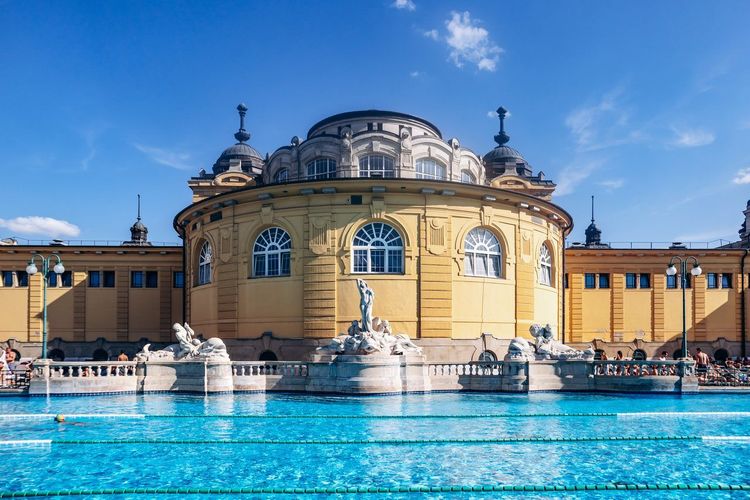
The third major period is that of the Austro-Hungarian monarchy at the end of the 19th century. Budapest became a capital of representation, and the baths followed suit: Széchenyi in 1913, Gellért in 1918. These wellness palaces were designed with Zsolnay mosaics and tiles, glass domes and marble décor. The Budapest bourgeoisie came to treat their rheumatism, but also to negotiate, read the newspaper and play chess.
What strikes visitors today is the continuity. Retired locals arrive at 7am before work. Families spend their Saturday in the pools. This unbroken link between past and present is what makes Budapest's thermal baths authentic — not aquatic museums, but social spaces that have never ceased to function.
Széchenyi Baths: Budapest's Largest Thermal Complex
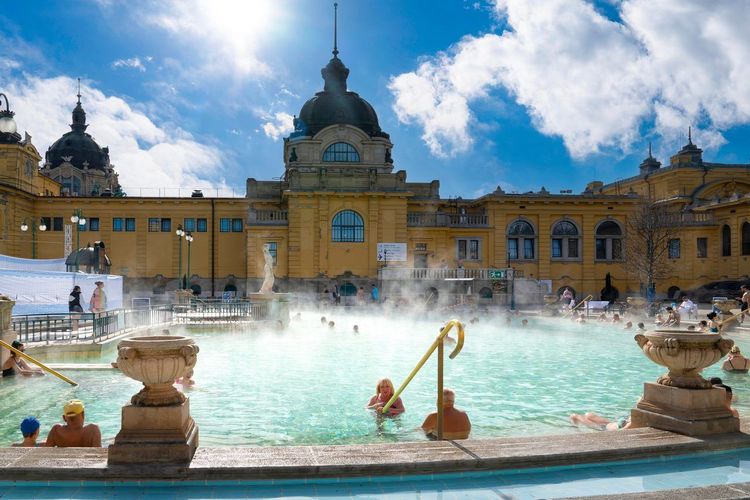
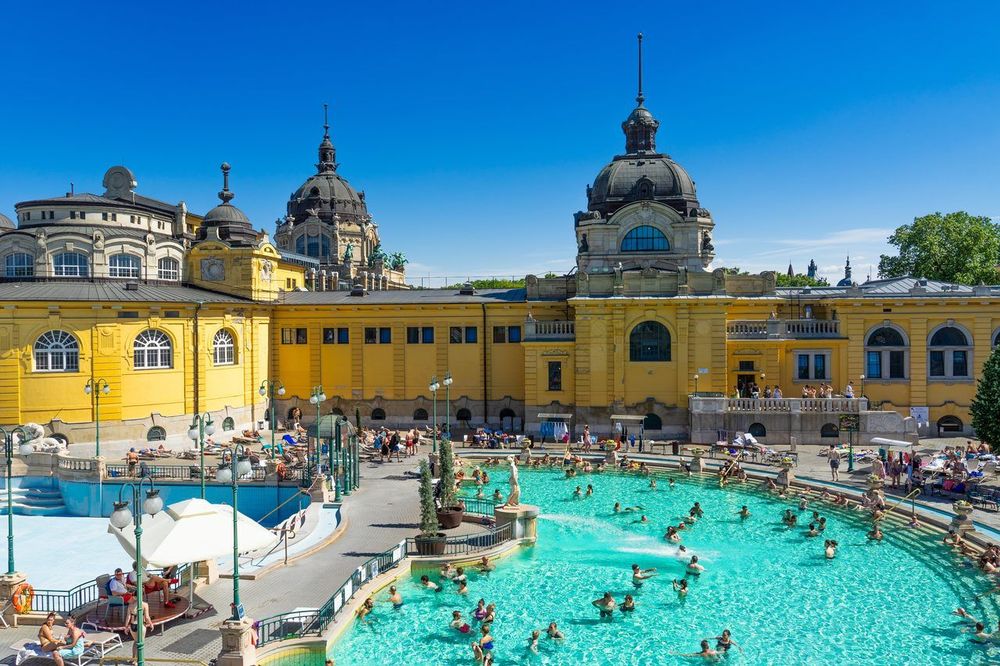
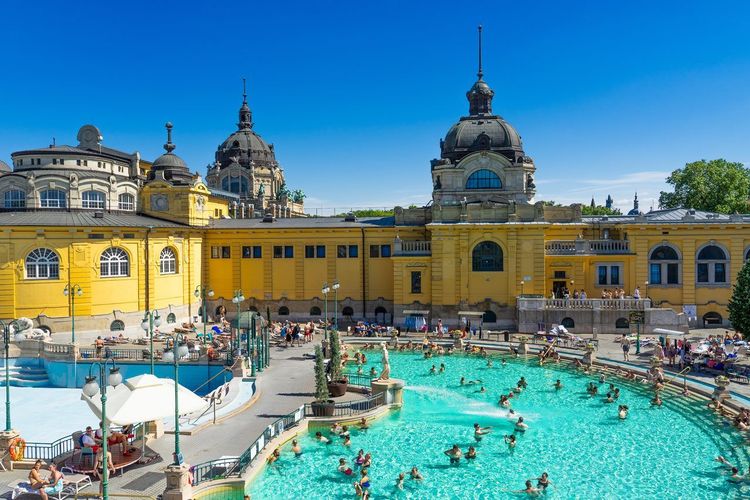
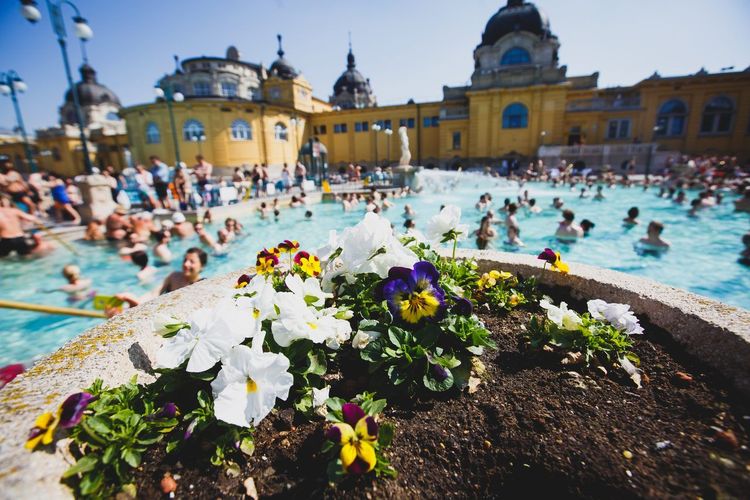
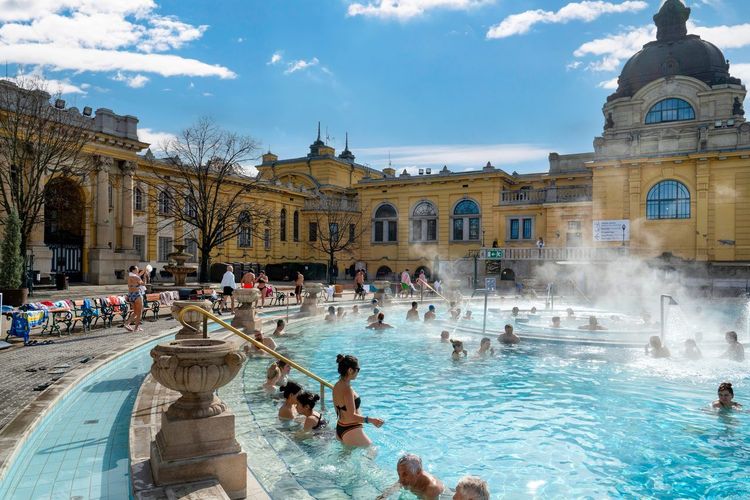
The building makes its presence felt from the moment you enter Városliget (City Park), in the 14th district: a mustard-yellow Neo-Baroque façade, two symmetrical domes, semicircular colonnade galleries. Architects Győző Czigler and Ede Dvorák inaugurated the complex in 1913, conceiving a monument as much as a swimming pool. The steam rising from the outdoor pools in cold weather, contrasting with the rigour of the architecture, is one of the most photographed images of Budapest.
The offering is considerable: 18 pools in total, including 3 large outdoor pools and 15 indoor pools at varying temperatures (28°C to 40°C). The large central outdoor pool, measuring 50 metres, is maintained at 38°C year-round. This is where the chess players gather — a ritual dating back to the 1950s: regulars play on floating boards, indifferent to the photographers surrounding them. The scene has become a hallmark image of Budapest, to the point that Széchenyi now offers chess boards for hire.
The complex also features a very popular circular whirlpool (körmedence), a section reserved for sport swimming on certain mornings, and several indoor pools at different temperatures. The classic thermal circuit starts with the large outdoor pool at 38°C for acclimatisation, progresses to the hotter indoor pools, ends with a sauna or steam session, then returns to the warm pool for gradual cooling.
2026 Prices (indicative): entry with locker (szekrény) between €22 and €24 on weekdays, private closed cabin (kabinet) between €26 and €30. At weekends, add approximately €2 more. Online tickets can sometimes help you avoid queues, which can exceed 45 minutes in July and August. A swimming cap is mandatory in the indoor pools, sold for €2 at the desk if you don't have one.
Getting There: metro M1 (the oldest metro line in continental Europe, opened in 1896), station Széchenyi fürdő, 10 minutes from Deák Ferenc tér.
Széchenyi is the most touristy thermal bath in Budapest. In July and August, the outdoor pools can resemble a water festival more than a thermal spa. To enjoy it in better conditions, aim for morning sessions between 7am and 9:30am on weekdays, or opt for another establishment if peace and quiet is a priority. That said, for space, architecture and overall atmosphere, Széchenyi remains unrivalled in the city. With Gellért closed, it now draws a large share of tourist footfall: booking online is all the more worthwhile.
Gellért Baths: the Art Nouveau Masterpiece (Closed for Renovation until 2028)
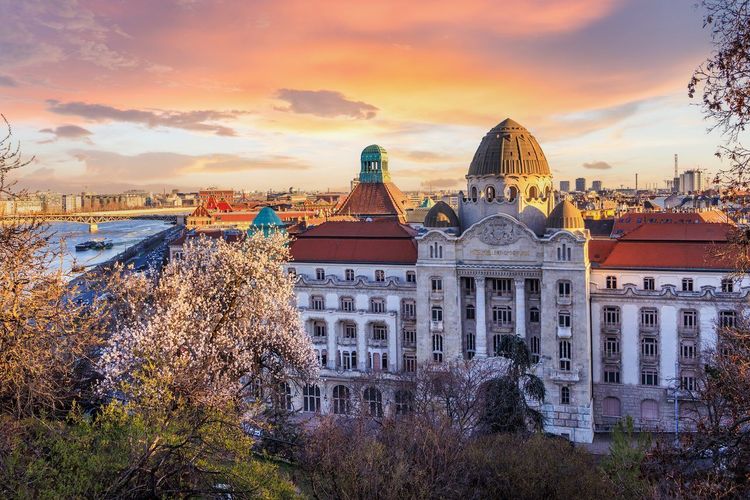
Good to know before planning your visit: the Gellért Baths closed on 1 October 2025 for a major renovation, with a reopening announced for 2028 (subject to the construction schedule and funding). They cannot be visited in 2026. We describe them here for their heritage value and to help plan a future stay; in the meantime, Széchenyi, Rudás or Lukács offer the best alternatives. (Kelenhegyi út 4, 1118 Budapest, rated 4.2/5 on Google from 30,390 reviews)
The Gellért Baths are not the largest in Budapest, but they make a rare claim: to be among the most beautiful thermal establishments in the world. Inaugurated in 1918 at the foot of Gellért Hill on the Buda bank, the complex is a monument of Hungarian Art Nouveau. The pale limestone façade and Zsolnay tiles in blue-green hues lend the whole a characteristic elegance; the marble columns of the main indoor pool, topped by a glass dome, make this a thermal cathedral rather than an aquatic centre.
The main indoor pool is the centrepiece: 32 metres long, with tiered galleries from which swimmers can be watched from the first floor, and natural light that passes through the dome at varying angles throughout the day. In the morning, raking rays create plays of reflections on the wet tiles. It is an architectural spectacle that justifies the entrance fee even for those who wouldn't dip a toe in the water.
The Gellért Baths practised mixed-gender access in most of their spaces — a historical feature that simplified logistics for couples and mixed groups, unlike the Ottoman establishments that alternate men's days and women's days.
The complex also houses an outdoor wave pool inaugurated in 1927, the first of its kind in the world. The thermal waters feeding Gellért come from springs at 44°C, diluted to reach an accessible temperature. This open-air pool on the garden side, quieter than the indoor spaces, was one of the great attractions of the site before its closure.
Upon reopening, prices should sit in the upper bracket of Budapest's thermal baths, comparable to Széchenyi. In the meantime, no tickets are being sold: be wary of third-party sites that may still be listing tickets for Gellért.
Getting There (for a future visit): tram 19 or 41, stop Gellért tér, or bus 7 from Pest, a 15-minute walk from the Elisabeth Bridge. Its location at the foot of Gellért Hill makes it a natural starting point for the climb to the panoramic viewpoint at the summit.
Rudás Baths: Budapest's Most Intact Ottoman Hammam
The Rudás Baths are the most singular in Budapest's thermal landscape. Founded around 1550 during the Ottoman occupation, they retain their original structure: a central dome 10 metres in diameter, pierced by small octagonal windows that scatter light in glowing dots across the greenish water. This aesthetic has not been reconstructed for tourists — it has been preserved intact for four centuries. With Király closed, Rudás is now the only original Ottoman hammam you can visit in Budapest in 2026.
The octagonal central pool, flanked by four smaller satellite pools at different temperatures (from 33°C to 42°C), is the essential Rudás experience. The water is slightly sulphurous, the light subdued, the atmosphere more conducive to solitary contemplation than conversation. This is the place to understand why public baths played such a central social role in 16th-century Ottoman cities.
One crucial organisational detail: Rudás is single-sex on weekdays. Men have access on Mondays, Wednesdays, Thursdays and Fridays; Tuesdays are reserved for women. At weekends, access is mixed. Check the schedule before you go — this is the most common mistake made by uninformed visitors, who find themselves turned away at the door.
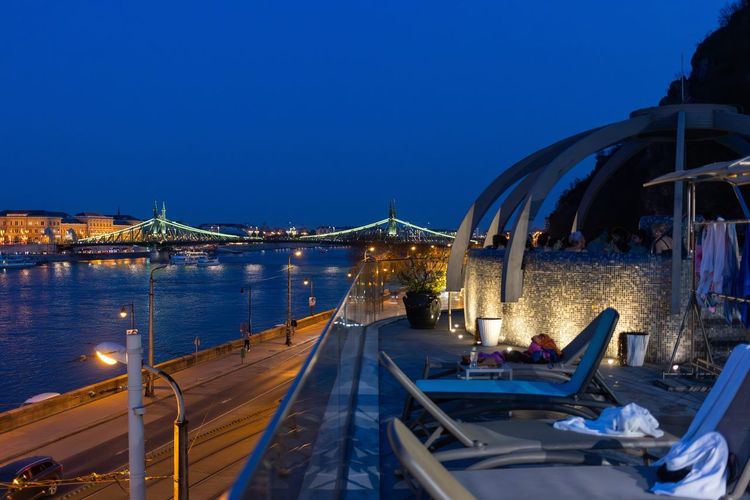
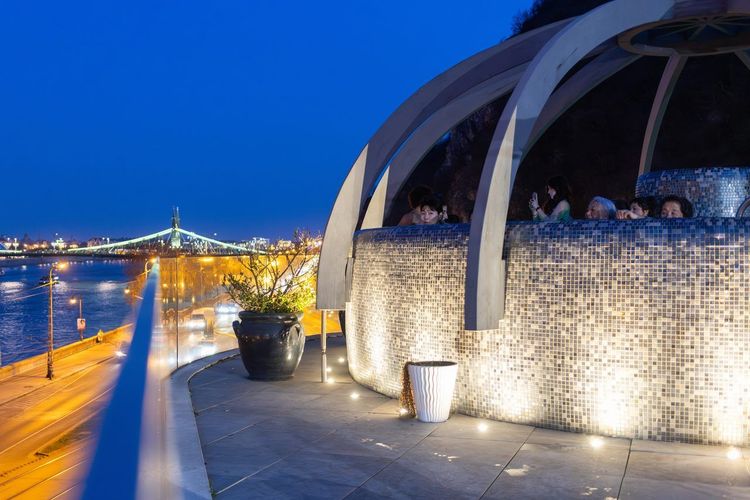
The complementary attraction is the rooftop panoramic pool (open since 2013): a circular basin at 36°C, with a direct view of the Danube, the Elisabeth Bridge and the Pest riverbank. On clear days, the Parliament building is visible to the right. Access is included in some tickets and charged as a supplement in others — check at the desk.
The night session at Rudás, on Fridays and Saturdays from 10pm, is an experience in its own right: the Ottoman dome lit differently, the rooftop with ambient music, a more festive atmosphere without crossing into clubbing territory. It is one of the most original thermal experiences in Budapest.
2026 Prices (indicative): entry with locker between €18 and €22 depending on the package. Weekend night session: €25–30, including rooftop and Ottoman dome.
Getting There: bus 7, stop Rudas fürdő. On foot from the Elisabeth Bridge on the Buda side, approximately 5–7 minutes. Night buses are available for the evening sessions.
Király Baths: Everyday Ottoman Authenticity (Closed for Renovation)
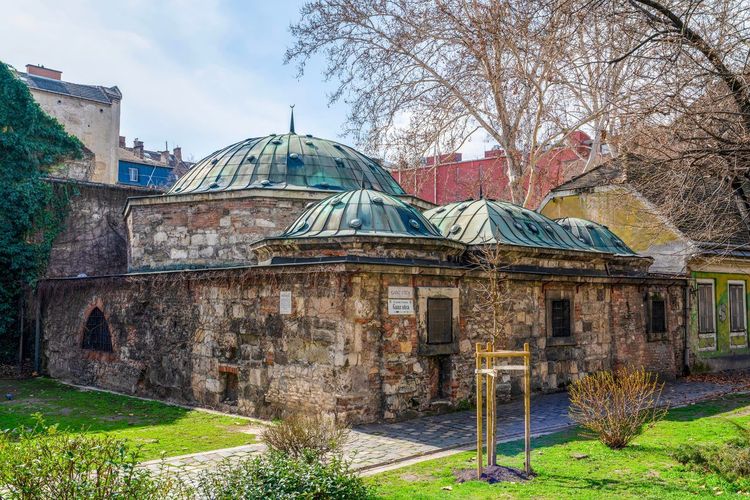
Good to know: the Király Baths have been closed since 2020 pending renovation, with no confirmed reopening date at the time of writing. They cannot currently be visited. We present them here for their historical interest and because they rank, alongside Rudás, among the city's most authentic Ottoman hammams. (Fő u. 84, 1027 Budapest, rated 4.4/5 on Google from 2,773 reviews)
The Király Baths — ki-rai in Hungarian, meaning "king" — occupy a peculiar position in Budapest's thermal history. Built in the 16th century under the Ottomans, they have a unique feature: they never had their own thermal spring. Water was piped in from the Lukács springs via underground channels, which made it possible to build them inside Buda's fortified walls, far from any natural outflow.
The architecture is quintessentially Ottoman: four small domes around a central one, columned niches, a main hot-water pool maintained at 36–38°C. The light filtering through the dome openings creates the same pointillist effect as at Rudás. Extensions were added over the centuries, but the original 16th-century sections remain legible to an attentive eye.
What set Király apart above all was its clientele. Less known to tourists than Széchenyi, it attracted more neighbourhood regulars: retired locals settled in for two hours with a newspaper, neighbours stopping by after the market, regulars whom the staff called by their first name. This was where the everyday use of the baths — not as a tourist attraction but as an ordinary practice — was most evident, and it is precisely this atmosphere that the renovation will need to preserve.
Before closing, Király applied, like Rudás, a gender separation on certain days of the week, and charged one of the lowest prices of any historic bath in Budapest (around €15–18 for entry). This information will need to be verified upon reopening.
Getting There (for a future visit): bus 86, stop Király fürdő, approximately a 15-minute walk from the Chain Bridge on the Buda side, along the Danube.
To explore Budapest beyond the thermal baths, our Ryo guide to activities in Budapest and surroundings covers museums, covered markets and the historic neighbourhoods on both banks.
Lukács Baths: the Locals' Favourite
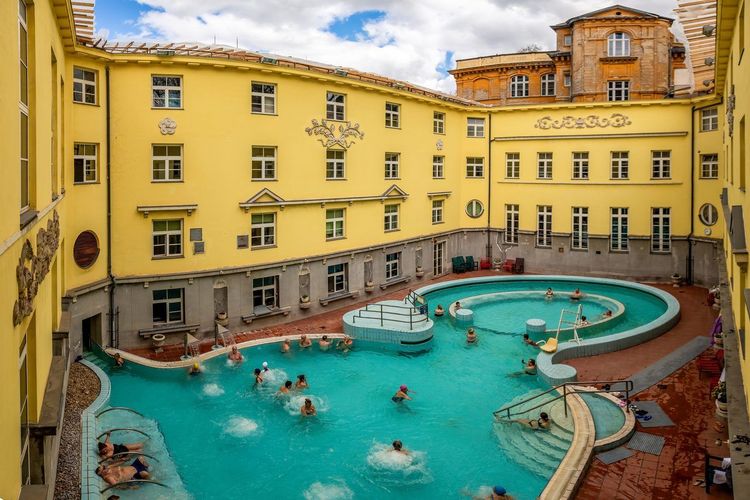
The Lukács Baths (Frankel Leó út 25-29, 1023 Budapest, rated 4.3/5 on Google from 12,664 reviews) are located in District II on the Buda bank, a few hundred metres from the Király Baths. Often described as "the oldest in Budapest" — a claim worth qualifying: thermal use of this site dates back centuries (possibly to the Roman period of Aquincum, according to some historians), but the current building dates mainly from the 19th and early 20th century.
What sets Lukács apart is not its architecture — modest compared to Gellért or Széchenyi — but its deep-rooted use. Long associated with medical treatment, with a thermal hospital adjoining the complex for decades, it still welcomes guests seeking rheumatological therapy. The walls of the inner courtyard are covered in small marble plaques: votive offerings left by patients who were treated here, bearing their name, nationality, diagnosis and date of recovery. A deeply human document, completely overlooked by mainstream tourist guides.
The outdoor pools are particularly pleasant in summer: an enclosed garden with several pools at different temperatures, shaded areas under linden trees, a residential neighbourhood atmosphere that stands in sharp contrast to the mass tourism of Széchenyi. In winter, the outdoor pool heated to 36°C remains accessible. Since the closure of the neighbouring Király Baths, Lukács has become the best port of call for experiencing the local atmosphere of the Buda bank.
2026 Prices (indicative): between €17 and €20 with locker.
Getting There: tram 17 or 19, stop Lukács fürdő, or bus 60 from Batthyány tér (M2).
Veli Bej Baths: Where Ottoman Heritage Meets Modernity
The Veli Bej Baths (Árboc u. 1, 1023 Budapest, rated 4.5/5 on Google from 3,366 reviews), founded in the 16th century, long operated as a military medical establishment before being completely renovated in the early 2010s. The renovation was careful: the original Ottoman elements — central dome, arched niches, stone pools — were preserved, while contemporary facilities (Finnish sauna, rainfall showers, additional pools) were discreetly integrated into the existing space.
The result is a successful balance between heritage and modern comfort. Five pools ranging from 30°C to 42°C allow a progressive thermal circuit: from warm to hot water, a pause in the sauna, then back to cooler water. Access is permanently mixed-gender, an advantage for couples. Veli Bej attracts a younger and more international clientele than the traditional Ottoman baths, and remains one of the few Ottoman baths open during the Gellért and Király renovation works.
2026 Prices (indicative): between €17 and €22 for standard entry. Treatment packages are available.
Getting There: bus 60 from Batthyány tér. A 5-minute walk from the location of the Király Baths.
Palatinus Baths: Open Spaces on Margaret Island
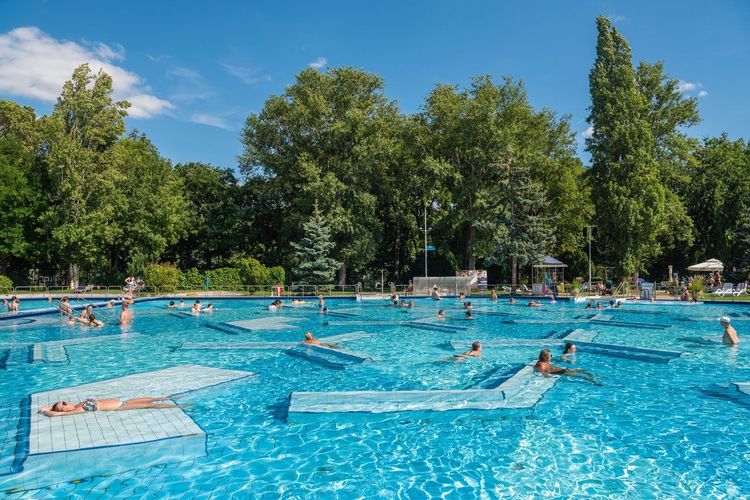
The Palatinus Baths belong to a different category. Located on Margaret Island (Margit-sziget), in the middle of the Danube between Buda and Pest, they form an open-air aquatic complex: 8 pools, several of which are fed by thermal springs at 29°C, an artificial wave pool, water slides and grassy relaxation areas.
This is not a thermal bath in the medical or historical sense — it is an open-air water park with thermal-fed pools, and that is precisely what makes it the best option for families with children. Margaret Island itself, with its medieval monastic ruins and musical fountains, makes for a full day between the pools and walks on foot or by bike.
Palatinus is open in summer only (generally May to September).
2026 Prices (indicative): adult between €15 and €18, child €9–12.
Getting There: bus 26 from Nyugati pályaudvar. By bike from the Margit Bridge, approximately 10 minutes.
Budapest Thermal Baths in Winter: Why It's the Right Season
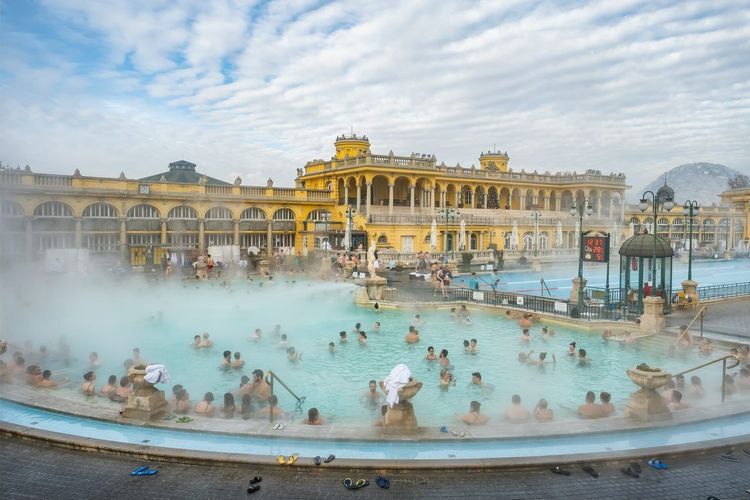
The question comes up every autumn: are Budapest's thermal baths in winter really a good idea? The answer is yes, and some travellers will tell you it is the best possible time. Physics works in your favour: when the outside temperature drops below zero, the steam rising from pools heated to 38°C becomes dense and visible. The contrast between the hot water and the icy air creates a sensory experience that summer simply cannot replicate.
The outdoor pools at Széchenyi operate year-round without exception. In January or February, the Neo-Baroque façade stands out against a grey Central European sky, steam rises in thick swirls, and the regulars play their chess matches indifferent to the cold. On December and January weekends, Budapestians themselves flock there in numbers: the baths are a local winter social outing, not merely a seasonal attraction for tourists.
A few practical points to bear in mind for a visit in freezing temperatures:
The walk between changing rooms and outdoor pools takes place in your swimsuit in temperatures that can be sub-zero. The distance is short — generally 10 to 15 metres — but it catches newcomers off guard. Bath sandals are essential; the paving can be slippery.
Drying your hair is a real consideration. The hairdryers in the changing rooms are not always available in sufficient numbers at peak times. If you have long hair, bring your own travel hairdryer or arrive outside busy periods.
Visitor numbers are noticeably lower than in summer, particularly in January and February. Shorter queues, more space in the pools, a more local atmosphere — the overall value of the experience improves considerably compared with a Saturday in July.
The indoor baths — Rudás in its Ottoman dome and the indoor section of Lukács — are unaffected by the weather and operate at full capacity year-round, regardless of the outside temperature.
Budapest Thermal Bath Prices in 2026: the Full Comparison
Prices vary significantly between establishments and depending on the option chosen. This reference table is indicative for 2026; prices are subject to change and it is recommended to check official websites before your trip.
| Bath | Locker (weekday) | Cabin (weekday) | Notes | |------|-----------------|-----------------|-------| | Széchenyi | ~€22–24 | ~€26–30 | Swimming cap mandatory in indoor pools | | Gellért | Closed | Closed | Renovation, reopening expected in 2028 | | Rudás | ~€18–22 | — | Night session ~€25–30 | | Rudás (rooftop only) | ~€15 | — | Panoramic view of the Danube | | Király | Closed | Closed | Closed for renovation since 2020 | | Lukács | ~€17–20 | — | Medical treatments available | | Veli Bej | ~€17–22 | — | Treatment packages | | Palatinus | ~€15–18 | ~€9–12 (child) | Summer season only |
Locker or cabin? This is the central distinction in Budapest's pricing logic. A locker (szekrény) is a storage space in an open communal changing room — you change in a shared area. A cabin (kabinet) is a small individually lockable room with a mirror and bench. The price difference is €4 to €6 depending on the establishment. For couples, a locker is logistically simpler. For a solo traveller with valuables, the cabin is more secure.
Online tickets generally save €1–2 on the door price and, above all, help you avoid queuing at the entrance. For Széchenyi in high season (July–August), buying online is strongly recommended — queues can exceed 45 minutes at weekends.
The Budapest Card (tourist pass) does not cover thermal bath entry, but may include discounts depending on the package. Check the exact contents before purchasing.
Treatments and massages: a one-hour Swedish massage costs between €30 and €60 depending on the establishment. Veli Bej offers one of the most comprehensive menus among the currently open establishments. If you are including a massage in your visit, book in advance on busy days.
On a tight budget, Lukács or Veli Bej offer the most authentic thermal or Ottoman experience at the best value among currently open baths. For a visit with more budget available, combining Széchenyi (space, outdoor pools) with the Rudás night session (Ottoman dome, views of the Danube) covers the full spectrum of Budapest's thermal experiences.
Swimsuit, Swimming Cap, Locker: the Practical Guide
The thermal bath experience in Budapest involves a few practical rules that general guides don't always explain clearly.
A swimsuit is mandatory in all of Budapest's thermal baths, including in the single-sex sections of the Ottoman baths. Budapest's thermal baths are not hammams where you enter wrapped in a loincloth. If you have forgotten yours, you can buy or rent one on site at most establishments, at tourist prices (€10–20 depending on the style).
A swimming cap (úszósapka) is mandatory only in the indoor pools at Széchenyi. At other establishments it is recommended but not always strictly required. A silicone cap bought before your trip (€3–5 at a sports shop) saves you from having to buy a basic one on site.
A towel: bring your own. Thermal baths generally offer towel hire at €3–5, but they tend to be on the small side. A good-sized microfibre towel is ideal.
Flip-flops (bath sandals) are essential for the walk between changing rooms and pools. Plastic flip-flops are available to hire at some establishments, but comfort is limited.
Ideal duration: allow 2 to 3 hours for a full visit, including the different pools, sauna or steam room, and rest periods. A session of less than an hour does not make the most of the entry fee or the thermal experience itself — the hot-cold-rest protocol requires time to be effective.
Which Thermal Bath to Choose Based on Your Profile
A straightforward breakdown, taking current closures into account:
Most complete experience: Széchenyi (18 pools, outdoor pools year-round). Ottoman authenticity: Rudás (intact 16th-century dome, night session option) — now the only original Ottoman hammam still open. Local atmosphere: Lukács (gardens, votive plaques, residential clientele). Modernity in a historic setting: Veli Bej (2010s renovation, permanently mixed-gender access). Families in summer: Palatinus (Margaret Island, water slides, open space). Art Nouveau architecture: Gellért Baths — save this for a future visit (closed until 2028).
On a tight budget? Lukács or Veli Bej. For a memorable evening? The Rudás night session.
Budapest has enough thermal baths to try several without ever feeling like you're returning to the same place. The Ottoman dome of Rudás has nothing in common with the open-air complex at Palatinus, which has nothing in common with the residential garden of Lukács.
How to Get to Budapest's Thermal Baths
All of the major open thermal baths are accessible by public transport from the centre of Budapest.
Széchenyi: metro M1, station Széchenyi fürdő (10 min from Deák Ferenc tér). Rudás: bus 7, stop Rudas fürdő, or 5–7 min on foot from the Elisabeth Bridge on the Buda side. Veli Bej: bus 60 from Batthyány tér (M2). Lukács: tram 17 or 19, stop Lukács fürdő. Palatinus: bus 26 from Nyugati pályaudvar.
A single BKK ticket costs 500 forints (~€1.30). The 24-hour pass costs 2,500 forints (~€6.50), the 72-hour pass 5,000 forints (~€13). For a multi-day stay with several thermal baths on the itinerary, a day pass is considerably more economical than buying individual tickets.



FAQ
Which is the most famous thermal bath in Budapest?
The Széchenyi Baths are the most visited: 18 pools including 3 outdoor ones, located in Városliget (City Park), with pools heated to 38°C and open year-round. The Gellért Baths are often cited for their exceptional Art Nouveau architecture, but they are closed for renovation until 2028. For a first visit in 2026, Széchenyi is the most versatile choice; for architecture, Rudás and its Ottoman dome step in.
Are Budapest's Thermal Baths Open in Winter?
Yes. Most of the major thermal baths, including their outdoor pools, operate year-round: Széchenyi, Rudás, Lukács and Veli Bej are open in winter and summer alike. The steam rising from the pools in freezing temperatures is one of Budapest's most iconic sights. Note, however, that the Gellért Baths (under renovation until 2028) and Király Baths (closed since 2020) are unavailable due to construction works, not seasonality. Palatinus, which is entirely outdoors, closes outside the summer season.
Do I Need to Bring a Swimsuit and a Swimming Cap?
A swimsuit is mandatory in all of Budapest's thermal baths, without exception. A swimming cap is only mandatory in the indoor pools at Széchenyi. At other establishments it is recommended but not always strictly required. Swimsuits and caps are available for purchase or rental on site.
How Much Does Entry to Budapest's Thermal Baths Cost in 2026?
Locker-included admission ranges from around €15 (Palatinus, Rudás rooftop) to €24 (Széchenyi on weekdays). A private cabin costs €4–6 more. The Rudás night session costs around €25–30. Discounts are available for students, seniors and children at most establishments.
Can You Visit Budapest's Thermal Baths with Children?
It depends on the bath. Palatinus (Margaret Island) is the most family-friendly, with a wave pool and water slides, open in summer only. Széchenyi welcomes children in its outdoor pools. Ottoman baths such as Rudás are less suitable for young children: some time slots are reserved for adults and high-temperature pools are not recommended for those under 14.
What Is the Difference Between Turkish Baths and Thermal Baths in Budapest?
"Turkish baths" (török fürdő) refer to the 16th-century Ottoman structures — Rudás, Király, Veli Bej — hammams with perforated domes fed by thermal water. "Thermal baths" is a broader term encompassing all establishments, including the early 20th-century Art Nouveau complexes such as Széchenyi and Gellért, which have a very different layout: large pools, multiple basins and full services. In Budapest, both types coexist and complement each other (even if Gellért and Király are temporarily closed for renovation).
Budapest's thermal baths are not a travel bonus — they are a gateway into the city's history. Twenty centuries of thermal bathing have left an infrastructure unique in the world: Ottoman domes in use since the 16th century, Art Nouveau palaces where water emerges at 44°C from the springs, outdoor pools where Budapestians play chess in the snow in January. This continuity is what Budapest offers that is most rare. Just bear in mind, for your 2026 visit, that Gellért and Király are under construction: Széchenyi, Rudás, Lukács, Veli Bej and the summer Palatinus step in.
To explore the city beyond its baths, the Ryo audio guide to Budapest takes you on 8.5 km through the historic centre, with 24 audio commentaries on the monuments, neighbourhoods and history of both banks of the Danube. The audio walking tour passes by several of the buildings mentioned in this guide — a way of placing the baths back in their architectural and urban context. To round out your stay, our Ryo guide to Budapest's culinary specialities points you towards the best dining addresses in the city.
À lire également