© Shutterstock
 Votre guide Ryo
Top 10 Culinary Specialties of Budapest to Try in 2026
Budapest is unlike any other European capital, and so is its food. The specialties of Budapest are as good to taste as they are to talk about: here, paprika is not a condiment — it's a philosophy. A bowl of goulash served in a Pest bistro at sunset, the caramelized scent of a warm kürtőskalács on Váci street, the golden grease of lángos dripping onto your fingers at the central market — these images leave a lasting impression. To prepare your trip or simply travel through your taste buds, the Ryo audio-guided tour of Budapest covers 8.5 km and 23 stops across a city where every neighborhood has its own go-to addresses.
This guide to Budapest's specialties takes you from slow-simmered soups dating back to the Middle Ages to showpiece cakes born in the great 19th-century patisseries. You'll discover why palacsinta is both a starter and a dessert, how to recognize an authentic halászlé from the Danube, and which Hungarian spirits deserve a spot in your luggage. Expect €2 to €5 for street food, up to €15–20 for a main course in a neighborhood étterem: Budapest remains one of the most affordable dining destinations in Central Europe.
Goulash: Far More Than a Soup, a National Symbol
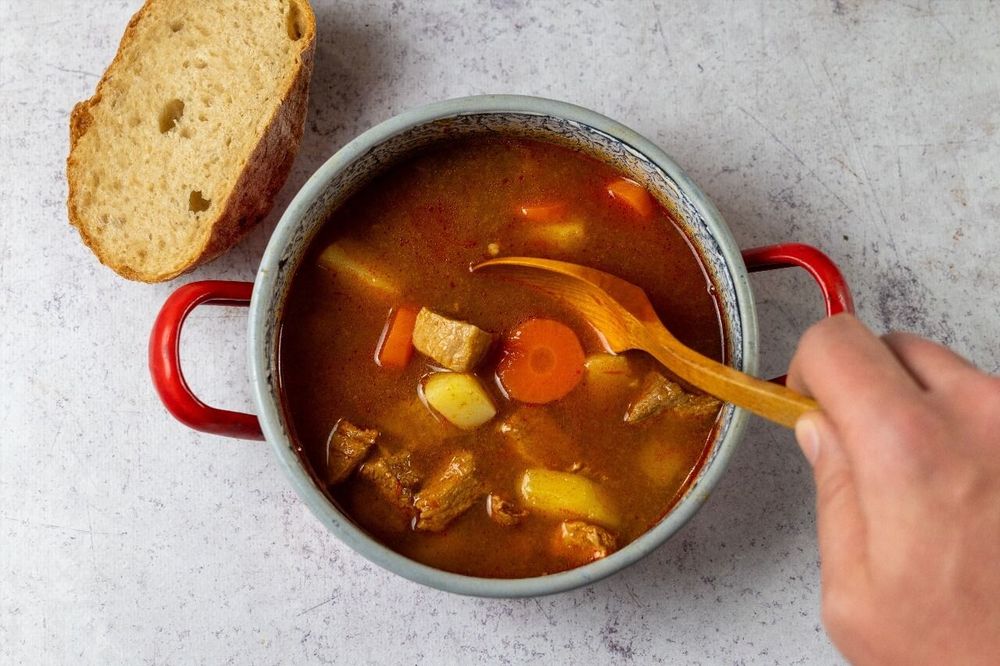
The word "goulash" comes from the Hungarian gulyás, which originally referred to the herdsman (gulya = cattle herd). This soup-stew was for centuries the food of the drovers of the Hungarian Great Plain, simmered outdoors in large cast-iron pots called bogrács. It didn't reach the bourgeois tables of Budapest until the 18th century, carried by a wave of culinary nationalism that sought to counter Viennese influence.
The fundamental recipe is simpler than you might expect: cubed beef, onions sautéed in lard, a generous amount of sweet paprika, caraway seeds, tomatoes, and potatoes. The long cooking — a minimum of two hours — transforms this simple base into something infinitely complex. The quality of the paprika makes all the difference: in Budapest, serious chefs still use paprika from Kalocsa or Szeged, two towns whose production is protected.
What you'll find in tourist restaurants is often called gulyás leves (goulash soup), thinner, served as a starter. The pörkölt version is thicker, closer to a stew, served with nokedli (small spoon-dropped dumplings). Ask for bográcsgulyás if you want the most authentic version, usually prepared outdoors.
Where to eat a good goulash in Budapest? Borkonyha Wine Kitchen in the 5th district offers a gastronomic version made with braised veal cheeks. For something more down-to-earth, the central market (Vásárcsarnok) on the first floor has several stalls serving generous bowls for under €6.
Lángos: The Street Food King of Budapest's Markets
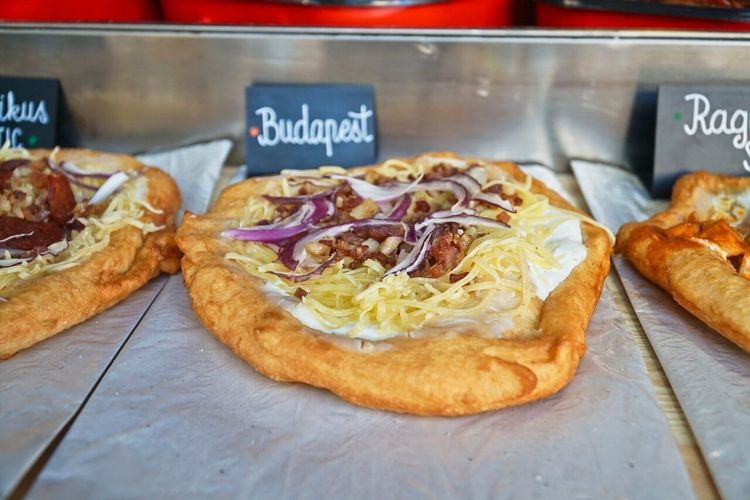
Lángos is what you'll almost inevitably eat on your very first morning in Budapest, and you'll quickly understand why Hungarians are crazy about it. It's a potato-based dough flatbread, deep-fried in hot oil until the surface turns golden and bubbly, soft on the inside. It's eaten hot, straight out of the fryer, topped according to taste.
The classic topping — the one that makes all other versions optional — is devastatingly effective: sour cream (tejföl) and grated cheese (sajt). Some vendors add minced garlic or mushrooms. Sweet versions — Nutella, jam — exist but remain a minority in traditional markets.
Lángos is eaten standing up, in the street or at a market stall counter. Prices are transparent: expect €1.50 to €3 depending on size and toppings. Budapest's central market is the epicenter, but you'll also find it around Lake Balaton (a summer institution) and at open-air markets across the city's districts.
It's worth knowing that lángos is etymologically linked to the word láng (flame) — in peasant kitchens, it was baked on the embers remaining after heating the bread oven. The current deep-fried version dates from the industrial era. A few artisan bakers in Budapest still offer the "oven" version, drier but closer to the original.
Kürtőskalács: The Chimney Cake That Perfumes the Streets
No Budapest specialty announces itself from as far away as kürtőskalács (pronounced "kür-teüsh-ka-lâtch"). This spiral brioche, wound around a cylindrical wooden spit and cooked over embers or heating elements, caramelizes on the outside and releases a buttery, sugary scent that draws passersby from twenty meters away.
The origins of kürtőskalács are disputed between Hungary and Transylvania (now Romania), but Budapest has made it its tourist showcase since the 2000s. The basic recipe is a butter-enriched leavened dough, rolled into a spiral, dusted with sugar that caramelizes into a golden crust during baking. Modern variations include cinnamon, crushed almonds, cocoa, and even savory fillings (cheese, bacon) for creative versions.
The purest version is recognizable by its stretchy, slightly elastic dough, a thin crust that cracks under the teeth, and a soft interior that stays warm for several minutes. To find a quality kürtőskalács, favor stalls that bake to order rather than those displaying cooled examples under glass.
Indicative price: €2 to €4 depending on size and toppings. Expect to pay double for premium versions (pistachio, Belgian chocolate) in city-center shops.
Palacsinta: The Hungarian Crêpe, From Starter to Dessert
Palacsinta resembles a thin French crêpe, but it holds a place in Hungarian cuisine that the Breton crêpe never quite claimed: that of a complete dish, served sweet or savory, as a first course or as a spectacular dessert.
In its most celebrated dessert version, Gundel palacsinta, it is filled with walnuts and raisins, flambéed with rum, and topped with a warm chocolate sauce. This recipe bears the name of the Gundel restaurant, founded in 1894 on the banks of City Park (Városliget), which has since become one of Budapest's most iconic dining establishments.
In savory form, palacsinta comes as a rolled crêpe filled with cottage cheese (túrós palacsinta), minced meat, or creamy mushrooms. It's a bistro staple found on virtually every menu in étkezde (small popular Hungarian eateries). The túrós version — sweet vanilla curd scattered with raisins — is a childhood favorite and remains a fixture at buffets.
Hortobágyi Palacsinta: The Savory Crêpe That Surprises
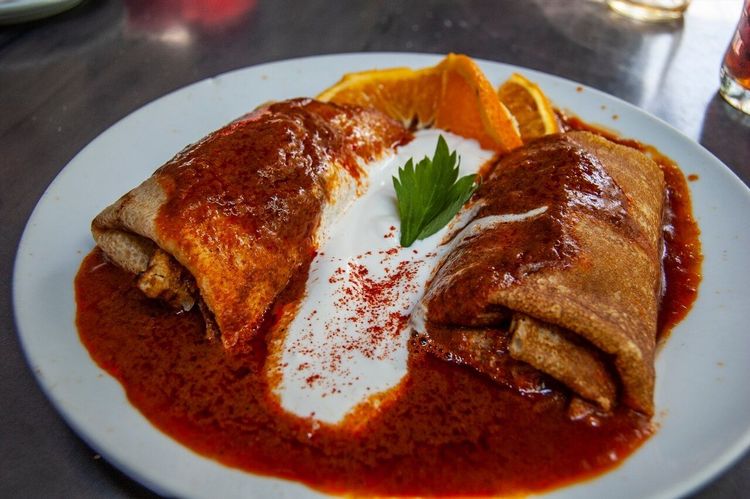
Hortobágyi palacsinta is not sweet, and that's precisely the surprise for anyone who encounters it unprepared. It takes its name from the Puszta (the Hungarian Great Plain), a pastoral farming region whose culinary heritage it embodies.
It is a thick crêpe filled with heavily paprika-spiced veal or pork stew (sometimes lamb), folded into a parcel and generously topped with sour cream. It is served hot, sometimes gratinéed. The contrast between the white cream, the red paprika, and the golden-brown crêpe makes for a visually striking dish.
You'll find it in almost every traditional Hungarian restaurant (vendéglő). In tourist menus, it often appears as a starter, but Hungarian portions are rarely light: a Hortobágyi palacsinta served with soup can easily make a full meal. Typical price in a neighborhood restaurant: €6 to €10.
Paprikás Csirke: Chicken Paprikash, the Reference Recipe
If goulash is the national soup, paprikás csirke (chicken paprikash) is the quintessential family dish. You'll find it in every Hungarian home, every neighborhood étkezde, every school canteen. And yet its apparent simplicity conceals a technical precision that Hungarian cooks pass down from generation to generation.
The canonical recipe begins with onions sautéed in lard or pork fat (butter is an option, never the benchmark), over which two generous tablespoons of sweet Kalocsa paprika are added off the heat. The off-heat step is crucial: paprika burns at high temperatures and loses its aromas. The chicken pieces are then added along with a little stock and sometimes a touch of chili (erős paprika) for those who like heat.
The finishing touch is the signature of the Hungarian recipe: the sauce is enriched with tejföl (thick Hungarian sour cream, more acidic than the French variety), giving it a velvety orange color and creamy texture. The dish is always served with nokedli, those small spoon-dropped dumplings that soak up the sauce.
It's worth noting that the quality of the paprika makes literally all the difference between a memorable paprikás csirke and a mediocre dish. Hungary produces around 50,000 tonnes of paprika per year, with its two flagship designations — Kalocsa and Szeged — benefiting from European recognition. If you cook at home, buying Hungarian paprika at a deli (€1.50 to €3 per 100 g) is one of the best souvenirs to bring back.
For the best paprikás csirke experience, aim for kifőzde (popular canteens open for lunch) rather than tourist restaurants in the 5th district. Prices hover around €4 to €7 for a full plate with nokedli.
Halászlé: The Fishermen's Soup of the Danube
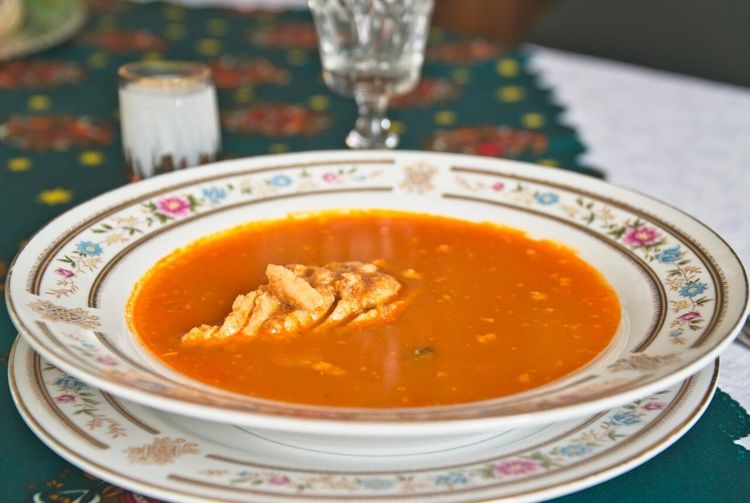
Halászlé (fisherman's fish soup) is one of the most contested specialties in Hungarian cuisine. Two cities have been arguing for decades over the origin of the recipe: Baja, on the Danube, and Szeged, on the Tisza. The two versions differ slightly in cooking technique and in the number of fish species used, but they share a common foundation: an intense, blood-red broth saturated with hot paprika.
The base of any authentic halászlé is a broth made from the heads, bones, and tails of river fish (carp, pike-perch, catfish), passed through a food mill for a thick texture. Whole fish pieces — traditionally carp (ponty) — are then added along with a generous dose of hot paprika. The result is a soup of considerable intensity and heat: not for the faint-hearted.
In Budapest, halászlé appears on the menus of fish restaurants in the Buda district, particularly those lining the Danube. It is often accompanied by white bread and pickled peppers. Expect €8 to €14 at a restaurant.
Töltött Káposzta: Stuffed Cabbage Leaves, the Ultimate Winter Comfort Food
Töltött káposzta (stuffed cabbage leaves) is the dish of great family gatherings, the one Hungarian grandmothers prepare in industrial quantities for Christmas and New Year's. It is also one of the most representative dishes of Central European peasant cooking, found in similar variations throughout the region.
The Hungarian version is distinguished by its sauce: the cabbage rolls, stuffed with a mixture of minced pork, rice, and paprika, cook slowly in a sauerkraut (fermented cabbage) and paprika sauce, then are topped with tejföl at serving time. The acidity of the sauerkraut counterbalances the richness of the stuffing and creates a complex balance.
It's not uncommon for töltött káposzta to simmer for 4 to 5 hours over very low heat. Hungarian cooks consider it even better reheated the next day. In restaurants, it is served in generous portions, often two or three rolls per plate, with bread and sour cream. Hearty enough to carry you through the 8.5 km of our audio-guided walk across Budapest.
Dobos Torte: The King of Budapest's Patisseries
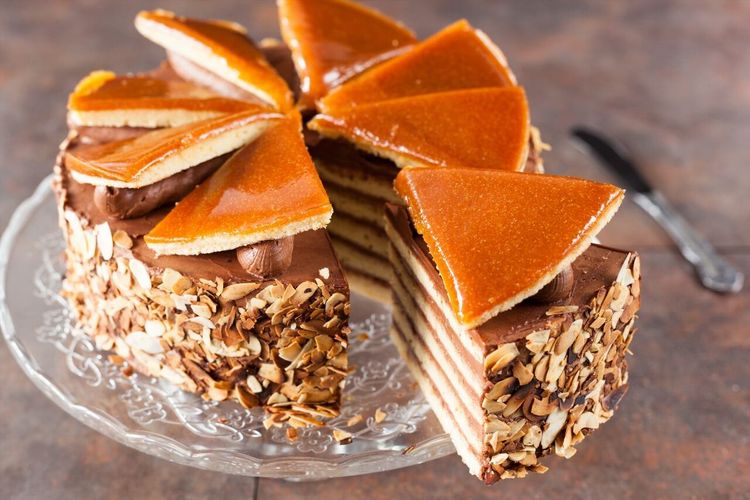
Dobos torte is one of the great culinary inventions of the late 19th century. József C. Dobos, a Budapest confectioner, presented it for the first time at the Budapest National Exhibition in 1885, before King Franz Joseph I and Empress Elisabeth, who is said to have been delighted by it. The cake immediately conquered European courts and made its creator a celebrity.
The original recipe, still used in serious patisseries, is rigorously precise: five to seven thin sponge layers alternating with chocolate buttercream, crowned with a layer of hardened caramel cut into characteristic triangles. This caramel is the cake's visual signature: its golden, brittle surface contrasts with the soft layers beneath.
The technical feat that made dobos torte revolutionary in its time: Dobos used quality butter and a cream that kept for several days without refrigeration, allowing his cakes to be sent by rail across the entire Austro-Hungarian Empire. The exact recipe was protected until 1906, then made public.
Where to find a flawless dobos torte in Budapest? Gerbeaud, founded in 1858 on Vörösmarty Square, offers a classic version in a fin-de-siècle setting that alone justifies the visit. Ruszwurm in the Castle District, a patisserie open since 1827, is even more intimate and, by many accounts, even more authentic.
Expect €3.50 to €6 per slice depending on the establishment. At Gerbeaud, the view of Vörösmarty Square is included.
Somlói Galuska: The Dessert That Has Won Over Central Europe
Somlói galuska (Somló sponge cake) is less internationally famous than dobos torte, but it is ubiquitous in Hungarian restaurants and patisseries, and it may well be the dessert that most pleasantly surprises foreign visitors.
It is a relatively recent creation, imagined by Károly Gollerits, head waiter at the Gundel restaurant, and perfected by pastry chef József Béla Szőcs, whose version won a prize at the Brussels World's Fair in 1958. The dessert combines three types of sponge cake (plain, walnut, chocolate), soaked in rum and orange syrup, with raisins and vanilla custard, all topped with melted chocolate and whipped cream.
The result is generous, fragrant, and lightly boozy — a celebration dessert that always leaves you wondering how you managed to finish the main course first. Somlói galuska is served in almost every étterem and vendéglő in Budapest, usually at a very accessible price (€2.50 to €4.50).
Specialties to Bring Home: Gourmet Souvenirs and Hungarian Spirits
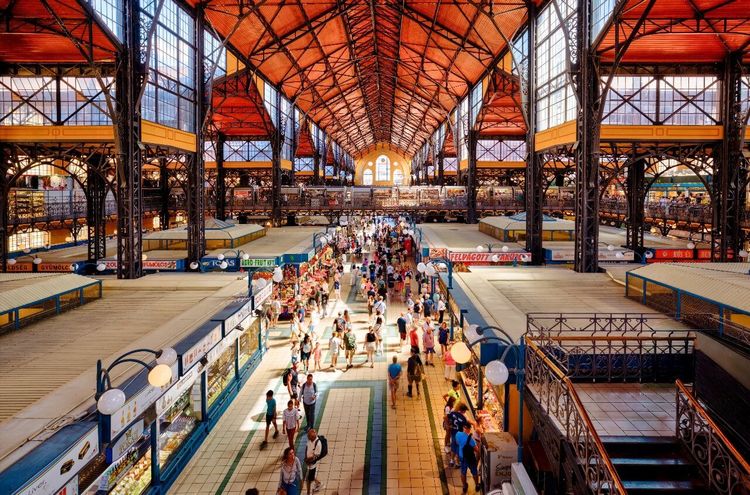
Budapest is a generous city for food lovers who want to extend the experience beyond the trip. Many of these Hungarian specialties slip easily into a suitcase. Fine food shops, covered markets, and specialist stores offer a wide range of products that travel well and make for flavorful souvenirs.
Paprika: The Must-Have Souvenir
This is the quintessential Budapest gastronomic souvenir. Hungarian paprika comes in several grades: édesnemes (sweet, the most common), csípős (hot), and különleges (extra-fine, bright red). The Kotányi and Pick brands are available in European supermarkets, but the versions sold at Budapest delicatessens — particularly at the central market — are often of superior quality and twice as affordable. Budget: €1.50 to €5 per 100 g depending on quality.
Hungarian Foie Gras (libamáj)
Hungary is the world's second-largest foie gras producer after France, and the product sold in Budapest (predominantly goose liver rather than duck) is of excellent quality at prices far below French levels. You'll find it in tins or jars at the central market and in fine food shops in the 5th district. Expect €8 to €18 for a 180–200 g jar, a fraction of Parisian prices.
Pálinka: The National Spirit
Unicum is often the first spirit that comes to mind in Budapest (a liqueur made from over 40 herbs, in its distinctive spherical bottle), but it is pálinka that represents the true traditional Hungarian spirit. These are fruit brandies — plum (szilva), apricot (barack), pear, cherry — distilled artisanally in family pot stills. Legal home production has been permitted in Hungary since 2010 (up to 50 liters per year), which has revived the artisan distillery scene.
The best pálinkas come from small producers in the Szabolcs region (plum) and Kecskemét (apricot). In Budapest, the Pálinka Háza shop (Rákóczi út 17, 1088 Budapest, rated 4.6/5 on Google across 170 reviews) in the 5th district offers over 200 references with tastings. Expect €15 to €35 for a good artisan 50 cl bottle. Unicum can be found in supermarkets: €8 to €12 for a standard bottle.
Tokaj: The Wine of Kings
Tokaj (Tokaji in Hungarian) is one of the world's great naturally sweet wines, produced since the 16th century in the hills of northeastern Hungary. King Louis XIV of France called it "the wine of kings, the king of wines." The Tokaji Aszú designation is protected and classified by the number of puttonyos (a measure of botrytized grape concentration): from 3 to 6 puttonyos — the higher the number, the more concentrated and sweet the wine. Excellent bottles are available in Budapest for €12 to €50 depending on the estate and vintage.
Charcuterie and Hungarian Pasta
Pick salami (produced in Szeged since 1869) is a dry-cured paprika-and-spice charcuterie, lightly smoked, that travels well vacuum-packed. The Herz brand offers an equally renowned Budapest version. On the pasta front, tarhonya (small toasted round pasta, cooked like rice) are virtually unavailable outside Hungary and make a practical, lightweight souvenir.
The central market (Vásárcsarnok) remains the best place to buy these products: the ground and first-floor stalls combine quality, reasonable prices, and tourist-friendly presentation. Budget €30 to €50 for a complete souvenir basket (paprika, salami, miniature pálinka, Tokaj).
Where to Eat in Budapest: Prices, Neighborhoods, and Types of Venues
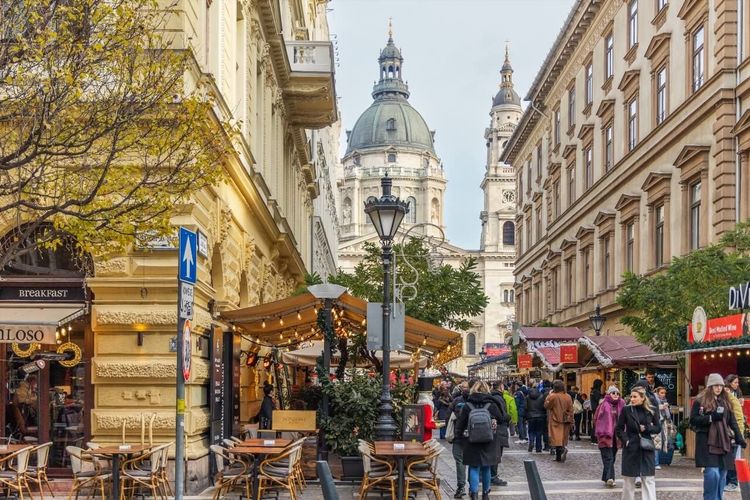
Budapest is one of the European capitals where the value for money of dining out remains among the best. Understanding the hierarchy of local establishments will allow you to eat excellently without breaking the bank.
A Guide to Hungarian Restaurant Types
- Étterem: classic restaurant, ranging from neighborhood to gastronomic
- Vendéglő: traditional inn, home-style cooking, more rustic atmosphere
- Kifőzde / Étkezde: popular canteen, daily specials, fast service, very low prices (main course €3–6)
- Csárda: village-style inn, often folksy, peasant specialties
- Cukrászda: patisserie and tea room
Budget and Price Ranges
For lunch at a kifőzde or étkezde (soup + daily special): €5 to €9. For dinner at a neighborhood vendéglő (starter + main + dessert + drink): €15 to €25 per person. At a gastronomic étterem in the 5th or 7th district, expect €35 to €70 per person excluding wine. Local Hungarian wines (Eger, Villány, Tokaj) by the carafe are often cheaper than imported mineral water — ask for házi bor (house wine).
The Best Neighborhoods for Eating
The 7th district (the "Jewish Quarter") concentrates the most vibrant addresses, from ruin bars serving food until 2 a.m. to modern-Hungarian restaurants reinventing the classics. Kazinczy street and its surroundings cluster several artisan cukrászdas and vendéglős that are packed every evening.
The 5th district (Belváros) is touristy but unmissable for the great historic addresses: Gerbeaud, Central Kávéház, and a handful of étterems that maintain high standards despite the crowds. Avoid laminated photo menus displayed in windows — they generally indicate mediocre food at inflated prices.
For the most local experience, the 2nd and 3rd districts on the Buda bank are home to vendéglős and kifőzdék frequented almost exclusively by locals. The Víziváros (Watertown) neighborhood between the Castle and the Danube is particularly well supplied.
If you'd like to combine culinary discovery with sightseeing, the Ryo audio guide for Budapest takes you through the historic neighborhoods with 23 commented stops — a way to connect the architectural heritage and culinary history of the city in a 3h45 walking tour.
A Few Reference Addresses by Category
Borkonyha Wine Kitchen (Sas u. 3, 1051 Budapest, rated 4.6/5 on Google across 2,546 reviews) (5th district) is a Michelin-starred restaurant with reasonable lunch prices. Kéhli Vendéglő in Óbuda is the archetype of the no-compromise Hungarian family restaurant. Frici Papa Kifőzdéje in the 7th district is the ultimate popular address: soup + main course for under €7, 100% local clientele at lunchtime. For a historic sweet break, Ruszwurm in the Castle District is the oldest patisserie in Budapest still in operation.



FAQ
What is the most iconic specialty of Budapest?
Goulash (gulyás) remains the most symbolic specialty of Hungarian cuisine, recognized all over the world. But in Budapest, locals often consider palacsinta and paprikás csirke to be the dishes that best represent the city's everyday cooking. For a street food experience, lángos stands out as the most immediate memory.
How much does a meal cost in Budapest in 2026?
Budapest remains very affordable. A full meal (soup + main course) in a popular canteen (kifőzde) costs €5 to €9. In a neighborhood restaurant (vendéglő), expect €15 to €25 per person for a starter, main course, and dessert. Gastronomic venues range from €35 to €70 per person. Street food (lángos, kürtőskalács) is around €2 to €4.
Which Hungarian specialties can you bring back in your luggage?
The products that travel best: Hungarian paprika in a tin, Pick or Herz salami vacuum-packed, a bottle of pálinka (artisan fruit brandy) or Unicum, a Tokaji Aszú, and tarhonya (dried pasta virtually unavailable outside Hungary). Hungarian foie gras in a jar offers excellent value for money, but check customs restrictions if traveling outside the EU.
Is Hungarian goulash a soup or a stew?
It's both, depending on the version. Gulyás leves (goulash soup) is a clear broth made with beef, potatoes, and paprika, served as a starter. Pörkölt is its stew version, thicker, without potatoes, generally served with nokedli. Bográcsgulyás is the traditional version cooked in a cauldron over a wood fire, closer to the original rustic stew.
Where can you find the best pastry shops in Budapest?
The three must-visit addresses: Gerbeaud (Vörösmarty Square, founded 1858) for the décor and classics like dobos torte; Ruszwurm (Castle District, founded 1827) for its authenticity and intimate size; New York Café (7th district) for the architectural experience as much as the pastries. For a more everyday format, the cukrászdas in the 7th district around Kazinczy utca offer excellent somlói galuska and rétes.
Is vegetarianism difficult in Budapest?
Traditional Hungarian cuisine is very meat-heavy, but Budapest offers serious alternatives for vegetarians. Plain lángos, túrós palacsinta (cottage cheese crêpes), gombapörkölt (mushroom stew with paprika), rétes (strudel with spinach or cheese), and the many vegetable soups are all vegetarian. The 7th district has several well-rated vegetarian and vegan restaurants. The offering has evolved considerably over the past ten years.
Budapest: A Cuisine Best Explored on Foot
Budapest's gastronomy only truly makes sense when you walk through it — moving from a neighborhood kifőzde to a grand fin-de-siècle cukrászda, from the lángos stall at the central market to the wine cellars of the 7th district. Every dish has its neighborhood, every specialty its go-to address.
If you're planning your visit, Ryo's audio-guided tour of Budapest offers a 3h30 walk covering both banks of the Danube and the historic neighborhoods in 24 commented stages — a way to connect the architecture, history, and flavors of the city before you've even ordered your first goulash.
À lire également