© Shutterstock
 Votre guide Ryo
Things to Do in Taormina in 2026: 15 Must-Have Experiences
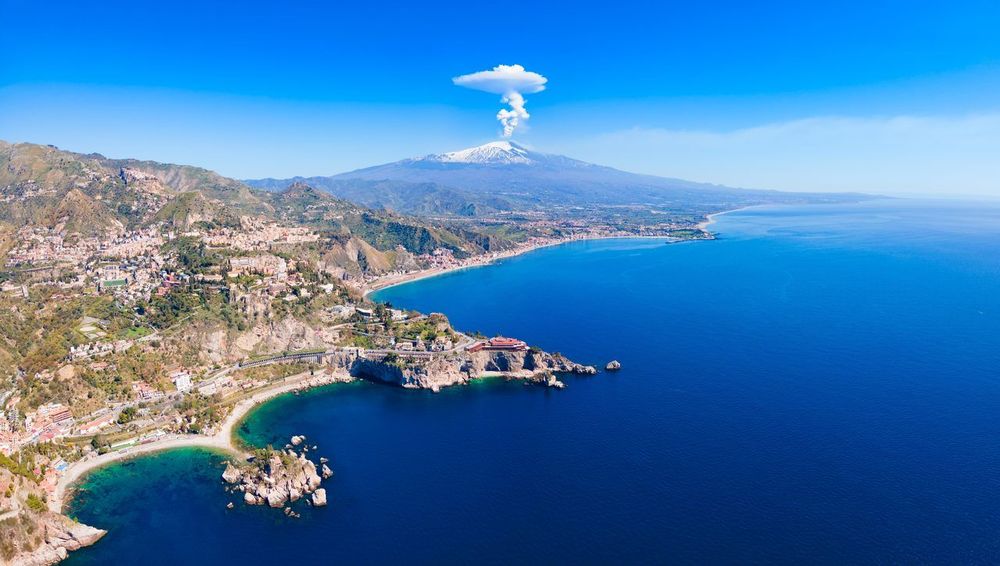
Perched 200 meters above the Ionian Sea, between a smoking Etna and two bays of an almost unreal blue, Taormina can be daunting for a first-time visitor simply wondering what to do in Taormina in two or three days. The town doesn't yet have its own Ryo audio guide, but the team behind audio-guided tours elsewhere in Europe — including the Ryo audio guide of Palerme at the other end of Sicily — spent a week in its alleyways preparing this guide, notebooks and good shoes in hand.
The result comes down to a few figures that set the tone. The Teatro Greco, built in the 3rd century BC, still serves as a giant concert hall in summer with views of the volcano. Isola Bella, a tiny island connected to the shore by a pebble causeway, is just a five-minute cable car ride from the historic centre. The village of Castelmola, perched more than 300 meters above Taormina, is worth visiting for almond wine served in century-old bars. And less than an hour's drive away, the Alcantara Gorges offer a basalt canyon where you can swim in the full Sicilian heat. Enough to build a trip that goes well beyond the postcard view of Corso Umberto.
1. The Ancient Greek Theatre (Teatro Greco)
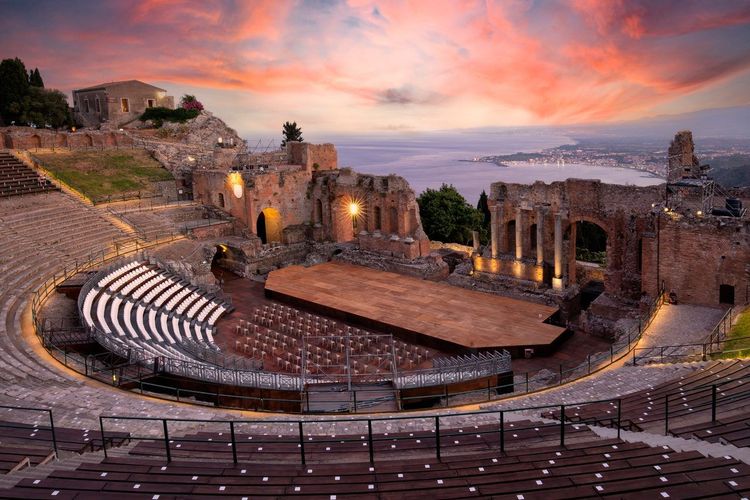
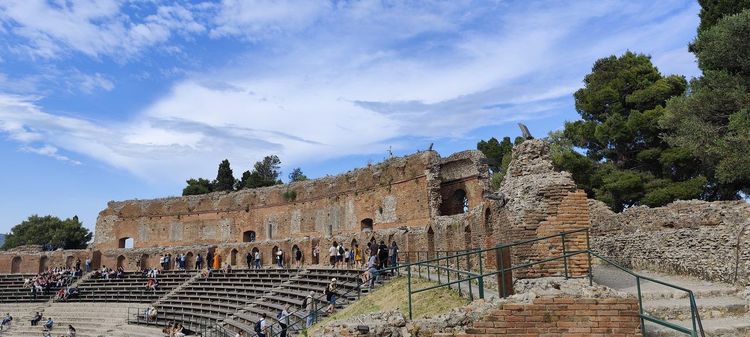
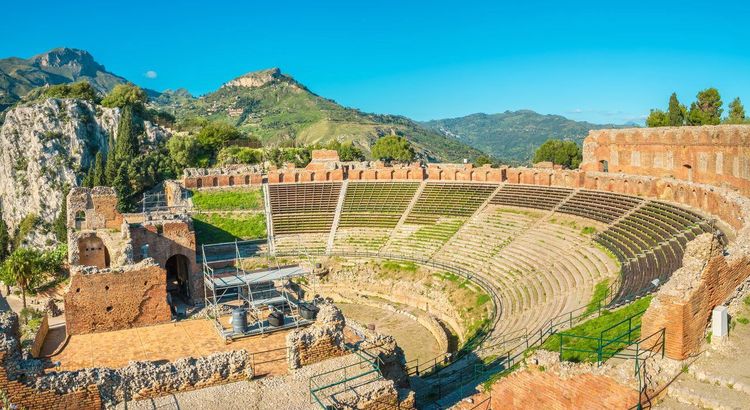
The Teatro Greco (Via Teatro Greco, 98039 Taormina, rated 4.6/5 on Google across 39,290 reviews) is, after Syracuse, the second-largest ancient theatre in Sicily. Built by Greek colonists in the 3rd century BC on a rocky spur, it was substantially enlarged by the Romans in the 2nd century AD, who transformed it into an arena capable of hosting gladiatorial combat.
What strikes you upon reaching the tiers is not so much the stage itself, largely in ruins, but the backdrop it frames: the bay of Naxos on one side, the cone of Etna on the other, often crowned by a plume of white smoke. Few archaeological sites in the world offer such a natural setting, and photographers know it well: the columns of the Roman portico, still standing behind the stage, compose a foreground almost too perfect to be real.
Take the time to walk the full circuit of the cavea rather than stopping at the first viewpoint. The upper tiers on the west side offer a far more open framing of the volcano, and the small antiquarium set up under the arches displays statue fragments, inscriptions, and architectural elements found on site. The explanatory panels, in Italian and English, are fairly sparse: it's better to arrive with some background knowledge, or a guided tour, to fully grasp the layering of the two Greek and Roman building phases.
Admission is around 14 euros at full price, with reduced rates for 18–25 year olds and free entry for under-18s. The site generally opens at 9am and closes between 5pm and 7pm depending on the season, with last admission roughly one hour before closing. You can avoid the tour-group rush by arriving at opening time or after 4pm, when the raking light also does wonders for the stonework. In summer, the theatre still hosts concerts and performances as part of the Taormina Arte festival: on stage-assembly days, part of the seating may be closed to visitors, a common disappointment that nobody will warn you about before you buy your ticket. A quick check of the events calendar before choosing your time slot saves any nasty surprises.
2. Strolling through Taormina's Old Town: Piazza IX Aprile, the Cathedral, and Corso Umberto
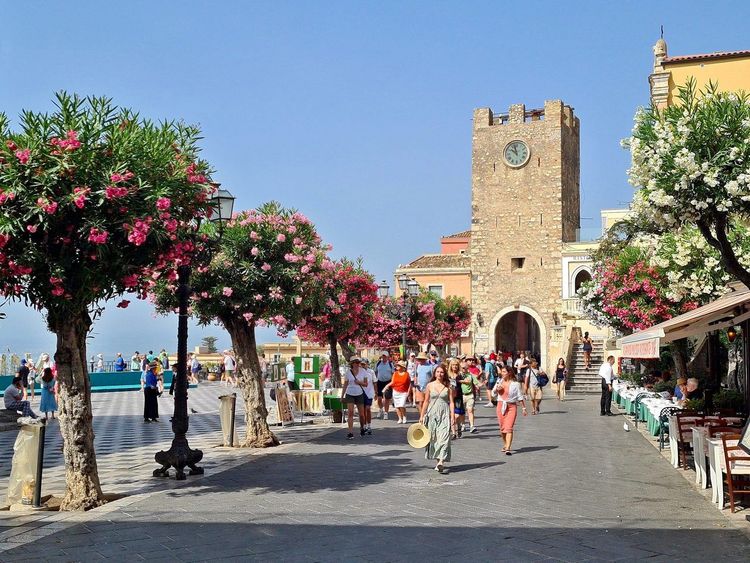
The Corso Umberto is the backbone of Taormina: a pedestrian street of roughly one kilometre running east to west through the entire old town, from Porta Messina to Porta Catania, lined with medieval palaces converted into shops and café terraces. It is the best way to connect most of the sites in this guide on foot, allowing detours into the perpendicular alleyways where the crowds thin almost instantly.
Piazza IX Aprile and the Palazzo Corvaja
Halfway along Corso Umberto lies Piazza IX Aprile, nicknamed the "living room of Taormina". Its black-and-white chequered floor and balustrade suspended above the drop offer one of Sicily's most photographed panoramas, with Etna as a backdrop on clear days. The clock tower, Torre dell'Orologio, rebuilt in the 17th century on medieval foundations, marks the entrance to the oldest part of town. The church of Sant'Agostino, a former Gothic church converted into the municipal library, closes off the square to the west; entry is free, and the contrast between the bookshelves and the nave is worth a look.
Nearby, the Palazzo Corvaja blends Arab, Norman, and Catalan Gothic elements accumulated between the 10th and 15th centuries. The Sicilian parliament met here in 1411 to settle the question of succession to the throne, an episode few visitors know as they discover its inner courtyard. A small folk art museum displays traditional costumes, puppets, and painted Sicilian carts; the tourist office occupies the ground floor, handy for picking up a free map at the start of your visit.
The Cathedral of San Nicolò and the Gardens of the Villa Comunale
Further along Corso Umberto, the Cattedrale di San Nicolò looks more like a crenellated fortress than a church, a 13th-century architectural choice designed as much for defence as for worship. Its rose window and baroque-style portal contrast with the sobriety of the stone walls. In front, the Duomo fountain, erected in the 17th century, features a two-legged female centaur, the heraldic symbol of the town that you will find on manhole covers as readily as on the ceramics in the shops.
Continuing eastward, the gardens of the Villa Comunale (Via Bagnoli Croci, 98039 Taormina, rated 4.7/5 on Google across 9,854 reviews) tell another story: that of an eccentric English aristocrat, Florence Trevelyan, who settled in Taormina at the end of the 19th century and laid out this park suspended above the bay. Her small towers of stone and brick — an improbable mix of pagoda and Victorian folly — were used as bird-watching hides. You will find shade, benches facing south over the sea, a children's play area, and arguably the best spot in town to catch your breath between visits. Entry is free, making it also the most panoramic picnic spot in the city.
Porta Messina, the Naumachie, and the Roman Odeon
Most visitors walk the length of Corso Umberto without suspecting that a 122-metre-long Roman wall lies hidden behind a simple gate just a few metres from the street. The Naumachie, an enormous brick-niched substructure dating from the imperial era, served as a retaining wall for a large cistern and a monumental terrace — not for naval battles, despite its misleading name. It is one of the longest Roman remains preserved in Sicily, and the visit takes just ten minutes, free of charge.
A little further up, tucked between houses behind the church of Santa Caterina, the Roman Odeon completes the picture: a small roofed theatre of around 200 seats, built partly on the foundations of a Greek temple and rediscovered by chance in the 19th century. Add Porta Messina and Porta Catania, the two fortified gates that bookend the Corso, and you have a complete historical loop that can be covered in an hour without spending a euro. These are precisely the stops that excursion groups skip for lack of time, and they are what makes the old town readable rather than merely pretty.
3. Isola Bella and the Cable Car to the Mazzarò Beaches
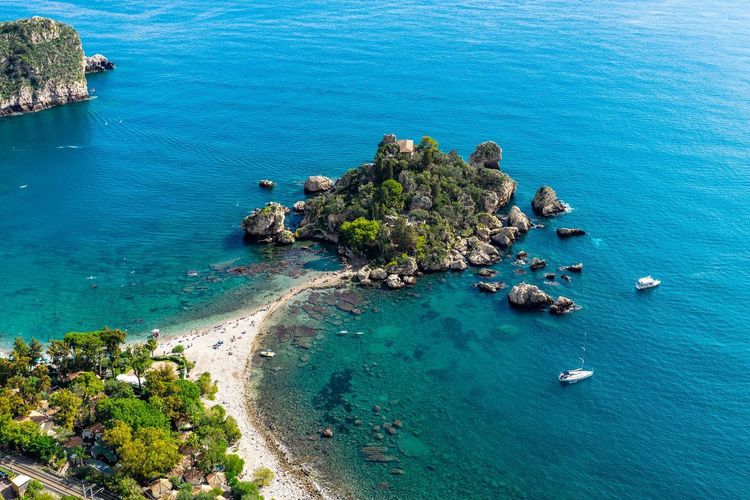
Isola Bella (Via Nazionale, 98039 Taormina, rated 3.9/5 on Google across 630 reviews) is a rocky islet connected to the beach by a pebble causeway that the sea submerges depending on the day and the currents. Designated a nature reserve since 1998 and now managed by the Sicilian Region, it once belonged to the same Florence Trevelyan who designed the Villa Comunale gardens: her villa houses a small museum dedicated to local fauna and flora, and the garden planted with exotic species can be explored in around twenty minutes.
How do you get to Isola Bella from Taormina? The quickest option is the Taormina cable car, which descends to Mazzarò in under five minutes, roughly 800 metres on foot from the island. Allow a few euros for a one-way ticket, with departures every 15 minutes or so and long queues in peak summer season around 10am and again on the return in late afternoon. A return ticket or a day pass quickly pays off if you are alternating between the beach and the historic centre in the same day. Watch out for the last departure time, which varies considerably by season and has left more than one visitor climbing the stairs back up in the dark.
To be honest: in July and August, Isola Bella disappoints some visitors who find a cove packed from 9am onwards, with paid sun loungers on most accessible areas and an uncomfortable beach of large pebbles underfoot. If you are after peace and quiet, aim to arrive before 8:30am or visit in the shoulder season (April–May), when the reserve regains its tranquillity and the turquoise water is disturbed only by a few early-morning swimmers. Water shoes and a snorkelling mask completely transform the experience: the rocky seabed immediately to the right of the isthmus is among the most fish-rich along the entire coastline.
4. Climbing to the Castello di Taormina and the Madonna della Rocca
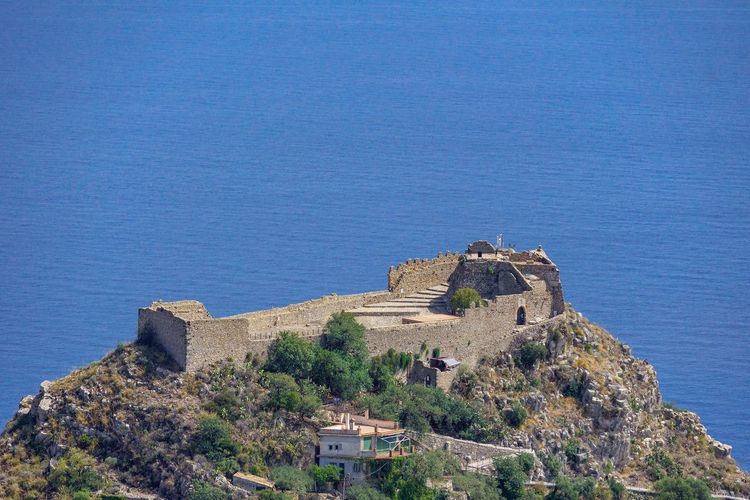
Above the town, the ruins of the Castello di Taormina crown the summit of Monte Tauro at nearly 400 metres above sea level. Of ancient origin and further fortified through successive Arab and Norman occupations, they offer a 360-degree view over both bays of Taormina — something even the Teatro Greco cannot match. Access to the enclosure itself is regularly restricted for safety or maintenance reasons: check beforehand, bearing in mind that the esplanade just below is more than sufficient for the panorama.
Two options for the ascent: around 30 minutes on foot from the centre via a steep stairway path — the famous Salita Castello with its hundreds of steps — or the local bus serving Castelmola, which stops nearby. On the way up, make a stop at the Santuario Madonna della Rocca (Salita Castello, 98039 Taormina, rated 4.7/5 on Google across 1,418 reviews), a 17th-century chapel literally carved into the rock, its ceiling nothing more than the raw face of the mountain. The modest interior contrasts with the panorama it overlooks, one of the best free viewpoints in the entire town.
Ideally, come about an hour before sunset: the golden light on the tiled rooftops and the sea below is well worth the effort of the climb, and the crowds are far thinner here than at the ancient theatre at the same hour. Bring water — there are no fountains on the path — and a torch or simply your phone for the descent, as the steps are only lit in places.
5. Castelmola, the Hilltop Village above Taormina
Castelmola (Piazza Sant'Antonio, 98030 Castelmola, rated 4.6/5 on Google across 4K reviews) looks down on Taormina from just over 500 metres above sea level, a medieval village with alleyways so narrow that cars are virtually absent. Its main square, barely a few dozen square metres, nonetheless offers one of Sicily's most vertiginous panoramas over the coastline and, on clear days, over the Strait of Messina and Calabria.
The local speciality not to be missed: vino alla mandorla, a sweet almond wine served chilled in the village bars, most famously at Bar Turrisi, whose very distinctive décor surprises as much as the recipe itself. The ruins of the Norman castle at the very top of the village can be visited freely and round off the walk in a good hour.
To get there, a local bus runs regularly from Taormina (around 15 to 20 minutes); the more adventurous can tackle the steep footpath on foot, roughly 45 minutes to an hour, best attempted early in the morning or late in the day. A popular combination is to take the bus up and walk back down via the old mule track, which passes right by the Madonna della Rocca and the castle — allow an hour for the descent, with views that make the detour worthwhile in themselves. The village has a handful of trattorias with prices noticeably lower than those in town below, a good option for a no-reservation lunch in peak season.
6. What to See around Taormina
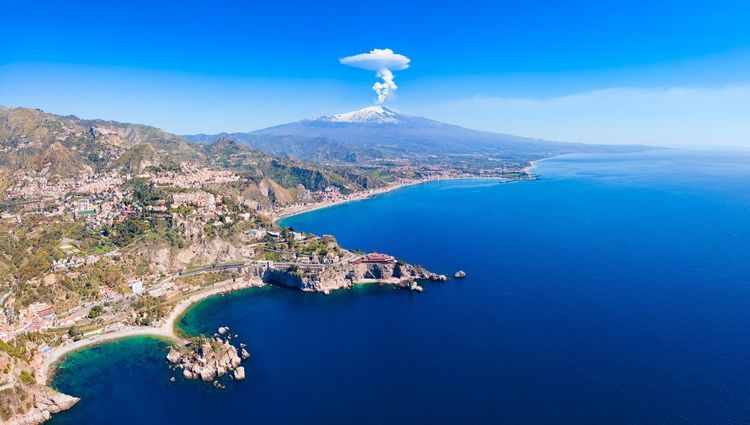
Taormina makes an ideal base for exploring some of eastern Sicily's most spectacular sites, all reachable on a half-day or full-day excursion. This is where much of the answer to the question of what to see around Taormina lies — a question often overlooked by hurried visitors who stay confined to the historic centre.
Etna, Sicily's Iconic Volcano
Rising to around 3,350 metres, Etna is the highest active volcano in Europe and visible from almost every high point in Taormina. Is Taormina a good base for visiting Etna? Yes: allow roughly 1 hour 15 to 1 hour 30 minutes by road to reach the Rifugio Sapienza on the southern flank, the departure point for the cable car that climbs to around 2,500 metres, followed by an optional guided 4x4 excursion to whichever summit zones are authorised that day.
Two habits prevent disappointment. First, the weather at the summit bears no resemblance to conditions on the coast: it can be 30°C in Taormina and 5°C with a biting wind at 2,900 metres, so a fleece and closed shoes are essential even in August. Second, access to the summit craters depends on volcanic activity and can be restricted overnight by the civil protection authority without any systematic refund. The northern flank, near Piano Provenzana, offers a less crowded alternative with spectacular recent lava flows and paths accessible without a guide.
The volcano's slopes also conceal a little-known winemaking tradition: on the black ash soils, generations of winegrowers cultivate native grape varieties such as nerello mascalese and carricante, producing the wines of the Etna appellation found on every good table in Taormina. A half-day at a family winery on the northern flank, around Randazzo or Linguaglossa, is a chance to meet the guardians of these Etna vineyards and understand why the area is attracting a growing number of wine enthusiasts. Most estates require a booking the day before, including off-season.
The Alcantara Gorges
About thirty minutes by road, the Gole dell'Alcantara form a spectacular canyon carved by the river through basalt organ pipes formed by an ancient lava flow that descended from Etna thousands of years ago. You descend by paid lift or by a public stairway to the riverbed, where the water — rarely above 10°C even in midsummer — invites a swim as brief as it is bracing.
An honest tip: don't visit the Alcantara Gorges if your stay is limited to two full days, as the round trip and a swim easily take half a day. That said, if time is not an issue, renting a wetsuit and appropriate footwear on site makes the experience far more comfortable than a quick fly-by in flip-flops. Also note that there are two access points: the private, paid park with a lift and facilities, and the free public stairway a little further along the road. If it has been raining on the upper slopes of Etna, the river level rises quickly and the descent may be closed — check the day before.
Giardini Naxos and Its Beaches
Fifteen minutes by bus at the foot of Taormina, Giardini Naxos was the very first Greek colony in Sicily, founded in 734 BC, well before Syracuse itself. The archaeological park bordering the sea preserves the remains of lava-stone ramparts, a sanctuary, and a potter's kiln, in a far more peaceful setting than the Teatro Greco, with a small museum housed in a Bourbon coastal fort by the water's edge.
Above all, this is the place for a proper beach day: unlike the pebble coves of Taormina, Giardini Naxos stretches for several kilometres of gently sloping sand, with both paid facilities and free areas. A popular choice for families seeking a relaxing afternoon without Taormina's steps and staircases. The seafront promenade, lively in the evenings, offers fish restaurants at prices noticeably lower than those on Corso Umberto, making it a more affordable base for accommodation as well.
Savoca and the Villages of the Val d'Agrò
About forty minutes to the north, the village of Savoca draws film enthusiasts who come in search of the Sicilian settings from Francis Ford Coppola's The Godfather: it is here, not in Corleone, that the scenes of Michael Corleone's wedding were filmed, at the church of Santa Lucia, and the sequences at Bar Vitelli, still open and now a small film-memorabilia museum. The neighbouring village of Forza d'Agrò rounds off the loop with its terrace-like square overlooking the sea and its cobbled climb up to the church.
The appeal goes well beyond the cinematic nod: these villages of the Val d'Agrò reveal an intact rural Sicily just ten kilometres from the tourist coast, where trattoria prices bear no relation to those in Taormina. A car is essential as bus connections are rare and inconvenient, and allow half a day to take in both villages at leisure.
Catania and Syracuse, Two Easy Day Trips
To extend the trip, two major cities can be visited in a day from Taormina. Catania, about 45 minutes to an hour by train, captivates with its baroque centre in black lava stone, a UNESCO World Heritage Site along with the other Val di Noto towns, and its lively morning fish market, La Pescheria, one of the most animated in Sicily. Syracuse, further away, is worth the journey for the island of Ortigia, its own Greek theatre, and the Ear of Dionysius, an artificial cave with impressive acoustics: allow around 1 hour 30 minutes by car, or close to two hours by train.
Both cities are connected by train on the Messina–Catania–Syracuse line or by car via the A18 motorway, departing from Taormina-Giardini Naxos station below the town. Set off early in the morning to make the most of whichever city you choose before heading back in the evening, and check the return timetables: train services thin out considerably after 8pm.
7. A Boat Trip along the Taormina Coastline
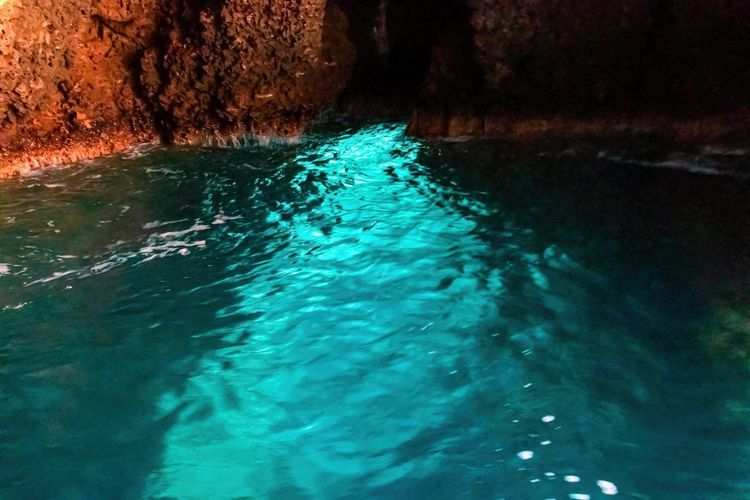
Seen from the sea, Taormina takes on an entirely different face. Several operators offer boat trips departing from Mazzarò or Giardini Naxos, heading to the small sea caves carved into the rocky coastline, including the Grotta Azzurra, whose bluish reflections recall — on a more modest scale — the famous one at Capri.
These excursions, lasting one to three hours depending on the package, are above all a chance to admire Isola Bella from a completely different angle, free from the crowds that besiege it from the beach, and to skirt Capo Sant'Andrea, whose cliffs shelter several caves accessible only by sea. Expect to pay roughly between 35 and 45 euros per person for a small-group outing with a swimming stop and snorkelling masks provided, more for a private sunset trip.
Choose late-afternoon departures for the light and a generally calmer sea, and ask the operator about group size: the difference between a boat of ten and a shuttle of forty changes everything, particularly for entering the caves, which are accessible only to smaller vessels.
8. A Brief History: Taormina from the Greeks to the Normans
Where is Taormina in Sicily? On the east coast, between Messina and Catania, a location that in itself explains much of its turbulent history. Founded under the name Tauromenion in the 4th century BC, in the orbit of the neighbouring Greeks of Naxos, the town subsequently came under Roman, Byzantine, and then Arab rule from the 10th century onwards, before being taken by the Normans.
It was the Normans, in the 11th century, who gave Taormina much of its current medieval character — the one you encounter today in the palaces along Corso Umberto and the crenellated silhouette of the cathedral. The town underwent a second renaissance in the late 19th century, when writers, painters, and aristocrats from northern Europe made it a stop on the Grand Tour: Goethe had celebrated it, the photographer Wilhelm von Gloeden set up his studio here, and a small cosmopolitan colony formed, of which Florence Trevelyan and her gardens remain the most visible trace. More recently, the filming of the second season of "The White Lotus" reignited a fame that had never truly faded.
Why visit Taormina on a Sicily road trip rather than another coastal town? Because it concentrates within a few hundred metres historical layers that other destinations on the island spread across kilometres — a welcome shortcut when visiting time is limited.
9. Restaurants and Culinary Specialities to Try in Taormina
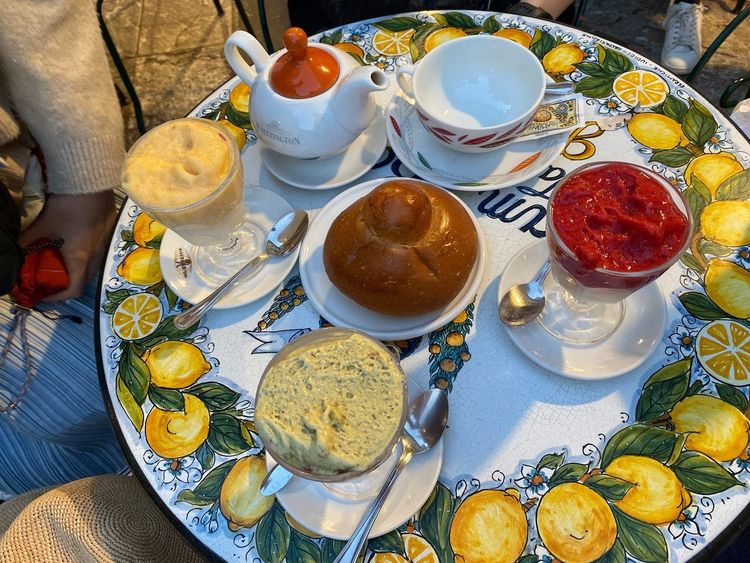
Sampling Sicilian specialities starts at breakfast: lemon, almond, or pistachio granita accompanied by a warm brioche col tuppo, an institution found in almost every café along Corso Umberto that more than replaces a coffee taken standing at the bar. At lunchtime, pasta alla Norma — tomato, fried aubergine, and salted ricotta — was born just down the road in Catania and appears on virtually every local menu.
Food and wine pairings take on real meaning in this part of the world: Etna wines — nerello mascalese reds or carricante whites — pair particularly well with fried arancini, fish involtini, or a simple grilled catch of the day. On the sweet side, it's impossible to leave without a cannolo filled to order, a slice of cassata, or almond paste shaped into colourful fruit in the pasticcerie windows of the centre.
What are the best restaurants in Taormina? As a rule, it pays to step a hundred metres or so away from Corso Umberto: the trattorias tucked into the perpendicular alleyways and along the steps of Via Naumachia offer more reasonable prices and a cuisine often closer to family tradition than the most prominent addresses on the main street. Three reliable signals: a short, seasonal menu, a menu not translated into six languages, and a dining room that fills up after 8:30pm rather than at 7pm. In high season, book the evening before for tables with a view, which are consistently full at sunset.
10. How to Get to Taormina: Plane, Train, Ferry
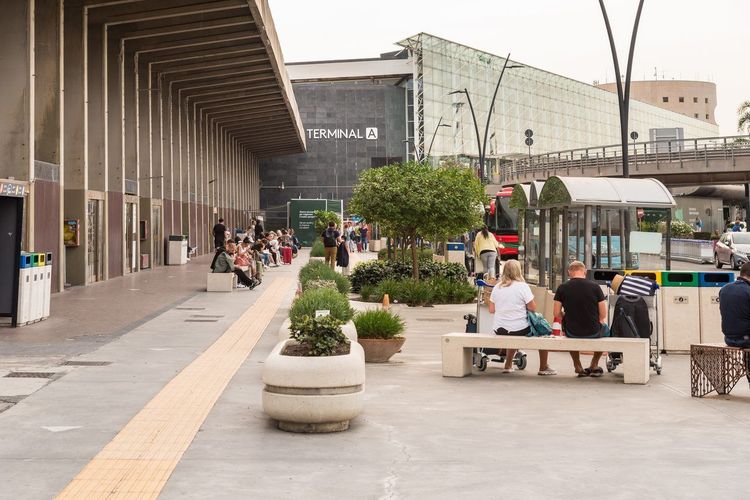
How do you get to Taormina? The nearest airport is Catania Fontanarossa, about 45 minutes to an hour by road, well connected by direct flights from France in summer. Shuttle buses link the airport to Taormina in just over an hour, with several daily departures and a terminus stop near Porta Messina, a stone's throw from the historic centre.
Palerme airport remains an option for cheaper flights, but adds around three extra hours of travel across the island, usually by hire car. If your itinerary passes that way, the Sicilian capital deserves two days in its own right: its Ryo audio guide of Palerme gives a good overview of what you can see in a day's walk.
By rail, Taormina-Giardini Naxos station sits by the sea below the old town, on the Messina–Catania–Syracuse line: a local bus or taxi completes the journey up to the hilltop historic centre, as the climb on foot with luggage is genuinely not recommended. There is no direct ferry to Taormina, but cruise ships call at Messina or Catania, about 45 minutes and an hour by road respectively, and mainland crossings arrive at Villa San Giovanni–Messina, an hour to the north.
11. Getting around and Parking in Taormina
Taormina's historic centre is entirely pedestrianised, which simplifies sightseeing but considerably complicates parking. Where can you park in Taormina? The most convenient option is the Lumbi car park to the north of town, connected to the centre by a free shuttle running at regular intervals. The car parks at Porta Catania and Mazzarò offer alternatives, often full by mid-morning in high season. Budget around twenty euros for twenty-four hours in a covered car park, more in August, and beware of the blue on-street spaces whose regulations change every hundred metres.
Where can you hire a car in Taormina? Most agencies are based at Catania airport rather than in town, since a car is only truly useful for excursions to Etna, Alcantara, Savoca, or Castelmola. Many travellers opt for a mixed approach: three days in Taormina without a car, then a two-day rental to explore the hinterland. For local travel, intercity buses efficiently serve Castelmola, Giardini Naxos, Mazzarò, and the airport, with single tickets or day passes to purchase before boarding, at bars or the bus station ticket office.
12. Where to Stay in Taormina: Neighbourhoods and Tips
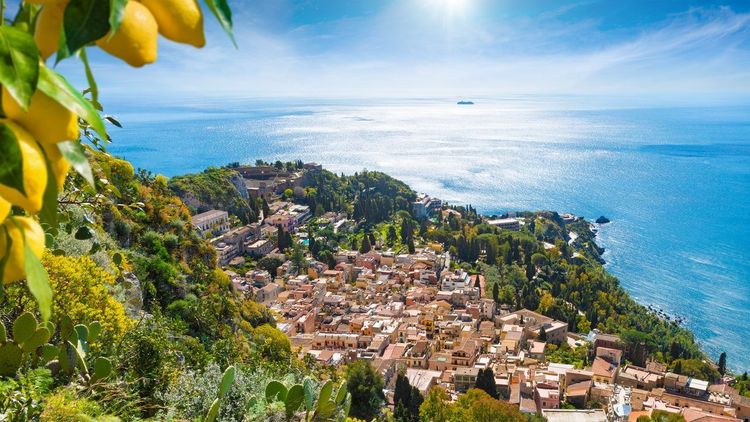
Where to stay in Taormina depends largely on the pace of visit you are looking for. Three areas stand out clearly, each with its own atmosphere and average budget, with Giardini Naxos as an additional option for tighter budgets.
The Historic Centre, for Being in the Heart of the Action
Staying along or close to Corso Umberto lets you reach virtually all the sites in this guide on foot, the Greek theatre included. It is the logical choice for a first visit when you don't want to lose a minute to transfers, and the only one that lets you enjoy the town in the evening, once the day-trippers have gone and the alleyways empty out. The downside is noise: lively terraces running late into summer evenings, particularly at weekends, don't suit every traveller. Hotels here also tend to be pricier for equivalent amenities, and many rooms are accessed via stairways with no lift — worth checking if you have heavy luggage.
Mazzarò and Isola Bella, Right by the Sea
Heading down to Mazzarò, connected to the centre by the cable car, appeals to travellers wanting the beach right on their doorstep. Properties here often offer direct or near-direct sea access, a real draw for couples or families who want to alternate sunbathing and cultural visits without extra journeys. Prices climb steeply in summer, and you'll need to keep track of the last cable car departure in the evening if you want to head up for dinner in town — or factor in a taxi whose night fare can come as a surprise.
Castelmola, for a Peaceful Stay
Staying in Castelmola suits those who prioritise silence and panoramic views over immediate proximity to the sites. Nights here are far quieter than in the town centre, rates are often gentler, and the breakfast terraces are hard to beat. The trade-off is needing to travel by bus or car every day to get down to Taormina, a constraint that does not work well for very short two-or three-day stays. For tighter budgets, Giardini Naxos offers a good compromise: noticeably cheaper rooms, beach at the hotel's doorstep, and frequent buses to the historic centre in fifteen minutes.
13. How Long to Stay and When to Visit Taormina
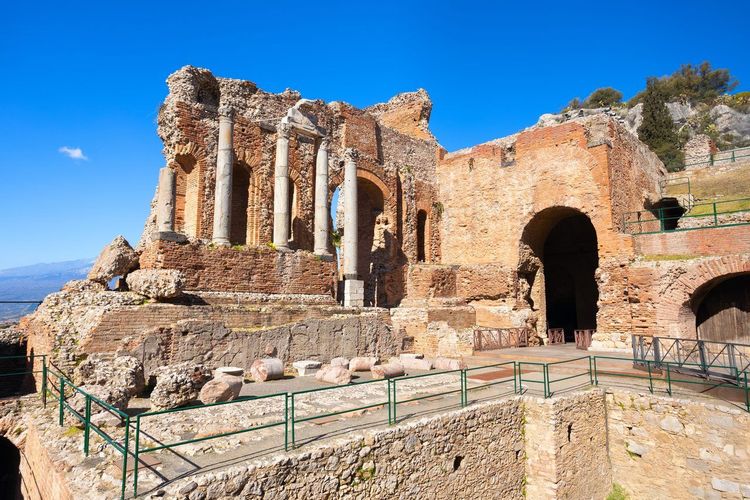
How many days should you spend in Taormina? Two full days are enough to cover the Greek theatre, the old town, Isola Bella, and the Castello. Allow four to five days if you want to add Etna, the Alcantara Gorges, Castelmola, and a beach break in Giardini Naxos without rushing between sites. On a cruise stopover, half a day allows at best the Teatro Greco and a walk along Corso Umberto.
A Typical Day in Taormina
For a successful first day, start at the Teatro Greco when it opens at 9am, when the tiers are still nearly empty and the light is soft on Etna. Walk back down via Via Teatro Greco to Piazza IX Aprile for a granita on the terrace around 11am, then head up Corso Umberto as far as the Duomo, ducking through the Naumachie gate on the way. Have lunch in a side alley away from the main street, before the hottest hours of the day.
The afternoon belongs to the sea: cable car to Mazzarò around 2:30pm, swimming and a shady rest until 5pm. Head back up and tackle the Salita Castello, stopping at the Madonna della Rocca an hour before sunset — the best photography window of the day. End with an aperitivo in the gardens of the Villa Comunale, open into the evening in summer, then a late dinner in the Italian way, after 8:30pm. This template leaves the second day entirely free for Etna or Alcantara.
What Is the Best Time to Visit Taormina?
The windows of April to June and September to early October offer the best compromise: pleasant temperatures around 22 to 27°C, a sea that is already or still swimmable, and crowds noticeably lower than in July and August. Peak summer, very hot and very crowded, also coincides with the highest accommodation rates and the longest cable car queues. Winter stays mild, around 12 to 16°C, with the town returned to its residents, but some seaside hotels close and several sites reduce their hours. May and September remain, year after year, the two months that locals themselves recommend.
14. Events and Festivals
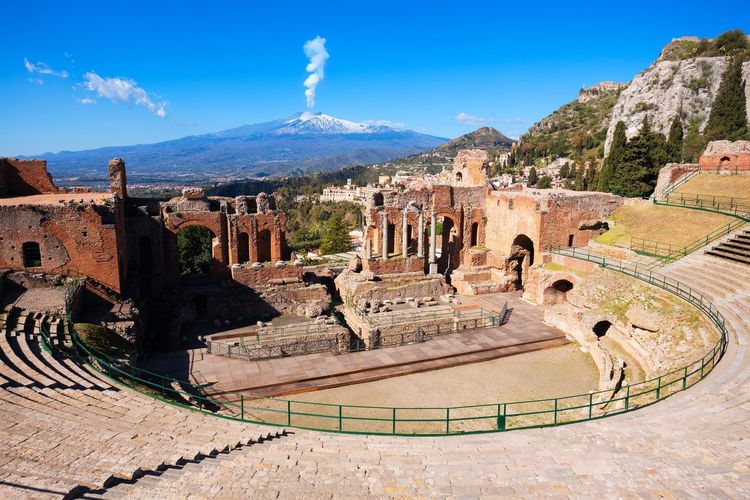
Attending a performance with Etna occasionally glowing red behind the stage remains, by almost unanimous agreement, the most lasting memory of a stay here. Booking several weeks in advance is essential as tickets sell out fast for headline acts, and bring a cushion — the seating is stone.
In June, the Taormina Film Fest transforms the town into a small Sicilian Cannes, with a red carpet, international guests, and open-air screenings at the Teatro Antico. At Easter, traditional processions animate the streets of the historic centre, a moment that is far more authentic and far less touristy than the summer months. On 9 June, the feast of the patron saint Pancras brings local celebrations, and the Wednesday morning weekly market below the centre remains the best place to observe everyday life away from the luxury shop windows. It is best to check the precise calendar for the current year before booking, as dates vary noticeably from one edition to the next.
15. Good to Know before You Go: Budget, Safety, and Tips
What should you not miss on a visit to Taormina? Book your Teatro Greco tickets online in advance, and bring a pair of comfortable shoes: the steps and uneven cobblestones of the historic centre show no mercy to heels or smooth soles.
Budget on average between 60 and 100 euros per person per day for a comfortable stay, excluding accommodation, with meals, local transport, and entrance fees included. You can easily come in under 45 euros by opting for arancini at lunch, drinking from the public fountains, and taking advantage of the many free sites: the Naumachie, the Villa Comunale, the Madonna della Rocca, and the alleyways of Castelmola. Some smaller trattorias and bars accept cash only, so it is always worth keeping some on hand. On the safety front, Taormina is among the safest destinations in Sicily; the usual vigilance against pickpockets in the busiest areas is more than sufficient. One last useful habit, whatever the next Sicilian stop: check whether there is a Ryo audio guide available, as there is for the Palerme audio guide, to have a reliable visit framework in your pocket from the very first hour.
Taormina with Children: What Changes with Kids
With young children, the terrain becomes the real issue: prams struggle on the cobblestones and stairways, and a baby carrier often proves more practical for the climb to the castle. Base yourself in Mazzarò or Giardini Naxos, where the beach is immediate and journeys are short. Reliable highlights for children: the cable car, experienced as an attraction in itself, the shaded play area in the Villa Comunale, snorkelling at Isola Bella, the boat trip to the caves, and — for older children — the excursion to Etna, provided you check the minimum age imposed by guides for high-altitude outings. The morning granita does the rest. Finally, plan visits before 11am and after 5pm: between those times in July and August, the heat on the bare rock makes any climb genuinely gruelling for younger visitors.

FAQ
Is Taormina Worth Visiting?
Absolutely. Few Sicilian towns pack so many major attractions into such a small area: an ancient Greek theatre, a medieval old town, an island nature reserve, and an active volcano visible from the alleyways. Two days cover the essentials; four to five let you explore the surroundings in depth.
How Many Days Do You Need to Visit Taormina?
Allow two full days for the historic centre, Isola Bella, and the Castello. Add two to three extra days if you want to include Etna, the Alcantara Gorges, Castelmola, and a trip to Catania or Syracuse at a relaxed pace.
What Is the Best Time to Visit Taormina?
April–June and September–October offer the best balance of pleasant weather and manageable crowds. July–August is very hot and very busy, while winter, though mild, sees some attractions reduce their opening hours.
Do You Need a Car to Visit Taormina?
Not to explore the historic centre, which is entirely pedestrianised. However, a car makes excursions to Etna, the Alcantara Gorges, Savoca, or Castelmola much easier, as these sites are poorly served by local buses outside tourist hours.
Where Can You Park in Taormina?
The Lumbi car park, to the north and connected to the centre by a free shuttle, is the most practical option. Porta Catania and Mazzarò offer alternatives, though both tend to fill up by mid-morning in peak season.
Which TV Series Was Filmed in Taormina?
Taormina served as the main setting for the second season of "The White Lotus", broadcast in late 2022, most notably in the former convent turned luxury hotel above the ancient theatre. The town gained significant international fame and a noticeable rise in visitor numbers ever since.
Can You Walk to Isola Bella from Taormina?
Yes, by descending a stairway path of around 20 to 25 minutes from the historic centre, a free alternative to the cable car. The route is quite steep and requires sturdy shoes, especially on the way back up in the heat.
Conclusion
Taormina resists being squeezed into a single day's visit, layering as it does Greek, Roman, and Norman strata alongside backdrops that range from an ancient theatre to a turquoise island to a mountain village. The best strategy is to choose a neighbourhood to sleep in, keep at least half a day free to wander the alleyways at your own pace, and leave room for excursions to Etna or Alcantara rather than trying to tick everything off in the town centre. Add the free sites that almost nobody stops for — the Naumachie, the Odeon, the mule track at Castelmola — and the stay takes on a whole new depth.
If that approach resonates with you, it is exactly the philosophy behind every Ryo audio guide: favouring depth in a neighbourhood over a race through monuments. Taormina doesn't yet have its own Ryo audio guide, but if your Sicilian itinerary passes through the capital, the Ryo audio guide of Palerme extends this guide perfectly, headphones on, between Arab-Norman markets and baroque palaces. In the meantime, these fifteen experiences are more than enough to build a stay worthy of the panorama waiting for you from the tiers of the Teatro Greco.
À lire également
