© Shutterstock
 Votre guide Ryo
The Palace of the Normans in Palermo: Complete Visitor's Guide 2026
There is something unsettling about the fact that Europe's oldest active parliament sits inside an Arab palace repurposed by Norman kings, decorated by Byzantine craftsmen and crowned with a chapel that takes your breath away. The Palace of the Normans (Palazzo dei Normanni) is Palermo's most complex building: ten centuries of civilisational layers stacked on top of one another, yet with an architectural coherence that few monuments in the world can claim. To explore this exceptional heritage in its urban context, the Ryo Palermo audio guide tour accompanies you through the surrounding streets with 23 audio tracks over 7.7 km.
This guide gives you everything you need to plan your visit: the history of the emirate fortress that preceded the current palace, the golden mosaics of the UNESCO-listed Palatine Chapel, up-to-date prices and opening hours for 2026, tips for avoiding queues, and places to have lunch right afterwards. Competitors summarise the monument in 1,000 words; here you will find the details that guides systematically omit.
Ten Centuries of History on the Hill of Balarm
Before it was Norman, the site was Punic, Roman, then Arab. In the ninth century the Aghlabids built a fortress on the hill overlooking the city of Balarm, the Arabic name for Palermo, which would become the centre of emirate power under Kalbid rule. The rectangular structure still visible in the foundations dates from this period: a robust enclosure, square corner towers and stables for a standing army.
When Roger I of Hauteville seized Palermo in 1072, he did not raze the Arab palace: he took it over, enlarged it and transformed it into a royal residence. His son Roger II, the first King of Sicily crowned in 1130, made this building the showcase of an unprecedented political project: to demonstrate that a Latin kingdom could absorb Arab and Byzantine knowledge without destroying it. It was during his reign that the Palatine Chapel was commissioned, in 1132 — an order placed simultaneously with Norman craftsmen for the structure, Byzantine mosaic artists from Constantinople for the decorations, and Arab craftsmen for the carved wooden ceilings.
After the Hautevilles, the Hohenstaufen and then the Angevins occupied the palace, each adding or erasing elements. The Aragonese period (14th–15th century) left more discreet traces. The building regained a major institutional function: the Parliament of Sicily has sat here since 1130, and this function has never been interrupted. Today the Sicilian Regional Assembly still holds its sessions within the same walls. It is this extraordinary continuity that justified UNESCO World Heritage inscription in 2015, as part of the serial property "Arab-Norman Palermo and the Cathedral Churches of Cefalù and Monreale".
The oldest surviving tower, the Torre Pisana, dates back to the 11th century. It was here that King William I, known as "the Bad", installed his astronomical observatory — a typically Arab facility inside a Norman palace, further evidence of the deliberate cultural hybridisation of the Sicilian monarchy.
Architecture: When East and West Become One
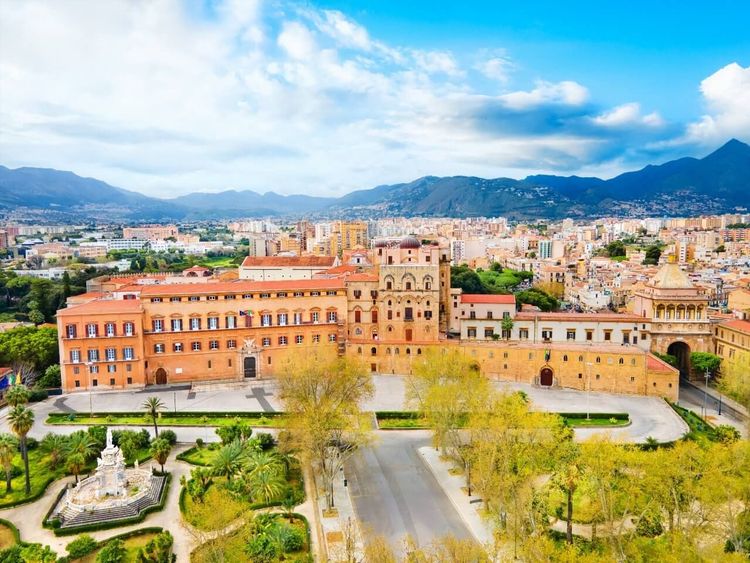
Seen from the outside, the palace is disconcerting. The main façade, facing the Piazza del Parlamento, is austere: broad walls of white limestone, twin windows with pointed arches, an arcaded loggia. A blend of Lombard Romanesque and classical Arabic that nothing in contemporary French architecture could have prepared you to see. The building measures approximately 120 metres long and rises across four levels in its central section.
The Torre Pisana, to the north-east, contrasts with the sobriety of the façade: taller, narrower, it retains horseshoe-arch openings typical of Islamic architecture. The Joharia Tower, to the south-west, dates from the 12th century and long served as the royal treasury. Between the two stretches the main body of the palace, altered over the centuries, but whose inner courtyard retains a layout reminiscent of Abbasid palace courts.
Inside, the contrast is striking between the state rooms — gilded, covered in mosaics, bathed in filtered light — and the circulation corridors, austere with their bare rubblestone walls. The result is a succession of architectural surprises that even regular visitors to Palermo describe as unsettling. The Norman architects did not seek to homogenise: they juxtaposed spaces designed for different functions, without erasing the diverse origins of each one.
The floor of Roger's Room rests on columns that descend directly into the Arab foundations, visible in the crypt accessible with certain combined tickets. This physical stratification makes the monument unique: each floor layer corresponds to a different civilisation.
The Palatine Chapel: Absolute Masterpiece of Norman Syncretism
The Cappella Palatina (Piazza del Parlamento 1, 90129 Palermo, rated 4.7/5 on Google from 11,745 reviews) is what the majority of visitors come for. And the reality far exceeds the photographs. Built from 1132 on the orders of Roger II and completed around the middle of the 12th century, it occupies the intermediate level of the palace and its east-west orientation guarantees a raking morning light that literally makes the mosaics shine as if lit from within.
The iconographic programme is breathtaking in its ambition. The central nave is entirely covered with Byzantine mosaics on a gold background, depicting Christ Pantocrator in the main apse, surrounded by apostles, prophets and scenes from the Old and New Testaments. The mosaic surface approaches 2,000 m², making it one of the densest and best-preserved ensembles of medieval mosaics in the world. Craftsmen from Constantinople were specially brought in for this project: in the faces of Christ and the angels one recognises the purest Byzantine canon.
But it is when you look up at the ceiling that the cultural singularity truly explodes. The muqarnas ceiling, those carved and painted wooden honeycomb cells characteristic of Fatimid architecture, is the largest ceiling of this type preserved outside the Islamic world. Hundreds of star-shaped niches, decorated with scenes of court life, hunting, feasting, and figures in turbans and oriental robes: motifs with nothing Christian about them, yet executed by Arab craftsmen at the very top of Roger II's royal chapel. The message was as much political as aesthetic.
The opus sectile floor and the 12th-century bronze paschal candlestick complete an interior where every square centimetre tells a story of trade, domination and cultural hybridisation. A detail often overlooked: the wall inscriptions are in Greek and Arabic, side by side, on the same panels. This linguistic coexistence reflects the reality of a court where administrators, scholars and craftsmen genuinely spoke both languages.
Practical tips for the chapel: arrive at opening time (8:30am) or in the late afternoon to avoid groups. The chapel is inaccessible during religious ceremonies (Sunday mornings). Morning light is best for the apse mosaics. Dress code is mandatory: shoulders and knees must be covered; shawls are available at the entrance.
To extend this immersion in Arab-Norman Palermo, the audio sequences of our Palermo audio-guided tour contextualise the entire neighbourhood: mosques converted into churches, the Arab urban logic that survives in the street grid, the markets that perpetuate millennia-old practices.
Roger's Room and the Royal Apartments
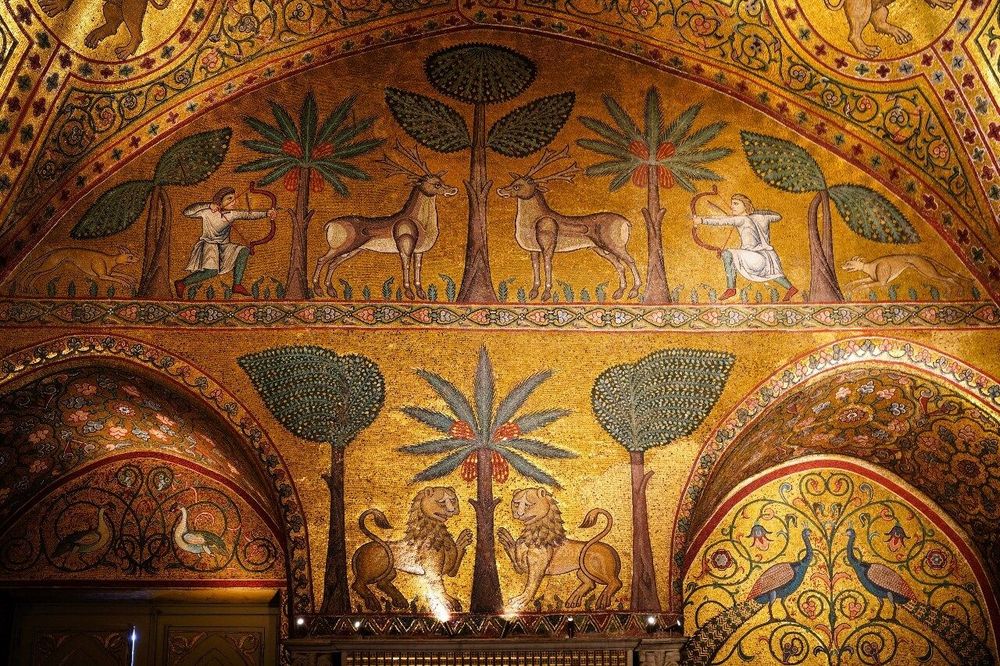
On the first floor of the palace, the Sala di Ruggero is the second great attraction after the chapel. Fitted out in the 12th century as a state room for the Norman sovereigns, it features a radically different mosaic programme: here there are no religious scenes, but secular mosaics depicting peacocks, centaurs, lions in combat, deer and palm trees. An entire bestiary inspired by the Oriental silk textiles that circulated across the medieval Mediterranean.
The room is accessible during guided tours of the royal apartments, held Thursday to Monday (on Tuesdays and Wednesdays the apartments are closed, and only the chapel and gardens remain accessible). These tours also include several other rooms on the piano nobile whose layout has changed little since the 16th century: marble floors, painted coffered ceilings, mullioned windows overlooking the gardens.
The Torre Pisana houses a museum space dedicated to medieval astronomy, recalling the scientific vocation given to it by William I. Reproduction instruments (astrolabes, quadrants) and explanatory panels in Italian and English trace Sicily's role in the transmission of Arab mathematical and astronomical knowledge to Latin Europe. The tower also offers an unobstructed view over Palermo Cathedral and the rooftops of the Capo district.
Please note: access to the royal apartments requires a separate ticket from the basic entry. Allow 2h30 to 3h for a complete visit including the apartments, the chapel and the Torre Pisana.
The Gardens and the Villa Bonanno
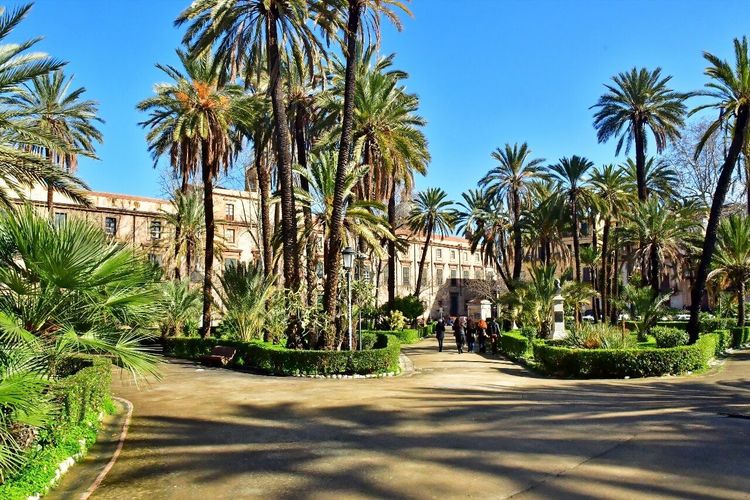
Less well known than the mosaics, the outdoor spaces of the Norman complex deserve a visit in their own right. Directly opposite the palace, on the Piazza del Parlamento, the public gardens of the Villa Bonanno (Piazza del Parlamento, 90129 Palermo, rated 4.5/5 on Google from 1,147 reviews) are often ignored by visitors queuing to get in. This is a mistake: beneath the paths, Roman mosaics from the 1st–2nd century have been uncovered, visible through glass protective covers. These remains of a Roman villa are a reminder that the hill was occupied long before the Arabs.
At the rear of the building, the Giardino Pensile (hanging garden) extends across several terraces linked by stone staircases and offers an unobstructed view over the cathedral dome. Bitter orange trees, lemon trees and cascading bougainvilleas enliven the low walls. In spring, the blossoming citrus trees release a fragrance that contrasts sharply with the severity of the stone.
Opening Hours and Prices 2026
The palace is managed by the Fondazione Federico II. The information below is valid for 2026 but subject to change; always check the official website (fondazionefedericosecondo.it) before booking.
Opening hours:
- Monday, Thursday, Friday and Saturday: 8:30am to 4:30pm (last entry around 3:45pm)
- Tuesday and Wednesday: royal apartments closed (chapel and gardens open) due to parliamentary activities
- Sunday and public holidays: 8:30am to 12:30pm (last entry 11:45am)
- Partial closures possible during Regional Parliament sessions
Prices (full access: chapel + apartments + gardens + archaeological area):
- Full price: €19 (Thursday–Monday) / €15.50 (Tuesday–Wednesday, without the apartments)
- Reduced (EU 18–25 year-olds, teachers): €17 / €13.50
- Seniors 65+ (EU): €15.50 / €13.50
- Youth 14–17 years: €11 / €9
- On-site audio guide in English: €5
Booking: strongly recommended from May to October and during public holiday weekends. Queues of 30 to 60 minutes are common in high season without a reservation. Online ticketing allows you to choose a time slot.
Key tip: avoid Monday and Tuesday mornings in July and August, when cruise ship groups arrive from the port. Tuesday afternoons and Thursdays are the quietest time slots, and the best moments to follow on with our 24-stop audio walking tour of the city.
How to Get There from the Centre of Palermo
The Palace of the Normans is located on the Piazza del Parlamento (Piazza del Parlamento, 90129 Palermo, rated 4.4/5 on Google from 900 reviews), at the western end of the historic centre, approximately 600 metres on foot from Piazza Pretoria.
On foot from Via Maqueda: allow 10 to 12 minutes walking west along Via Vittorio Emanuele. This is the most practical option from most accommodation in the centre.
By bus: AMAT lines 104, 105 and 109 serve the Palazzo dei Normanni or Piazza Indipendenza stop. A single ticket costs €1.40, valid for 90 minutes.
By taxi or rideshare: from the central station, allow 8 to 12 minutes travel time and €7 to €10 depending on traffic.
By car: parking is difficult and often saturated around the square. The nearest paid car park is Piazza Indipendenza (around €2/h). It is best to leave the car at your hotel.
What to See around the Palace of the Normans
The palace is part of a network of Arab-Norman monuments inscribed on the UNESCO list in 2015. In an additional half-day, you can visit several sites less than 15 minutes' walk away.
Palermo Cathedral, 500 metres to the east along Via Vittorio Emanuele, is the other pillar of the city's Arab-Norman architecture. Its façade blends Norman pointed arches, Arab geometric motifs and Baroque additions in a visually fascinating accumulation. Inside, the Norman royal tombs include those of Roger II and Frederick II of Hohenstaufen.
The Chiesa della Martorana (Santa Maria dell'Ammiraglio), a 10-minute walk to the east at Piazza Bellini, houses Byzantine mosaics almost contemporary with those of the Palatine Chapel, commissioned by Admiral George of Antioch around 1143. The cycle of the Coronation of Roger II by Christ is particularly remarkable, and one of the only known representations of the Norman king.
The church of San Giovanni degli Eremiti (Via dei Benedettini 20, 90134 Palermo, rated 4.2/5 on Google from 2,227 reviews), 400 metres south of the palace, is recognisable by its five red domes inspired by Islamic architecture. Its 12th-century Arab-Norman cloister, planted with orange trees and palm trees, is one of the most photographed in Palermo. Built on the foundations of an earlier building, it illustrates better than any other the Norman logic of repurposing and transformation.
Our article on the must-sees of Sicily completes this overview with the island's essential sites beyond Palermo, notably Monreale and its cathedral with 6,000 m² of mosaics.
Where to Eat near the Palace
The neighbourhood around the palace is the Albergheria, one of the most vibrant and least touristified districts in Palermo. A few addresses to recharge after your visit.
The Ballarò market, 600 metres to the north-east, is Palermo's oldest street market. The street food stalls come alive from 11am: panelle (chickpea flour fritters), crocché (potato croquettes), pane ca' meusa (spleen and lung sandwich). Prices: €1 to €3 per item. Atmosphere guaranteed — loud and colourful — Monday to Saturday from 7am to 2pm.
For a more sit-down lunch, Trattoria Ai Cascinari (via d'Ossuna) offers home-style Sicilian cooking: pasta con le sarde, caponata, sarde a beccafico. Expect to pay €15 to €20 per person. Closed Sunday evenings.
For a break before or after your visit, the Bar del Parlamento on Piazza del Parlamento serves homemade granitas and cannoli at reasonable prices (€2.50 for a granita, €1.80 for a cannolo).
For a complete list of experiences in the city, the article on things to do in Palermo offers itineraries that include markets, museums and lesser-known neighbourhoods.
FAQ
How long does it take to visit the Palace of the Normans?
Allow 1h30 for a visit of the Palatine Chapel alone. For a full visit including the royal apartments, Roger's Room and the Torre Pisana, plan for 2h30 to 3h. If you wish to include the gardens of the Villa Bonanno and the nearby monuments (cathedral, Martorana), a full half-day is required.
Is the Palace of the Normans closed on certain days?
Yes. The palace is partially or fully closed during plenary sessions of the Sicilian Regional Assembly, on variable dates. It also closes on 1 January and 25 December. The royal apartments are additionally inaccessible on Tuesdays and Wednesdays (only the chapel and gardens remain open on those days). Check the calendar on the Fondazione Federico II website before booking.
Is advance booking required?
Not mandatory in low season (November–March), but strongly recommended from May to October and during Italian school holidays. Booking online lets you choose a time slot and avoid waits that can exceed one hour at the entrance. Tickets are available on the official website or through partner platforms such as Tiqets or GetYourGuide.
Can you photograph the Palatine Chapel?
Yes, photography without flash is permitted throughout the palace, including in the Cappella Palatina. Tripods are not allowed inside. Morning light (9am–11am) is best for photographing the apse mosaics without backlighting. Switch to manual mode on your camera to avoid overexposing the gilding.
Is the Palace of the Normans accessible to visitors with reduced mobility?
Accessibility is partial. The ground floor and the Palatine Chapel (intermediate level) are accessible by lift from the main entrance. Some historic areas such as the Torre Pisana and the crypt require climbing stairs with no adapted equipment. Contact the Fondazione Federico II before your visit if you have specific needs.
Is an audio guide available on site?
Yes, an audio guide in English is available at the entrance for €5. It covers the Palatine Chapel and the main apartments. For a more immersive experience that goes beyond the palace alone and covers the city's entire Arab-Norman heritage, the Ryo audio-guided tour of Palermo offers 24 audio sequences over 7.7 km, available on the app before you even leave home.
A Monument That Changes the Way You See Palermo
Visiting the Palace of the Normans means understanding why Palermo fascinates historians so much: rarely has a city produced such a fertile, deliberate and legible cultural blending in its monuments. The Palatine Chapel is not an Arab monument, nor a Byzantine monument, nor a Norman monument: it is all three at once, and that is precisely what makes it unique in the world.
Take the time to look at every detail: the muqarnas ceiling above a Christian iconographic programme, Arabic inscriptions on Corinthian columns, mosaics from Constantinople on walls built by Lombard stonemasons. It is the finest summary of the medieval Mediterranean you will find in a single building.
To continue exploring Palermo beyond the palace walls, the Ryo Palermo audio guide takes you through the historic markets, Baroque oratories and Arab quarters that make up the unique fabric of this city. 23 audio stops to make sure you miss nothing that printed guides leave out.