© Shutterstock
 Votre guide Ryo
What to Do in Agrigento in 2026: 15 Experiences Between Greek Temples and White Cliffs
In Agrigento, Sicily delivers something rare: 2,500-year-old Doric columns towering over a turquoise sea, just a short distance from a white chalk cliff that rivals the most dramatic coastlines in Europe. What to do in Agrigento when the city packs so many contrasts into such a compact area? The answer fits into either one full day or a three-day stay, depending on how much time you devote to the Valley of the Temples — the largest Greek archaeological site outside Greece — and the coastal landscapes that surround it.
In the pages that follow, you will discover why the Temple of Concordia has survived 25 centuries almost intact, how an ancient citrus garden still thrives under the stewardship of a private foundation, at what hour the Scala dei Turchi changes colour at sunset, and where a convent of cloistered nuns still sells their pastries through a wooden revolving hatch. At Ryo, we love uncovering destinations where antiquity mingles with everyday local life: our Ryo's audio tour of Palermo already covers Norman and Arab Sicily, two hours' drive from here. Here is a complete guide, temple by temple, beach by beach, to help you plan your stay in Agrigento and its surroundings.
1. Exploring the Valley of the Temples, the Essential Archaeological Site
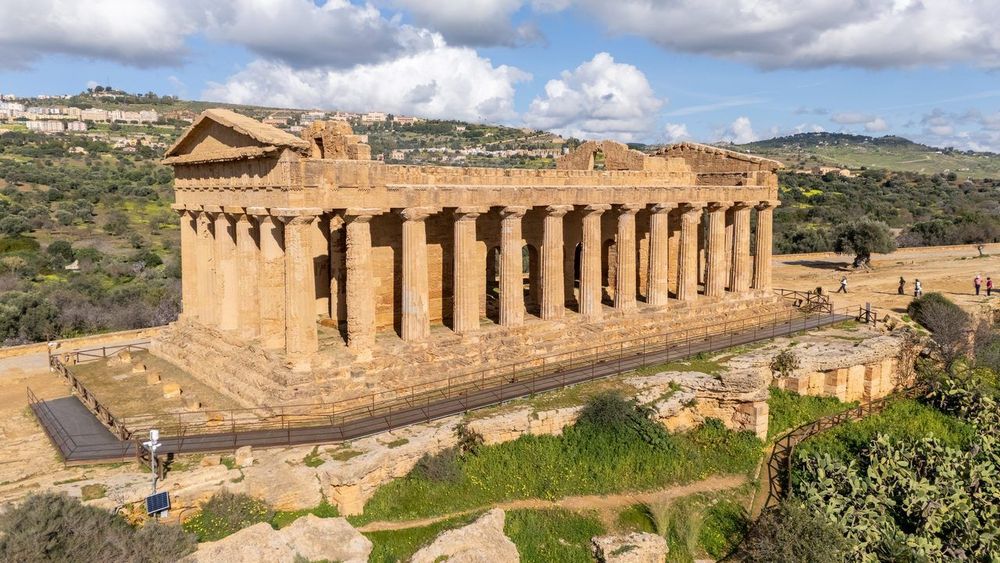
The Valley of the Temples (Valle dei Templi, Via Panoramica dei Templi, 92100 Agrigento, rated 4.7/5 on Google with 59,887 reviews) stretches across roughly 1,300 hectares between the modern city of Agrigento and the sea, making it the largest ancient Greek archaeological site in the world — far more extensive than the Acropolis in Athens. Listed as a UNESCO World Heritage Site since 1997, the Valley brings together the remains of Doric temples built between the 6th and 5th centuries BC, at a time when Akragas ranked among the wealthiest cities in the Greek Mediterranean, renowned for its gardens and chariot races.
Two entrances serve the park: Gate V, on the side of the Hellenistic-Roman quarter and the Temple of Zeus, and Juno Gate, at the opposite end of the ridge. Plan to park in the large paid car parks along Via Panoramica dei Templi (a few euros for the day) rather than hunting for a space in the city; in high season, arriving before 9:30 am avoids queues at the ticket offices and the midday heat on a site that offers virtually no shade. A shuttle links the two entrances, a useful detail if you walk the site from end to end and don't want to retrace your steps.
Tickets can be purchased online through the park's official website — strongly recommended in summer, as slots fill up several days in advance — or directly at the ticket counters off-season. A standard ticket gives access to the temples; combined tickets include the Kolymbethra garden and the nearby archaeological museum, a wise choice if you plan to spend the whole day here. A small-group guided tour, available in English several times a day in season, adds genuine historical depth: local guides explain construction techniques and the archaeological theories still debated about certain buildings. At Ryo, we recommend setting aside at least a full half-day for this site; any less and the visit risks becoming a photography dash rather than a real discovery.
The park most often opens from 8:30 am to 7 pm (last entry one hour before closing), with evening openings in July and August, generally at weekends. This illuminated evening version completely transforms the atmosphere: the heat drops, crowds thin out, and the columns take on a particularly photogenic golden hue. Opening hours shift from season to season: check them the day before on the park's website, especially if you are aiming for the evening slot at the Temple of Concordia, the site's most photographed monument.
2. The Iconic Temples Not to Miss in the Valley
Several temples line the limestone ridge of the Valley, but four concentrate the bulk of the architectural interest and deserve a closer look.
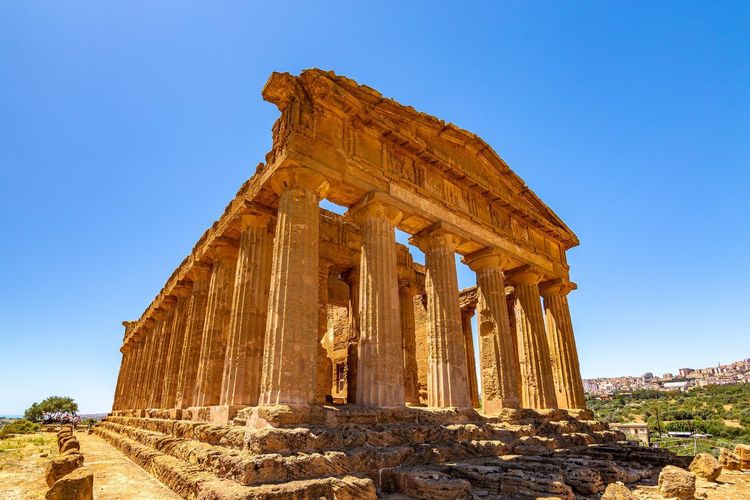
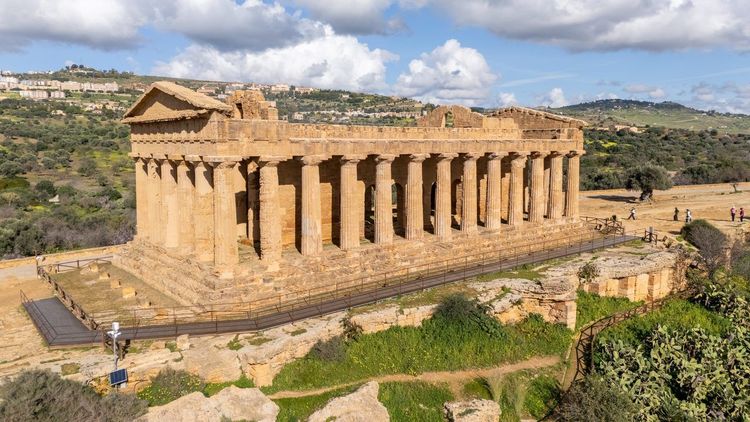
The Temple of Concordia ranks among the best-preserved Doric temples in the Greek world, alongside the Parthenon and the Theseum in Athens. Built around 430 BC, it owes its near-intact survival to its conversion into a Christian basilica at the end of the 6th century AD, which protected its 34 Doric columns from looting and collapse for over a millennium. It never bore the name Concordia in antiquity: the name comes from a Latin inscription found nearby and conveniently attached to the monument in modern times. Photograph it early in the morning from the east, when the raking light accentuates the relief of the Doric fluting.
The Temple of Olympian Zeus (Tempio di Giove), had it been completed, would have been one of the largest Doric temples ever built: more than 110 metres long and about 55 metres wide. Construction, launched after the victory at Himera in 480 BC, was never finished; earthquakes and quarrying subsequently reduced the building to a field of scattered blocks. You can still see a replica of the famous telamon — the stone colossi nearly 8 metres tall that once punctuated the temple's elevation — with the reconstructed original now housed in the nearby archaeological museum.
The Temple of Juno (Hera Lacinia), perched in a commanding position at the eastern end of the ridge, still bears traces of fire on some stones, scorched during the Carthaginian sack of 406 BC. The Temple of Hercules, the oldest on the site (late 6th century BC), was partially re-erected in the 1920s thanks to the British patron Alexander Hardcastle: eight of its columns stand once again, giving a fairly clear sense of what the valley looked like before the successive earthquakes that devastated it.
3. The Kolymbethra Garden, an Overlooked Ancient Oasis

Many rushed visitors head from the temples straight to the car park without stopping at the Kolymbethra garden — a mistake worth avoiding. This valley carved into the rock, developed over two millennia ago to collect and distribute water for the Greek city, had fallen into neglect before being restored and opened to the public by the FAI (Fondo Ambiente Italiano), which manages and funds it separately from the archaeological park itself.
Visitors wander among orange trees, lemon trees, centuries-old olive trees, pistachio trees and a network of underground hypogea — ancient irrigation tunnels, some of which can be visited with a FAI guide. Access requires a separate ticket, something few guides mention clearly, but it combines easily with the valley ticket for a few extra euros. Allow 45 minutes to 1.5 hours to stroll the shaded paths, a welcome break after the mineral walk among sun-exposed temples. In April and May, the citrus trees in bloom fill the entire garden with fragrance, and the scent of orange blossom remains, for many visitors, the most lasting memory of the day.
4. The Scala dei Turchi, Sicily's Most Photographed White Cliff
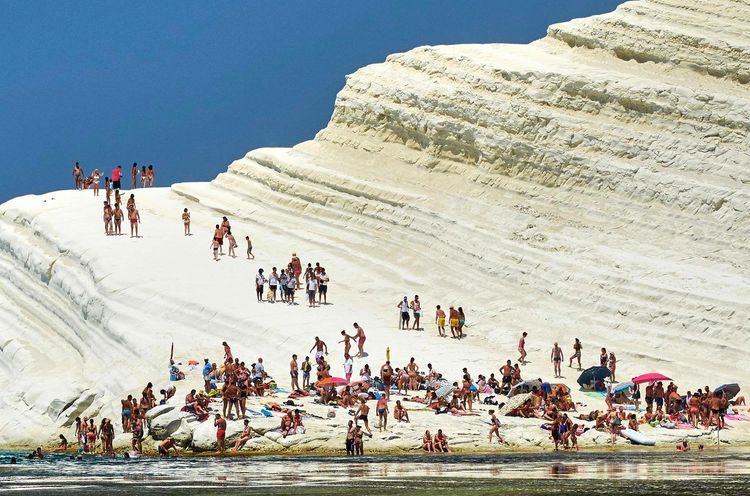
About twenty minutes by car from Agrigento, the Scala dei Turchi (Contrada Punta Grande, 92019 Realmonte, rated 4.5/5 on Google with 6,163 reviews) takes its name from the Ottoman pirates who, according to local legend, once used this white marl cliff as a discreet landing point for coastal raids. The rock, sculpted by erosion into wide natural terraces, forms an almost geometric staircase plunging into a turquoise sea — a chromatic contrast that makes it one of the most photographed sites in all of Sicily.
Warning: access to the cliff itself has been restricted since 2020 due to erosion and rockfall risk. Barriers and municipal orders regulate access, with periods of total closure and fines for those who ignore them, while safety works have continued from one season to the next. Check the current situation on the day with your accommodation or the tourist office: the rules have changed several times in recent years, and no one wants to find a red cordon after driving thirty kilometres. From the nearby beaches of Realmonte, the view of the white terraces is spectacular in any case, without setting foot on the marl.
The best time to visit is late afternoon: the raking light of sunset, between 7 and 8:30 pm in summer, gilds the cliff before it shifts to pink and then mauve as the sun descends. Bring water and a parasol — there is no natural shade anywhere on the site — and the paid car parks nearby fill up fast in July and August from mid-afternoon onwards. One last tip: avoid the full midday heat, when the glare off the white rock makes walking almost uncomfortable to the naked eye.
5. Zingarello Beach, the Alternative to the Crowded Coastline
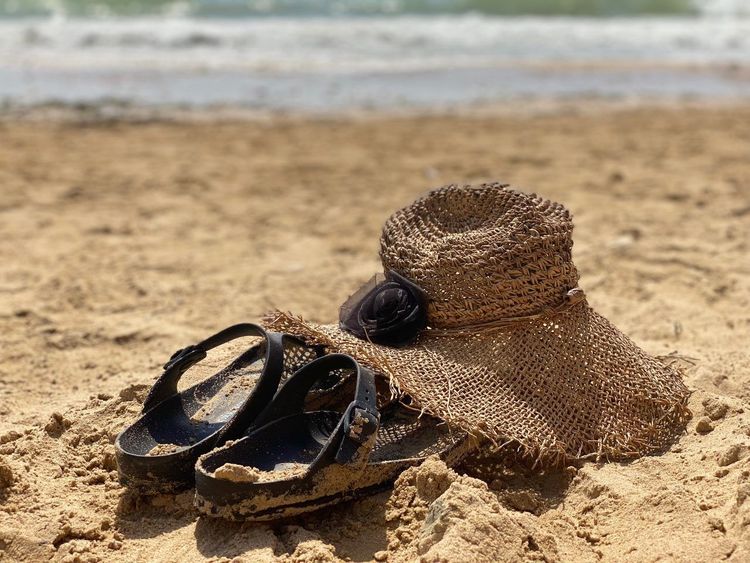
Along the Agrigento coastline, the small Zingarello beach offers a far less crowded alternative to the province's major seaside spots. This stretch of coast, a mix of sand, flat rocks and clear water, still largely escapes the crowds that flock to the most instagrammable sites in high season.
Access is by car along poorly signposted country roads: enter the exact name in your GPS rather than relying on road signs, and allow about twenty minutes from Agrigento. There are no sun loungers or organised beach services here: bring your own parasol, water and a picnic, as facilities are virtually non-existent. In exchange for that small logistical effort, you get an almost untouched setting, ideal for slotting in a swim between two archaeological visits without enduring the sunset crowds at the Scala dei Turchi.
6. The Pietro Griffo Regional Archaeological Museum
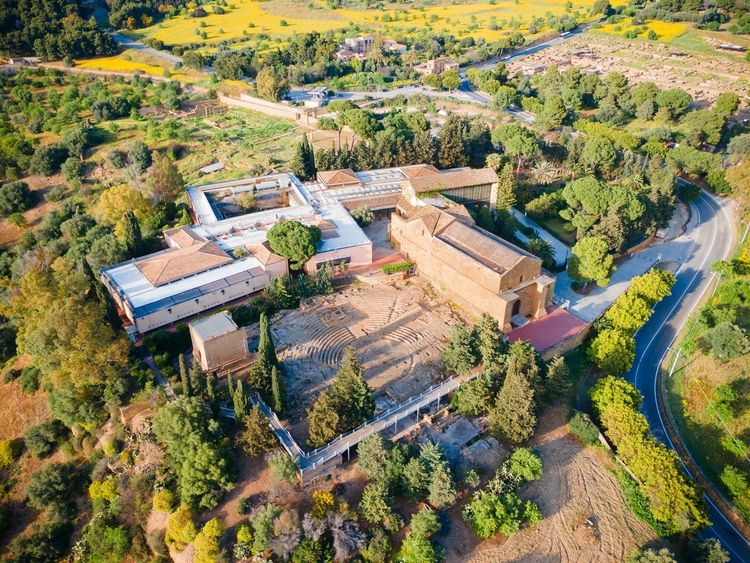
Visiting the temples and then heading straight into the city centre without stopping at the Pietro Griffo Regional Archaeological Museum would be a shame: it sits just a short walk from the Valley, right next to the San Nicola church, and houses one of the finest Magna Graecia collections preserved in Sicily.
The centrepiece is the reconstructed telamon — the stone colossus nearly 8 metres tall that once belonged to the Temple of Zeus: seeing it standing upright in a museum gallery gives a far more concrete sense of its scale than the scattered blocks on the archaeological site itself. The other star exhibit is the Ephebe of Agrigento, a marble statue from the early 5th century BC discovered near the Temple of Demeter. The museum also holds a rich collection of Attic red-figure and black-figure vases, ceramics imported over the centuries, and Roman sarcophagi decorated with mythological reliefs.
Allow 1.5 to 2 hours for the visit, a little more if you include the adjacent cloister, laid out over the remains of an ancient Cistercian monastery. Opening hours vary by season, with shortened days on Sundays and certain public holidays: check them before planning this stop at the end of an archaeological day, especially if you have already spent the morning in the Valley.
7. Agrigento's Old Town: Cathedral, Churches and Alleyways
Some guides flatly advise visitors to 'skip Agrigento's historic centre'; that advice deserves some nuance. A few streets of the centro storico do suffer from crumbling facades and shuttered shops, the legacy of demographic decline that gathered pace in the final decades of the 20th century. But the upper town, perched on the hill overlooking the Valley of the Temples, retains a dense medieval core, punctuated by Baroque churches and sea views, that is well worth a half-day's walk for anyone who takes the time to explore Agrigento beyond the temples alone.
The San Gerlando Cathedral, dedicated to Agrigento's first Norman bishop, dominates the city from the highest point of the hill. Its unfinished facade and massive bell tower tell nearly nine centuries of successive reconstructions, shaped by landslides, partial collapses and Baroque remodelling. The building has undergone lengthy restoration campaigns following ground movements that weakened the nave: check opening hours before making the climb, as they remain irregular.
A short distance from the Valley of the Temples, the San Nicola church, built in a Romanesque-Gothic style, houses one of the city's most moving sculpted treasures: the so-called Sarcophagus of Phaedra, adorned with an ancient relief depicting the myth of Hippolytus, long admired by Grand Tour travellers, Goethe among them.
Santa Maria dei Greci, built in the Middle Ages directly on the foundations of a 5th-century BC Doric temple, still shows its ancient columns embedded in the walls — a striking shortcut between Greek paganism and Norman Christianity; a side corridor allows you to see the original stylobate. The neighbouring episcopal palace preserves a diocesan library, rarely open to the public but visible from its inner courtyard on certain heritage open days.
From there, head down to the art street — Via Bac Bac — a lane in the historic centre taken over by local artists: murals, painted walls and repurposed objects transform a few dozen metres of alleyway into an open-air gallery, a welcome contrast with the grey stone surroundings. A note on the Turkish staircase, a term that comes up frequently in searches: this is not a staircase in the old town, but the literal translation of Scala dei Turchi, the white cliff at Realmonte described above. In the centro storico, it is the long flights of steps between Via Atenea and the cathedral that structure the walk, lined with small shops and shaded terraces.
Wear comfortable shoes: the historic centre involves a lot of climbing, and some cobbled lanes are poorly suited to sandals. Away from the main commercial streets, walking is generally safe during the day, including in the neighbourhoods that other guides may too hastily advise against. In the late afternoon, when the light rakes across the ochre facades, the view from around the cathedral toward the Valley of the Temples and the sea beyond is reason enough in itself to make the climb.
8. The Birthplace of Luigi Pirandello
In Caos, a coastal neighbourhood to the west of the city, the birthplace of Luigi Pirandello occupies a modest villa set among olive trees, where the future 1934 Nobel laureate in literature was born in 1867. The house-museum preserves period furniture, original editions and family photographs, but the most powerful experience unfolds outside.
A path leads to the centuries-old pine tree planted at the cliff's edge, facing the sea. Pirandello wished his ashes to be scattered; they rest instead, since 1962, in an urn sealed inside a rock at the foot of this tree, at the end of a long administrative saga. The original pine, uprooted by a storm in the late 1990s, has since been replaced at the same spot.
Allow 45 minutes on site, and check opening hours before making the trip: the house-museum closes early on some off-season days. The neighbourhood is a ten-minute drive from the centre of Agrigento, or reachable by urban bus from the bus station. Even without having read Six Characters in Search of an Author, you will understand, climbing towards that pine tree, why the writer described himself as a 'son of Chaos'.
9. The Santo Spirito Monastery and Its Traditional Pastries
The Santo Spirito monastery, founded at the end of the 13th century by the Chiaramonte family, still houses a small community of cloistered nuns — a rarity in Sicily. The nuns' living quarters are not open to visitors, of course, but the church and cloister remain accessible to the public, with Baroque stucco work attributed to the workshop of Giacomo Serpotta and a fine Gothic portal facing the street.
The real curiosity is next door: a ruota, a wooden revolving hatch set into the wall, still allows the sisters to sell their pastries without direct contact with the outside world, just as in the days of strict enclosure. Ring the bell, place your order, and the tray revolves. Ask for the cuscusu dolce — a sweet couscous with almonds, pistachios and chocolate, a speciality almost impossible to find elsewhere in Sicily — or the dolci di mandorla prepared that same morning. Visit in the morning: once the day's production is sold out, the ruota falls silent. If your Sicilian trip then continues up to Palermo, our audio-guided tour there extends the island exploration for a day.
10. Day Trip to Sciacca, the Nearby Spa Town
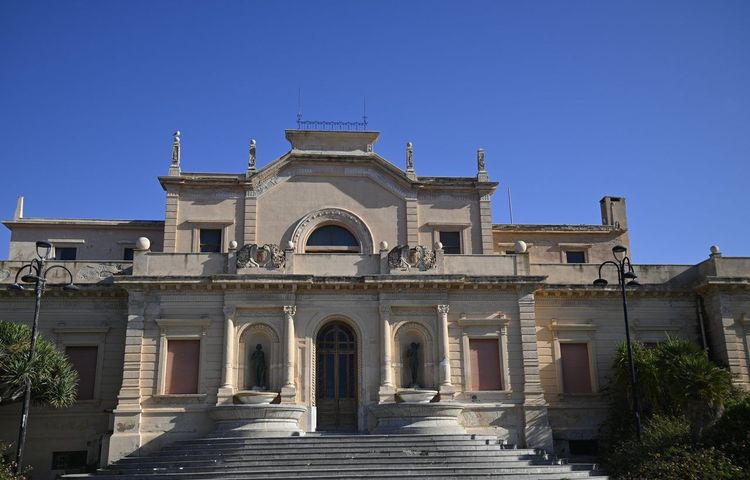
An hour's drive west of Agrigento, Sciacca (Corso Vittorio Emanuele, 92019 Sciacca) is worth a half-day excursion for visitors with a car. The town's reputation rests on its sulphurous waters, fed by vapours from Monte Kronio and exploited since antiquity for their respiratory and rheumatic benefits, already praised by the Greeks and Romans. One important caveat: the historic spa establishments, including the Grand Hôtel des Thermes and the San Calogero steam baths, have been closed to the public since the mid-2010s, despite repeatedly announced reopening projects. Come for the town and the coastline, not for a thermal cure.
The fishing port, still active, brings the waterfront to life from early morning with colourful boats and fresh fish stalls, while the historic centre, built in an amphitheatre above the shore, lines up Baroque churches, medieval gateways and terraces with views over the Mediterranean. Sciacca is also renowned for its artisanal ceramics, heirs to a long tradition of hand-painted majolica: several workshops in the town centre sell their work directly, a fine opportunity to bring back a souvenir that goes beyond the usual tourist fare.
Lovers of outsider art should push on to the Castello Incantato on the edge of town, where self-taught sculptor Filippo Bentivegna carved more than a thousand faces into rocks and olive trunks over the course of the 20th century — a site as bewildering as it is unknown to hurried visitors. If you happen to be there in February, ask about the Sciacca Carnival, one of the oldest in Sicily, with its satirical papier-mâché floats.
11. The Ancient City of Heraclea Minoa
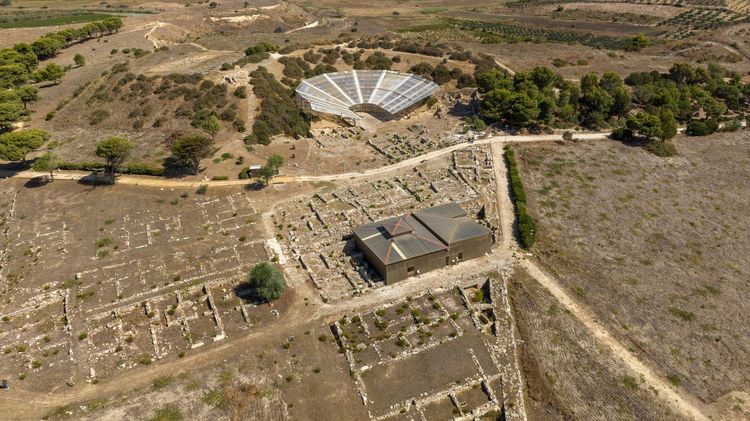
Less famous than the Valley of the Temples but spectacular in its own right, the ancient city of Heraclea Minoa (Contrada Eraclea Minoa, 92011 Cattolica Eraclea, rated 4.6/5 on Google with 2K reviews) occupies a promontory of white marl overlooking a long sandy beach edged with pine trees, about 45 minutes' drive west of Agrigento on the road to Sciacca.
Founded by Greek colonists from Selinunte in the 6th century BC, the city long served as a frontier between Greek and Carthaginian spheres of influence before declining under Roman rule. What remains today is a theatre carved into soft rock, protected by a site canopy that sometimes limits access to the tiered seating, the foundations of houses laid out in regular city blocks, and ramparts partially uncovered by successive excavations. Unlike the Valley of the Temples, the site attracts very few visitors, even in the height of summer: you are more likely to encounter lizards than tour groups. Pack your swimsuit and a towel — the beach below is a short drive away and ranks among the most pleasant on the southern coast.
12. How to Get to Agrigento and Get Around

How to get to Agrigento depends mainly on your point of entry into Sicily. The two closest airports are Palermo (Falcone-Borsellino, about 2 hours by road) and Catania (Fontanarossa, about 2.5 to 3 hours), neither of which has a direct and fast rail connection to Agrigento. If you land in the north, a day acclimatising in the Sicilian capital pairs well with the rest of the journey: our Palermo audio guide covers the historic centre before the drive south to the coast.
From Palermo, Cuffaro and SAIS Trasporti buses reach central Agrigento in about 2 hours, with several daily departures — a comfortable and affordable option if you don't plan to venture out to the Scala dei Turchi or Sciacca afterwards. The train is also available on the Palermo–Agrigento line, with a journey of roughly 2 hours, but the service is less frequent and sometimes subject to delays.
From Catania, there is no useful direct rail connection: SAIS buses cover the route in about 3 hours, or allow a similar driving time by car via the A19 motorway and then the SS640, a modernised road crossing the inland hills.
Renting a car remains the best option if your itinerary includes the Scala dei Turchi, Sciacca and Heraclea Minoa — three sites poorly served by public transport. Ryo recommends booking your rental several weeks in advance in July and August, when Sicilian agencies fill up and last-minute rates soar. Also compare the insurance policies included: the excess applied in the event of a scratch — common on Sicily's narrow country roads — varies considerably from one rental company to another. Once on the ground, the city centre of Agrigento and the Valley of the Temples are easily reachable by urban bus (a few minutes from the station) if you prefer to leave the car at the hotel for that leg. One last detail that saves a lot of frustration: the historic centre is largely pedestrianised or one-way, so park in the lower town car parks rather than attempting the climb.
13. Where to Stay in Agrigento: Neighbourhoods and Top Picks
Where to stay in Agrigento depends mainly on the balance you are looking for between urban atmosphere, proximity to the archaeological sites and access to the sea.
The historic centre (around the Duomo and Via Atenea) offers the best choice of restaurants and evening life, often in buildings steeped in history, sometimes with views over the Valley of the Temples from the upper floors. It is the most practical option for exploring the old town on foot, slightly less so for easy access to the coast, and you need to be comfortable with stairs.
In Villaggio Mosè, a residential neighbourhood between the city and the Valley, modern hotels and furnished rentals are plentiful at rates that are often gentler than the city centre, with quick access by car or bus to the temples. It is a good compromise for a two-to-three-day stay combining archaeological sites with coastal excursions.
For those who prioritise the beach, the seaside neighbourhood of San Leone, about 15 minutes from the centre, lines up seafood restaurants along the waterfront and holiday rentals — a pleasant base in summer for returning to swim after a day of archaeological visits. Another option: the masserie and agriturismi in the surrounding countryside, set among olive and almond trees, often with a pool, a mere ten minutes' extra drive away.
The Agrigento Airbnb offering is particularly well developed across all three zones, often cheaper than traditional hotels for stays of several nights, with the added benefit of a equipped kitchen if you want to cook with produce from the local market in the evenings. Book early in July and August: the town's hotel capacity remains limited compared to more developed Sicilian destinations such as Taormina or Cefalù.
14. Where to Eat in Agrigento: Trattorias and Sicilian Specialities
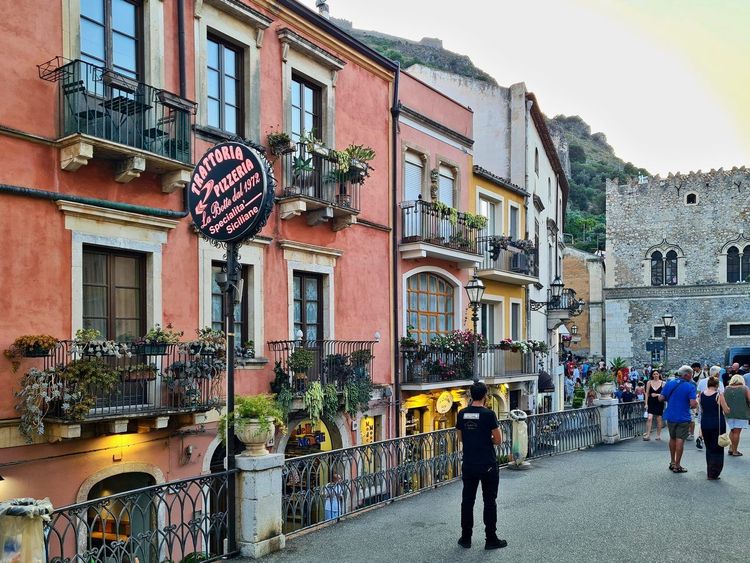
Where to eat in the old town of Agrigento is no great challenge: Via Atenea and its side streets concentrate trattorias and wine bars within a radius of just a few hundred metres. On the coast, in San Leone, seafood tables take over in the evenings.
Try the pasta con le sarde (pasta with sardines, wild fennel, raisins and pine nuts), the signature dish of Sicilian cuisine, or couscous di pesce, a legacy of the Arab presence and the proximity to Mazara del Vallo. Arancini — fried rice balls stuffed with meat or cheese — can be eaten standing up in any rosticceria for just a few euros, as can the sfincione, the local thick-based pizza.
For dessert, it is hard to beat the convent pastries, fresh cannoli and cassata aside: the best addresses on Via Atenea still work the ricotta on the day, a detail that makes all the difference to the final flavour. On the wine front, the province produces grillo whites and nero d'avola reds that trattorias often serve by the carafe at prices that bear no relation to what you would pay back home.
15. Visiting Agrigento in 1 Day or More: Itinerary and Budget
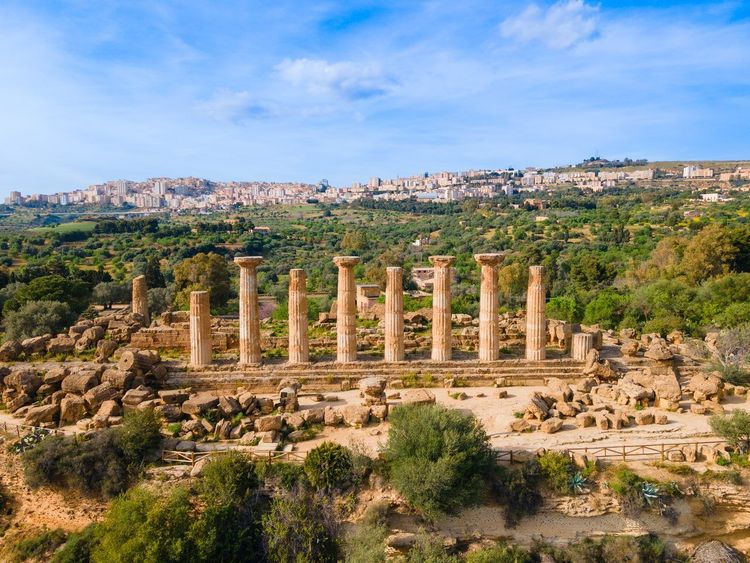
How much time do you need to visit Agrigento? One day covers the essentials: Valley of the Temples in the morning, Scala dei Turchi in the late afternoon. But two to three days allow you to add the old town, the archaeological museum, Sciacca and Heraclea Minoa without rushing at any point.
Condensed one-day itinerary: arrive at the archaeological park as soon as it opens (8:30 am) to enjoy the morning cool and avoid the groups; allow 2.5 to 3 hours to walk the temples and, if time permits, the Kolymbethra garden right next door. Have a quick lunch in Villaggio Mosè or the city centre, then head to the Realmonte coast in the late afternoon (5–6 pm) to catch the fading light and calmer water than at midday. This sequence works well by car and significantly less well by public transport, where connections add time to every leg.
2–3 day itinerary: day 1 devoted to the Valley of the Temples, the Pietro Griffo Museum and the old town of Agrigento; day 2 to the Scala dei Turchi, Zingarello and an excursion to Sciacca; day 3, optionally, to Heraclea Minoa, the Pirandello house and a morning on the beach before heading back towards Palermo or Catania.
Saving money while visiting Agrigento and Sicily comes down to a few simple habits: booking Valley of the Temples tickets online avoids the queue; the combined temples-and-Kolymbethra ticket works out cheaper than two separate tickets; and the low season (November to March, outside school holidays) cuts both accommodation rates and crowds on the sites. Sicily's regional museums and archaeological parks also offer free or reduced admission on specific occasions, notably for under-18s and during certain special opening days — worth checking on the official websites before you leave, as the policy changes every year.
FAQ
What are the absolute must-see sites in Agrigento?
The Valley of the Temples, particularly the Temple of Concordia, is the top priority. Round it out with the Scala dei Turchi for the coastline, the Pietro Griffo Archaeological Museum for historical context, and the old town for the San Gerlando Cathedral and the San Nicola church. With more time, add Sciacca and Heraclea Minoa.
Is Agrigento Worth Visiting?
Absolutely: the Valley of the Temples ranks among the best-preserved ensembles of Greek temples in the world, and its combination with coastal landscapes like the Scala dei Turchi is rarely matched elsewhere in the Mediterranean. The modern city, more modest architecturally, is worth exploring as a complement rather than a primary destination.
How Much Time Do You Need to Visit Agrigento?
One day is enough to cover the essentials, temples and coastline included. Allow two to three days to add the old town, the archaeological museum, the Kolymbethra, Sciacca and Heraclea Minoa at a relaxed pace, especially if you want to enjoy a proper swim.
Is the City of Agrigento Worth Visiting Beyond the Valley of the Temples?
Yes, if you focus on the right spots: the San Gerlando Cathedral, the San Nicola church, Santa Maria dei Greci and the art street justify half a day. Some alleyways look run-down, but the area is generally safe during the day and offers beautiful views of the Valley from the hilltop.
Should You Book Tickets for the Valley of the Temples in Advance?
Strongly recommended during high season, from June to September, when online slots fill up several days ahead. Off-season, on-site ticket counters are usually sufficient, but booking online remains faster and saves you from waiting in the sun with no shade.
Is a Guided Tour Necessary for the Valley of the Temples?
It is not essential to enjoy the site, but a guided tour or an audio guide app provides valuable historical context for ruins that are sparsely signed on the ground. For a first visit, it is especially helpful for distinguishing the various temples and understanding their respective construction timelines.
Is the Scala dei Turchi Accessible in 2026?
The cliff itself has been subject to access restrictions since 2020 due to erosion, with local orders that change from season to season. Check the current situation with the tourist office or your accommodation before heading out; the nearby beaches of Realmonte offer the best view of the white terraces regardless.
Agrigento packs into a small territory two faces of Sicily that rarely meet with such intensity elsewhere: the Doric rigour of the Greek temples and the mineral sensuality of a coastline carved from white chalk. Whether you have just one day or a long weekend, the essentials fit into a simple sequence — temples in the morning, coastline in the late afternoon — with the old town and its surroundings as a natural extension for those who want to explore the city more deeply.
At Ryo, we continue to explore Mediterranean destinations where ancient history feels as alive as it does in Agrigento. While a dedicated route for the southern coast is in the works, the Ryo audio tour of Palermo is the perfect complement for the northern side of the island, and this guide gives you everything you need to plan full days between the Valley of the Temples, the Scala dei Turchi and lesser-known gems like Heraclea Minoa or the Santo Spirito monastery with its ruota pastries.