© Shutterstock
 Votre guide Ryo
Activities in Marrakech and Surroundings: The Complete 2026 Guide
Marrakech doesn't wait for its visitors — it pulls them in. From the moment you leave Menara Airport, the air thick with cumin and roses tells you that activities in Marrakech and its surroundings are not to be visited: they are to be lived. And that is precisely what you should do. The Ryo audio-guided tour of Marrakech accompanies you through the medina without taking away the pleasure of discovery.
Activities in Marrakech and its surroundings cover a dizzying spectrum: from the bustling Jemaa el-Fna Square at the silent dawn of Toubkal (4,167 metres, the highest point in North Africa), through souks that have supplied the world with leather since the 11th century, to a cobalt garden designed by a French painter who became a legend. This guide covers fourteen stops in the city and five excursions in the region, from the Ouzoud Waterfalls 160 kilometres away to the Unesco-listed ramparts of Aït-Benhaddou. You will also find where to eat at every price point, where to sleep according to your travel style, and when to go to avoid the 45 °C of August. In the city itself, our audio walking tour links Jemaa el-Fna to the souks of the medina.
Jemaa el-Fna Square, the Burning Heart of the Medina
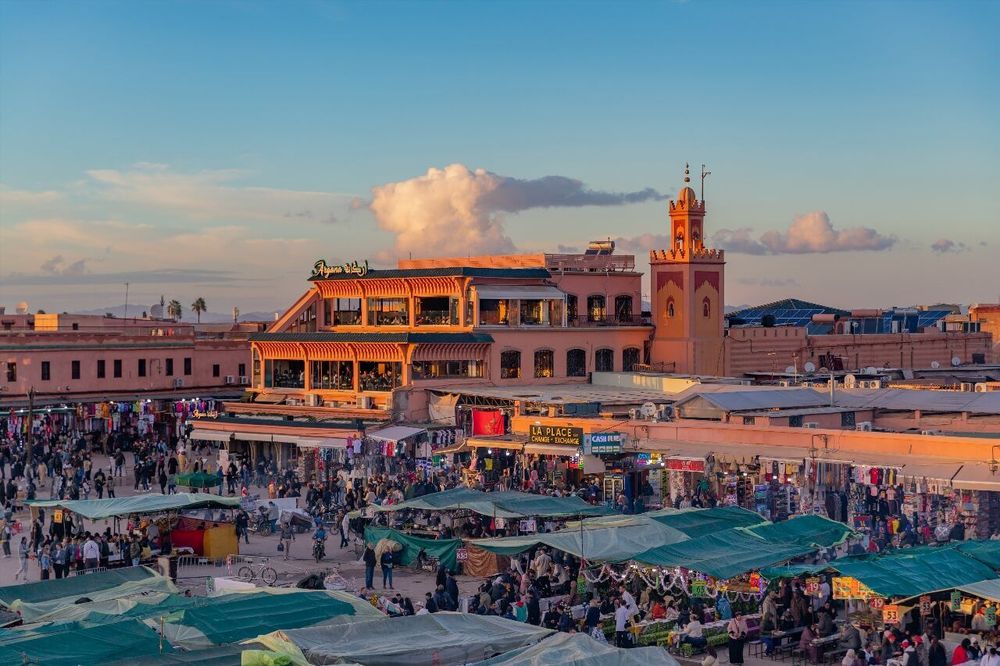
There are few places in the world where a single space transforms so radically within twelve hours. In the morning, Jemaa el-Fna Square is almost calm: a few carts of freshly squeezed oranges, waiting taxis, pigeons squabbling over msemen crumbs. By 11 am, the first snake charmers have set their cobras on jute mats. By 6 pm, when the muezzin of the Koutoubia begins his call to prayer, the square turns to organised chaos: a hundred food stalls, fifty storytellers, twenty groups of Gnawa musicians and a crowd of ten thousand people mingling in a blue haze of burning embers.
This square has existed in its current form since the 11th century, under the rule of the Almoravids who founded the city. Unesco inscribed it in 2001 on the Intangible Cultural Heritage of Humanity, not for its monuments, but for its living practices. This unusual designation recognises the halaqa — the circle of audience formed around a storyteller or acrobat — as an art form to be preserved in the same way as a cathedral. It is the only public square in the world to hold this distinction.
A few tips to make the most of it without unpleasant surprises: freshly squeezed oranges cost between 4 and 8 dirhams depending on the time of day and your ability to smile. If you photograph the performers (snake charmers, acrobats, musicians), a tip of 5 to 10 dirhams per photo is a respectful minimum. The rooftop terrace restaurants around the square offer a bird's-eye view of the action, but prices are 20 to 30% higher than on the street.
At night, the women cooks — the "mamas of the djemaa" — prepare tagines, brochettes, snails in spiced broth and slices of sweet pastilla in an atmosphere of neon lights and steam. The stalls, numbered in fluorescent digits, allow you to identify your stops before sitting down. Take time to walk the whole circuit before choosing: the best ones are often those where the servers don't accost you from ten metres away.
The Medina and the Souks: A Labyrinth of the Senses
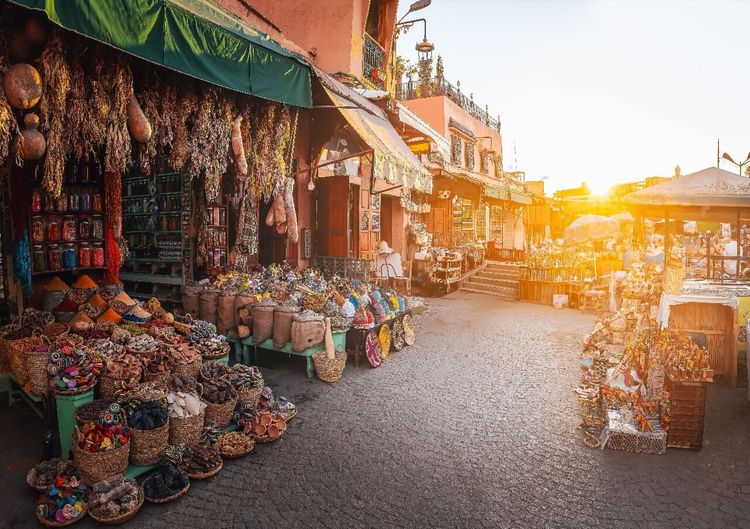
The medina of Marrakech, a Unesco World Heritage Site since 1985, covers 600 hectares and is home to more than 200,000 permanent residents. It is not an open-air museum: it is a city that works, trades and lives, in which the tourist is simply one guest among many.
The souks have been organised by trade guild since the Middle Ages, a tradition that has never truly disappeared. The dyers' souk (Souk Semmarine, 40000 Marrakech, rated 4.1/5 on Google with 664 reviews) displays its skeins of wool in saturated hues, from saffron to indigo, hung on lines strung between the houses. The babouche souk lines up thousands of yellow, red and burgundy leather slippers in light filtered through zinc skylights. The ironmongers' souk rings with hammers on tin and copper. And the spice souk, near Rahba Kedima Square, displays its pyramids of ras el-hanout (a blend of twenty-seven spices), turmeric, coriander and dried rose petals.
To navigate without wandering too long, a few useful landmarks: the Souk Semmarine street, a wide covered thoroughfare, leads directly northward from Jemaa el-Fna to the Medersa Ben Youssef in fifteen minutes on foot (if you can resist the shop windows). The alleyways to the right heading east lead to the fondouks, former caravan warehouses converted into workshops. Those to the left lead towards the tanneries and leather goods. But the best compass is still to follow a sound: the bells of a mule loaded with raw hide, a hammer on tin, the voice of a muezzin in an unnamed alley.
Prices are systematically negotiable. The unspoken rule: offer 40 to 50% of the first stated price, and settle somewhere around 60 to 70%. Never show excessive enthusiasm for an item before negotiating, as merchants read body language very well. If a stranger spontaneously offers to guide you through the souks, be aware that they earn a commission of 20 to 40% on your purchases in the shops they take you to.
A walking circuit through the souks can easily take 3 to 4 hours if you let yourself drift. Bring water, notes of 20 and 50 dirhams in small denominations, and flat-soled shoes: the alleyways are paved with round cobblestones on which high heels are a mistake you will only make once. The most pleasant hours are early morning (8–10 am) and late afternoon (4–6 pm), when the raking light gilds the ochre facades and the heat is more bearable.
The Koutoubia Mosque, the Minaret of an Entire Skyline
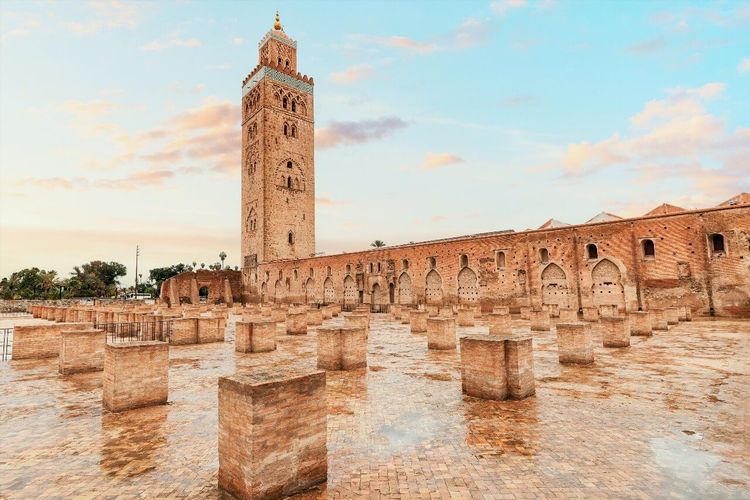
The Koutoubia Mosque (Avenue Mohammed V, 40000 Marrakech, rated 4.5/5 on Google with 18,265 reviews) is the most visible monument in Marrakech: its 77-metre minaret in pink ochre sandstone has dominated the skyline since the late 12th century. It served as a direct model for the Giralda in Seville and the Hassan Tower in Rabat — the three great Almohad minarets of the western Maghreb, built by the same architects for the same imperial power, with nearly identical proportions.
The mosque is reserved for practising Muslims. Its exterior gardens, however, are open to all and offer one of the finest views of the minaret, especially at sunset when the stone turns amber. The street running south alongside the mosque connects to Jemaa el-Fna in five minutes on foot: it is the natural route back from the medina in the evening.
Medersa Ben Youssef, the Beauty of Quranic Learning
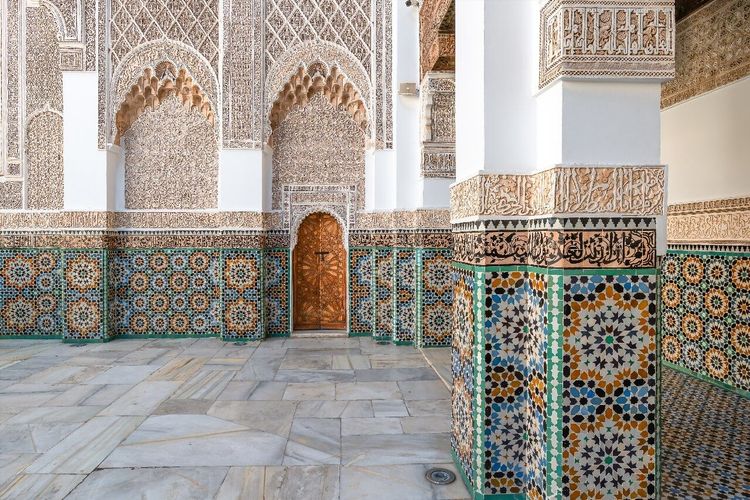
Founded in the 14th century and extensively rebuilt under the Saadian sultan Moulay Abdallah in 1565, Medersa Ben Youssef is the largest Quranic school in the medieval Maghreb. It once housed up to 900 students in its 130 rooms: young men who came from across the Moroccan empire to study theology, mathematics, astronomy and Islamic law, sometimes without leaving the walls of the medina for years.
The visit begins in the large inner courtyard, around a green marble basin where students performed their ablutions. The walls are decorated in the Hispano-Moorish tradition: geometric zelliges at the base, stucco carved with calligraphy in the middle, and panels of cedar carved with floral arabesques at the top. Each decorative register corresponds to a symbolic level: earth, thought, sky. The geometric patterns are calculated on mathematical grids of remarkable precision, with some designs repeating their symmetries infinitely, like fractals before their time.
Head up to the first-floor galleries to access the small student rooms overlooking the courtyard: 4 square metres, a carved wooden window, an alcove for books. It is hard not to imagine the generations of men who spent their best years here memorising texts by candlelight. Entrance fee: 50 dirhams (approximately €4.70). Open from 9 am to 7 pm. Avoid the lunch hour (noon–2 pm) when organised groups crowd the entrance corridor.
Jardin Majorelle: Cobalt Blue, Cacti and Relative Silence
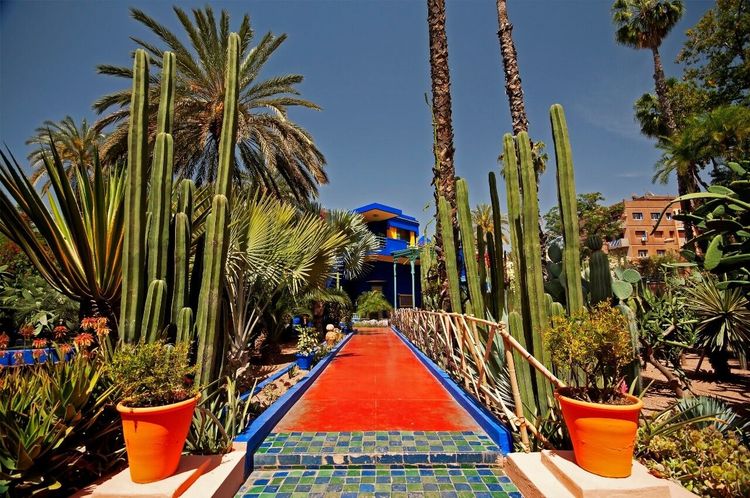
In 1924, French painter Jacques Majorelle purchased four thousand square metres in the palmeraie of Marrakech to create a private botanical garden. He spent forty years building it, collecting plants from five continents, and painting his villa in a cobalt blue so saturated that it would eventually come to be called "Majorelle blue". It is one of the rare cases where an artist has given his name to a colour without having formally invented it.
In 1980, the garden was abandoned and on the verge of being demolished for a hotel project. Yves Saint Laurent and his partner Pierre Bergé bought it, faithfully restored it and opened it to the public. After YSL's death in 2008, his ashes were scattered in the garden according to his wishes. Today, a discreet stele near the entrance is the quietest spot in a site that can become very busy.
The Jardin Majorelle (Rue Yves Saint Laurent, 40000 Marrakech, rated 4.4/5 on Google with 59,942 reviews) welcomes more than one million visitors per year, which creates a real tension with the experience one might expect. Between 10 am and 4 pm in high season (March–April and October–November), the paths can be very crowded. Two simple solutions: arrive at opening time at 8 am for an hour of near-solitude, or come in the last hour before closing (after 5 pm) when organised groups have already left.
The garden is home to more than 300 plant species: Mexican cacti reaching over five metres, architecturally shaped blue fan palms, golden bamboo, lotus in the central basin. Inside the cobalt building is the Berber Museum, which displays Yves Saint Laurent's personal collection of Amazigh jewellery, textiles and pottery — one of the most important collections of Berber art in the world, with pieces dating from the 12th to the 19th century. Admission: 170 dirhams for the garden only, 230 dirhams for the garden and Berber Museum. Allow 1.5 to 2 hours for the visit. Online booking is strongly recommended.
The Bahia Palace: the Magnificence of a Vizier
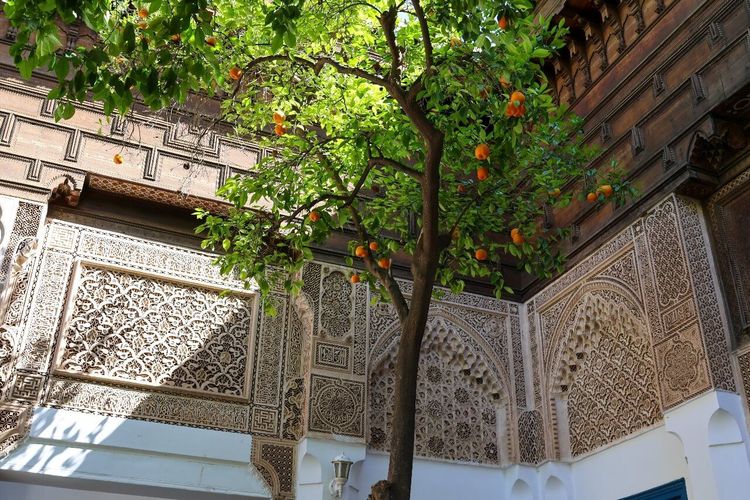
The Bahia Palace ("the Brilliant") was built between 1859 and 1900 by Bou Ahmed, grand vizier to Sultan Moulay Abd al-Aziz. This man of boundless ambition wanted the most beautiful palace in the Cherifian empire, and he very nearly achieved it.
The complex covers 8 hectares and comprises 160 rooms, Moroccan-style gardens with fountains and orange trees, several inner courtyards paved with marble, and apartments reserved for the harem. Bou Ahmed had four wives and twenty-four concubines, each with her own apartments. The painted and carved cedar ceilings are of rare refinement: some panels contain several thousand pieces of wood assembled by hand without a single nail. Zellige mosaics cover the lower walls to a height of two metres, in geometric patterns that change from room to room.
What is striking about the Bahia is the absence of any overall architectural logic: the wings and courtyards seem to have been added as Bou Ahmed's whims dictated, without a master plan. Some corridors lead nowhere. Others open onto hidden intimate gardens. It is disorienting and seductive in equal measure — exactly like the medina that surrounds it. After Bou Ahmed's death in 1900, Sultan Abdelaziz had part of the furnishings dismantled to appropriate them for himself. Entrance fee: 100 dirhams (30 dirhams for children), a ticket that remains worthwhile for 8 hectares of palace and gardens.
The Museums of Marrakech You Shouldn't Miss
Marrakech is home to several museums well worth a visit, often housed in converted palaces and riads that can be as remarkable as their collections.
The Museum of Marrakech (Place Ben Youssef, 40000 Marrakech, rated 4/5 on Google with 2,501 reviews), housed in the 19th-century Mnebhi Palace, displays Islamic and Berber art: Fes ceramics in blue-and-white patterns, High Atlas rugs with complex geometric designs, Almohad coins and framed Quranic calligraphy. The central courtyard of this palace, covered by a monumental contemporary chandelier composed of several hundred light bulbs, is worth the visit on its own. Admission: 50 dirhams.
The Marrakech Photography Museum presents more than 10,000 photographs of Morocco between 1870 and 1960: portraits of Amazigh women, Saharan caravans, souk scenes from the early twentieth century. The panoramic rooftop terrace on the top floor offers one of the finest views over the medina's rooftops, with minarets rising from the terraces. Admission: 50 dirhams.
The Dar Si Saïd Museum (Museum of Moroccan Arts and Crafts) houses a collection of carved woodwork, ancient weapons and textiles in a magnificent 19th-century palace. Part of it has been under renovation since 2024: check opening hours before your visit. The Marrakech Museum and the Maison de la Photographie are among the 22 stops of our audio-guided route through the medina.
The Marrakech Palmeraie
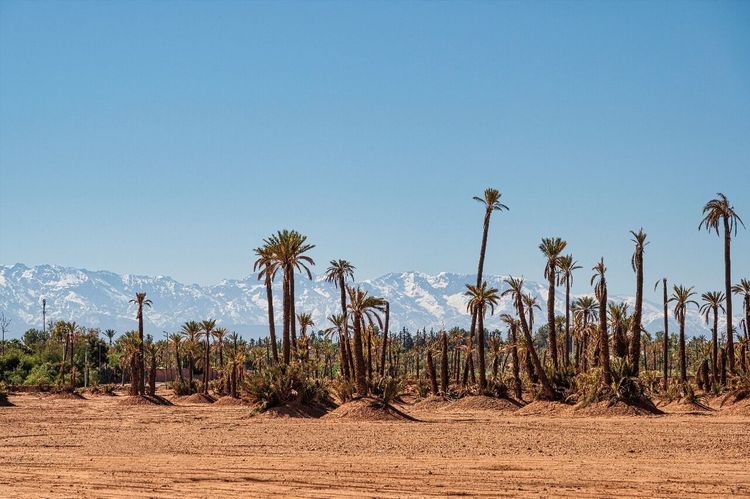
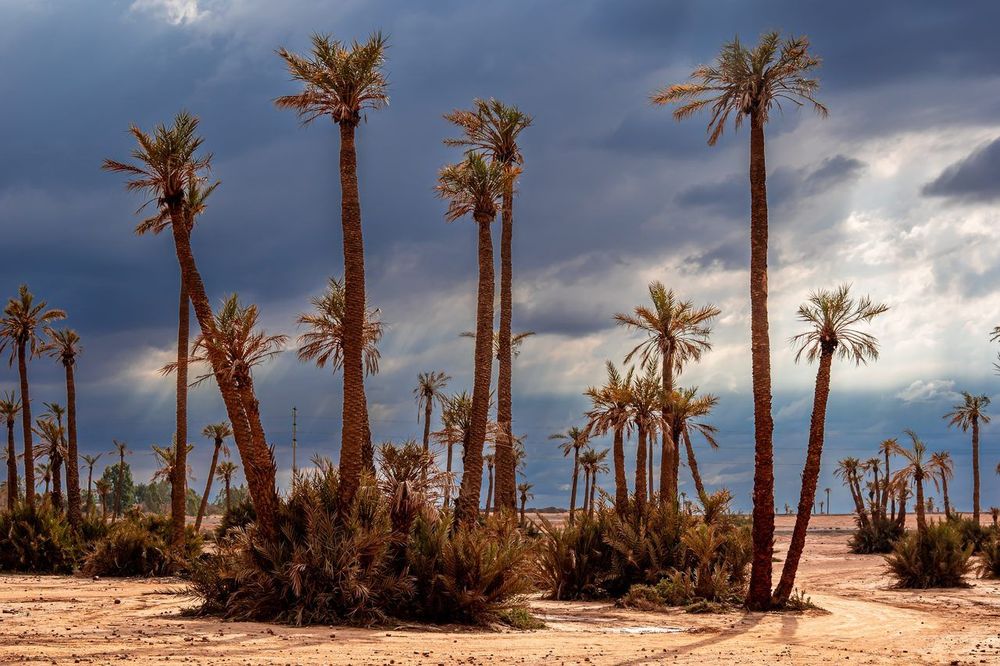
Just 7 kilometres north of the medina, the Marrakech palmeraie (Circuit de la Palmeraie, 40000 Marrakech, rated 4.5/5 on Google with 175 reviews) stretches across 13,000 hectares and contains between 100,000 and 150,000 date palms according to various estimates. Legend has it that it was born from the date stones spat out by Almoravid soldiers arriving from the Sahara in the 11th century — a charming story that botanists can neither confirm nor deny.
The palmeraie is now home to Marrakech's most exclusive riads and hotels. Even without staying there, a camel ride or a horse-drawn carriage through the shaded lanes is an experience in itself: the noise of the city disappears almost instantly as soon as you enter beneath the palm canopy.
For a more comprehensive visit and practical advice on the best activities in this part of the city, our Ryo article on the Marrakech palmeraie details the options according to your budget and available time.
The Gueliz District, the New Town
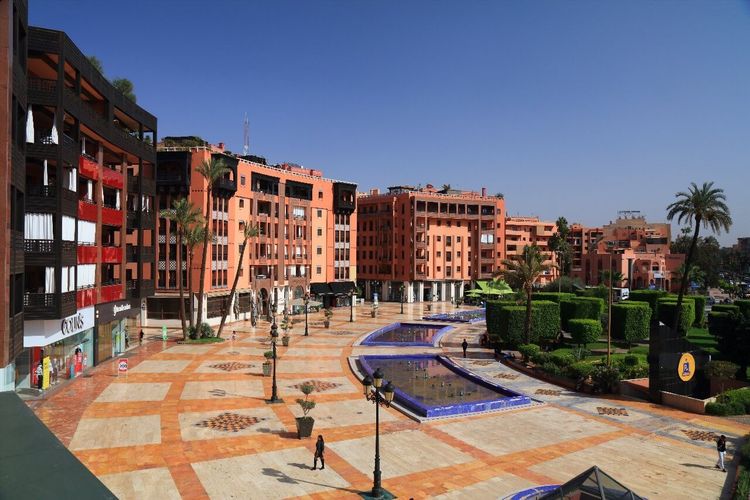
The new town of Gueliz contrasts sharply with the medina: wide French-style avenues, contemporary art galleries, Wi-Fi-connected café terraces, boutiques by Moroccan designers. It was laid out by the French Protectorate from 1912, deliberately set apart from the medina's ramparts so as not to alter its historic fabric.
Gueliz deserves half a day, especially if you are looking for a change of pace. Avenue Mohammed V (Avenue Mohammed V, 40000 Marrakech Gueliz) concentrates cafés, restaurants and Moroccan and international brands. Place du 16-Novembre is the lively heart of the district, with terraces open until midnight. Galerie 127, specialising in African photography, showcases a dynamic contemporary scene that few passing visitors know about. And some of the city's best restaurants are often found in this district, at prices 20 to 30% lower than in the tourist medina.
Hammam and Wellness: Blending into the City
The hammam is a social institution in Marrakech, not a hotel spa. In neighbourhood establishments (from 15 dirhams), you share the steam rooms with locals, in an atmosphere of conversation and black soap. In tourist hammams (150 to 400 dirhams), the ritual is more structured: black beldi soap with olive oil, a kessa exfoliation mitt, ghassoul for the hair, argan oil massage.
The Hammam El Bacha (20 Rue Fatima Zohra, 40000 Marrakech, rated 5/5 on Google with 1 review), founded in 1917 near Medersa Ben Youssef, is the most famous in the medina. Its domed rooms pierced with coloured glass stars and its turquoise mosaics make it an architectural monument in its own right. It is still frequented by local residents, which preserves an authenticity that purely tourist hammams have lost. From 30 dirhams for residents, 100 dirhams for tourists including a full scrub.
The High Atlas Mountains: Hiking and the Toubkal Summit
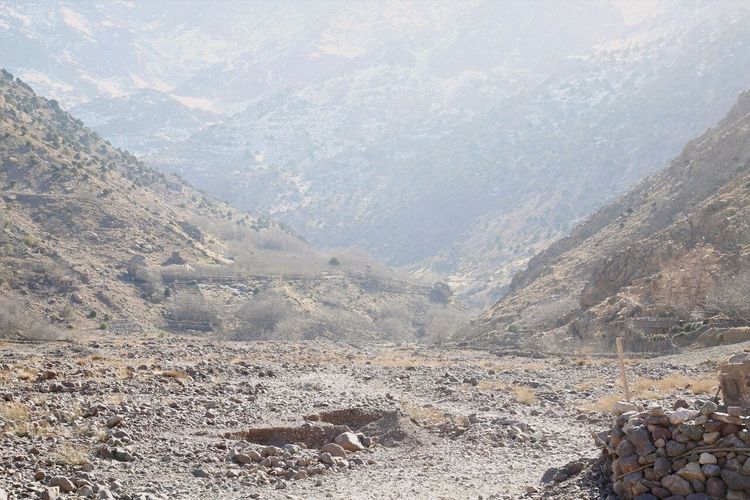
Just 60 kilometres south of Marrakech, the first ridges of the High Atlas exceed 3,000 metres. Mount Toubkal, at 4,167 metres, is the highest point in North Africa. It is not unusual to encounter at the refuge alpinists from around the world, alongside weekend Moroccan hikers and Berber guides who have been climbing there since childhood.
The ascent takes two days from the village of Imlil (Imlil, Province Al Haouz, Morocco, rated 4.7/5 on Google with 8K reviews), reachable from Marrakech in 1.5 hours by shared taxi or private taxi. Day one: ascent to the Toubkal refuge (3,207 metres) from Imlil, 4 to 5 hours of walking through a valley of junipers and oleanders. Day two: departure before dawn from the refuge to reach the summit (3 to 4 hours round trip), then descent to Imlil in the afternoon. The ascent requires no technical equipment between June and September, but trekking boots, thermal layers and a local guide are strongly recommended: temperatures at the summit drop to between 0 °C and -10 °C even in summer.
If you do not wish to go to the summit, a simple hike through the Imlil valley is well worth the trip. The Berber villages around Imlil, such as Aroumd at 1,900 metres or Sidi Chamharouch with its marabout shrine at 2,310 metres, preserve a surprisingly intact mountain way of life. The terraced cultivated fields, mules loaded with hay, pink pisé houses clinging to the slopes: you are less than two hours from Jemaa el-Fna, yet in another century entirely.
Organised day excursions from Marrakech (250 to 400 dirhams all inclusive) allow you to reach Imlil, hike for 3 to 4 hours and be back in time for dinner. For a more immersive experience, spend a night in a gîte in Imlil (200 to 400 dirhams half board) and set off the following morning in the golden light of the High Atlas on the snow-capped ridges.
The Ourika Valley: Freshness and Amazigh Villages
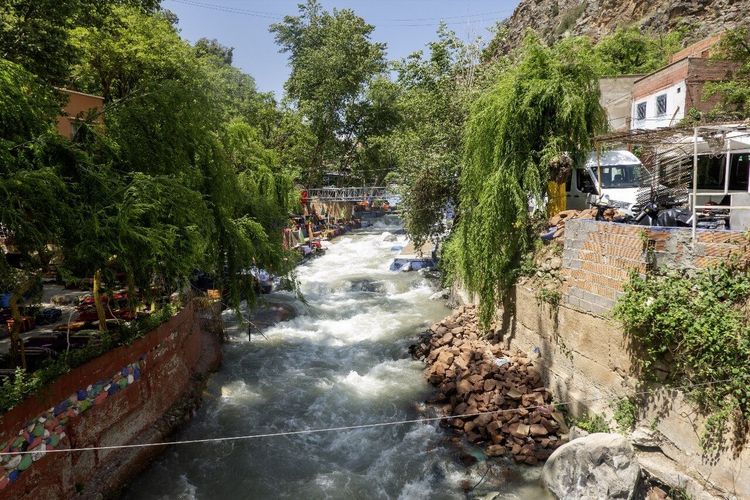
The Ourika Valley (Route d'Ourika, Province Al Haouz, Morocco, rated 4.5/5 on Google with 1,241 reviews) is the most accessible excursion from Marrakech: 30 kilometres to the south, 45 minutes by the R212 road. The Ourika River descends from the High Atlas through a lush 60-kilometre corridor, dotted with Berber villages, terraced gardens and cafés that set their tables right in the riverbed.
The usual tourist endpoint is Setti Fatma, a village at 1,500 metres of altitude where a hike to seven successive waterfalls begins. The first waterfall is reachable in 30 minutes on foot from the car park. The ones beyond require climbing on terrain that can be slippery after spring or autumn rains. Swimming is possible in the natural pools in July and August.
The Ourika road passes through many villages where Amazigh women's cooperatives sell their produce: geometric-patterned textiles, argan oil, mountain honey. The Tnin-de-l'Ourika market, held on Monday mornings, is one of the most authentic rural markets in the region and one of the least visited by organised tours. Arrive before 9 am to see it in full local vitality.
By shared taxi from Marrakech (departing from Bab Rob): 15 dirhams. By private taxi: 150 to 250 dirhams return including waiting time. There is no regular transport after 6 pm, so plan your return in advance, especially in winter when it gets dark as early as 5:30 pm.
The Ouzoud Waterfalls, the Region's Greatest Surprise
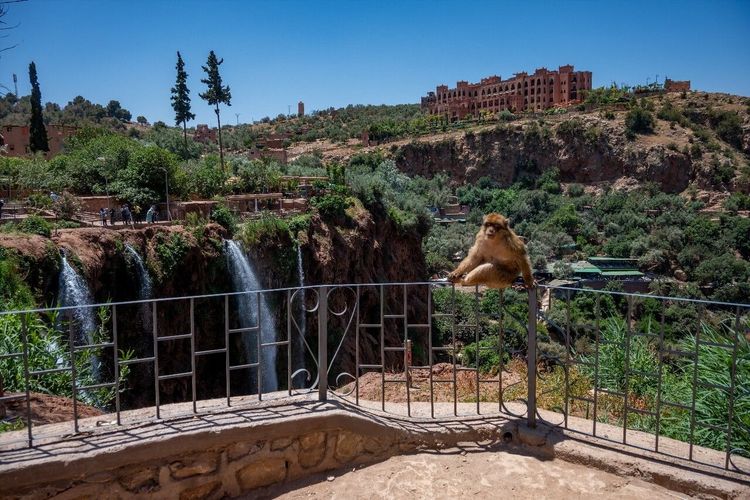
Some 160 kilometres north-east of Marrakech, about three hours by road, the Ouzoud Waterfalls (Route des Cascades, Province Azilal, Morocco, rated 4.6/5 on Google with 19,599 reviews) are the highest in Morocco: 110 metres of direct drop into an emerald-green travertine pool, framed by centuries-old olive trees and ruined water mills. The contrast between the violence of the main fall and the gentleness of the banks makes it one of the most unexpected images in the country.
Barbary macaques live freely around the waterfalls. They are accustomed to visitors and may approach very closely. Do not feed them: it disrupts their natural behaviour and can trigger aggressive reactions. The descent to the foot of the waterfalls takes 30 to 45 minutes via steps carved into the rock. Boats ferry visitors from the banks to get close to the base of the main fall (around 20 dirhams). In July and August, the pool is teeming with local swimmers who come from across the region — a festive atmosphere very far removed from the wild tranquillity one might imagine.
Agencies in Marrakech offer day tours at 250–350 dirhams including transport. A private taxi (600 to 800 dirhams return) offers more flexibility over timings, particularly for arriving early in the morning before the groups.
Essaouira: the Wind City on the Atlantic
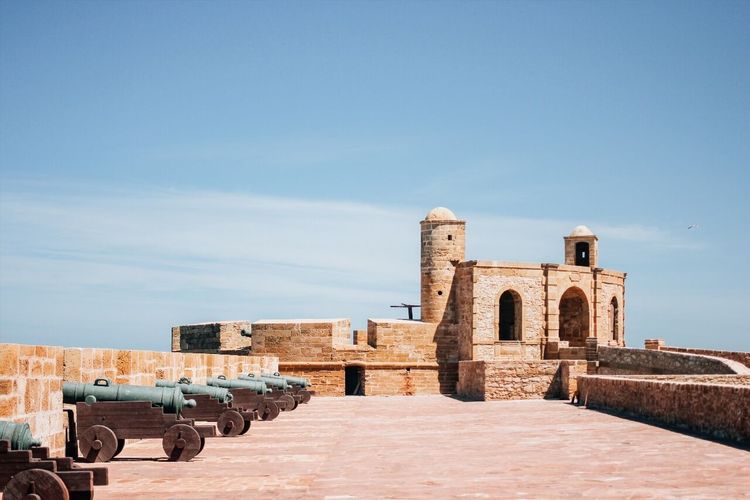
Some 175 kilometres west of Marrakech on the Atlantic coast, Essaouira (Médina d'Essaouira, 44000 Essaouira, rated 4.6/5 on Google with 30K reviews) is the perfect antidote to the hustle of the Red City. Its 18th-century Portuguese ramparts overlook an ocean of a striking Nordic blue, its white-and-blue alleyways stay cool even in July, and a constant wind keeps the flags snapping in every season.
Essaouira has been a Unesco World Heritage Site since 2001 for its ramparts and fortifications designed by the French engineer Théodore Cornut. The Skala de la Ville, the great cannon battery on the northern ramparts, offers an exceptional panorama over the ocean and the Purpuraires Islands, where Juba II had Roman imperial dye prepared. Below, the fishing port lines up its blue trawlers and stalls of fresh sardines. The port's fish restaurants (15 to 50 dirhams per dish) rank among the best tables in Morocco for absolute freshness.
The city is also a craft capital for thuya wood, a local cypress with orange and brown veins that Moroccan carpenters have been working for centuries. The workshops on the Rue de la Skala allow you to watch marquetry, trays and carved frames being made in real time. Prices are generally lower than in Marrakech for comparable craftsmanship.
The Essaouira beach stretches for 5 kilometres southward. The constant wind makes it one of the most renowned kitesurfing and windsurfing spots in West Africa, with the Windsurfing World Championships having been held there on several occasions. If you are not a windsurfer, the beach is excellent for walking: deserted beyond 2 kilometres from the centre, with dunes behind and the Atlantic ahead. Essaouira can be done as a day trip (CTM bus: 100 dirhams, 3 hours by road). But spending a night there changes the experience: the city in the evening, once the tourist coaches have left, has a rare serenity.
Aït-Benhaddou and Ouarzazate: Between Kasbahs and World Cinema
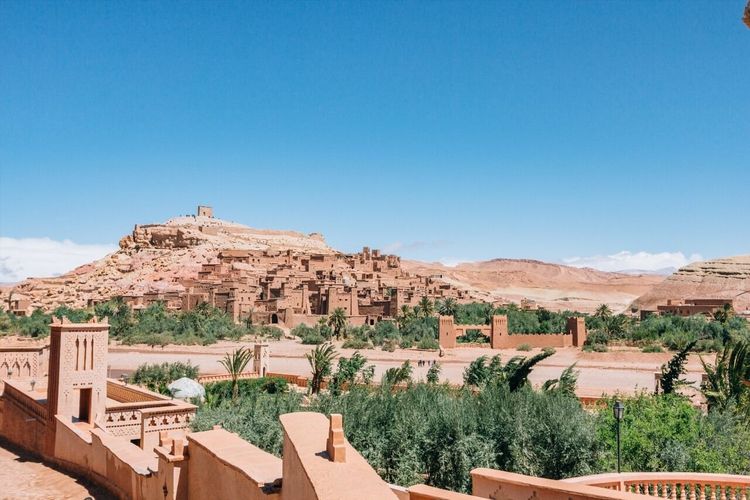
Some 200 kilometres south-east of Marrakech, three hours by road via the N9 which crosses the Tizi n'Tichka pass at 2,260 metres of altitude, the ksar Aït-Benhaddou (Route N9, Province de Ouarzazate, Morocco, rated 4.8/5 on Google with 45K reviews) is arguably the most photographed pisé village in the world. Its reddish-brown earthen towers stacked on a rocky hill beside the Ounila River form an almost hallucinatory image, halfway between a medieval fortress and a science-fiction city.
Aït-Benhaddou has been a Unesco World Heritage Site since 1987. It has served as a backdrop in dozens of productions: Gladiator (2000), Game of Thrones (the city of Yunkai), Lawrence of Arabia (1962), Babel (2006). The village has been inhabited since at least the 11th century by Berber families who have their homes and workshops there. Crossing the Ounila River by ford, or on stepping stones depending on the season, is an integral part of the experience.
Just 10 kilometres away, Ouarzazate (pronounced "Warzazat") is home to the Atlas Corporation Studios, the largest open-air studios in Africa. A guided tour (50 to 100 dirhams) reveals the permanent sets of around a hundred productions, including reconstructions of Egyptian temples and ancient cities of unsettling realism. Logistics: the Tichka pass by hire car is a fine drive (grandiose scenery, villages clinging to the slopes), but it can be closed by snow between November and March. A private taxi from Marrakech for the day costs 800–1,200 dirhams. To visit Ouarzazate without rushing, an overnight stay is recommended.
Where to Eat in Marrakech: From the Djemaa to the Tables of Gueliz
Eating in Marrakech is an activity in its own right. The price range is staggering: a sardine tagine for 25 dirhams in an alleyway eatery, or a gourmet dinner for 800 dirhams in a riad with an inner courtyard. Both can be memorable experiences.
In the medina, the Mouassine neighbourhood offers the best value for money. Restaurants on secondary streets (Rue des Banques, Rue Mouassine) serve vegetable tagines at 40–60 dirhams and Friday couscous at 50–80 dirhams. The Café des Épices, on Place Rahba Kedima, is a convivial terrace above the spice souk stalls: tagines and sandwiches, views over the rooftops, relaxed atmosphere for 50 to 80 dirhams.
The café Chez Chegrouni (Place Jemaa el-Fna, 40000 Marrakech, rated 3.8/5 on Google with 1,045 reviews), on Jemaa el-Fna Square, has been an institution for twenty years: a terrace with a direct view over the square, tagines at 50 dirhams, fast service for tight budgets. Arrive before 12:30 pm or after 2 pm to get a table without waiting.
In Gueliz, chef-led addresses offer contemporary Moroccan cuisine at 200–400 dirhams per person. The Table de la Mamounia (at the La Mamounia hotel) is one of the great tables of Morocco: expect 600 to 1,000 dirhams per person, with reservations required several weeks in advance.
Street food remains the best introduction to Moroccan cuisine: charcoal-grilled kefta brochettes (15 dirhams), msemen with butter and honey (5 dirhams), bissara (cumin-spiced broad bean soup, 10 dirhams), harira (spiced lentil and tomato soup, 10 dirhams), snails in spiced broth (10 dirhams a bowl). All of this can be found at the stalls of Jemaa el-Fna and in the streets of the medina from 5 pm onwards. Those same medina streets, Jemaa el-Fna included, are on our audio-guided tour of the city.
Where to Stay in Marrakech: Riads, Hotels and the Palmeraie
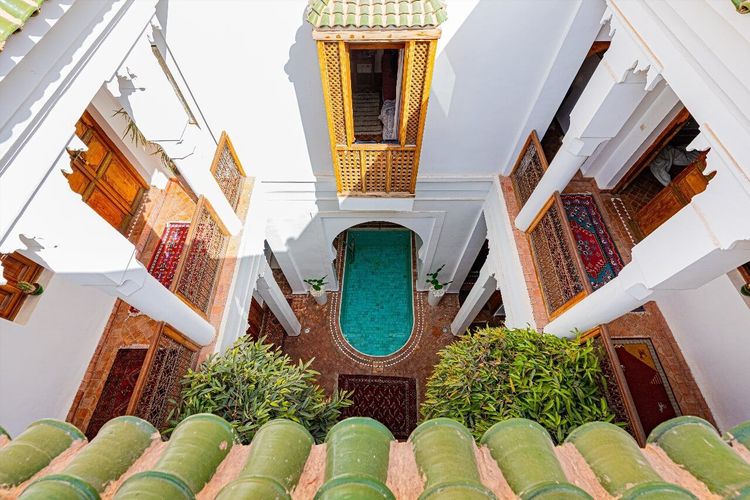
The accommodation question often comes down to a geographic choice: the medina (authenticity, noise, the charm of the alleyways) or Gueliz and the palmeraie (standardised comfort, quiet, swimming pool).
The medina riads are traditional houses with inner courtyards converted into guesthouses. They often have small rooftop pool terraces, and sometimes Moroccan dinner service. Budget: from 400 dirhams per night for a simple riad to 3,000 dirhams and above for prestigious addresses such as the Riad Kniza (34 Derb l'Hotel Bahia, 40000 Marrakech, rated 4.8/5 on Google with 416 reviews) or the Riad El Fenn. The trade-off: the access alleyways are often too narrow for cars, which complicates late arrivals with large luggage.
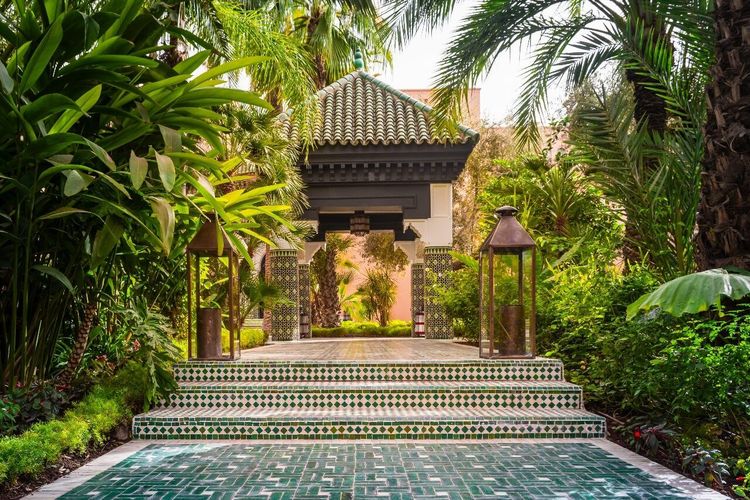
Gueliz hotels offer more standardised comfort and more predictable rates, with parking and easy taxi access. For the palmeraie, luxury lodges (Amanjena, Selman Marrakech) target an upmarket clientele from 5,000 dirhams per night, with large pools, gardens and full spas. Practical tip: book at least two months ahead for March–April and October–November, and three months ahead for the year-end holidays, when prices can triple.
When to Visit Marrakech
Temperatures follow a continental Mediterranean cycle with marked extremes. In July and August, thermometers regularly exceed 40 to 45 °C: outdoor activities between 11 am and 5 pm become difficult, and the vast majority of European tourists have left the city. In December and January, nights drop below 5 °C, and snow is visible on the High Atlas from the medina's rooftops.
The best periods are spring (March to May, 20–28 °C during the day) and autumn (September to November, 18–30 °C). April and October are the most sought-after months: pleasant temperatures, clear skies, and light that flatters the ochre of the ramparts.
If your stay coincides with Ramadan, adapt your rhythm: restaurants closed during the day, nocturnal activity greatly amplified, markets opening after the ftour (breaking of the fast). It is a unique atmosphere that some travellers prefer above all other times of year.
Getting Around Marrakech and the Region
In the medina, everything is done on foot. Small red taxis operate throughout the city with a mandatory meter (base fare: 7 dirhams; medina journeys: 15–30 dirhams depending on distance and time of day). Large white taxis cover intercity routes: Marrakech–Imlil by shared taxi costs 150 dirhams per person, or 400–500 dirhams for the whole taxi.
For excursions, three options: organised bus tours (economical at 150–350 dirhams, but with rigid schedules and large groups), private taxis (flexible, 400–800 dirhams per day depending on the destination), or car hire (from 300 dirhams per day with basic insurance). Car hire is ideal for the Atlas, Essaouira and Aït-Benhaddou. The Tichka pass can be closed by snow between November and March: check weather conditions before setting out.
FAQ
How many days do you need for Marrakech and its surroundings?
3 days are enough for the must-sees of the medina: Jemaa el-Fna, the souks, Medersa Ben Youssef, Jardin Majorelle and the Bahia Palace. 5 to 7 days allow you to add the Ourika Valley, a night in the High Atlas and a trip to Essaouira. 10 days open up the possibility of reaching Aït-Benhaddou, Ouarzazate and perhaps the dunes of Erg Chebbi on the edge of the Sahara.
Is it dangerous to get lost in the medina?
Marrakech's medina is generally safe for tourists. The common risks are spontaneous pseudo-guides (who offer help and then demand payment) and overly persistent sales attempts in the souks. Keep your phone in an inner pocket in crowded areas. The main alleyways remain busy until 10–11 pm: nighttime poses no particular risk on well-frequented routes.
Should you book tourist sites in advance?
The Jardin Majorelle: yes, strongly recommended (45 to 90 minutes of queuing without a booking in high season). Medersa Ben Youssef and the Bahia Palace have manageable queues and don't require advance booking. For popular restaurants in Gueliz during high season, booking the day before is advised.
What budget should you plan for a stay in Marrakech?
Budget (simple riad, street food, shared transport): 250 to 400 dirhams per day (€23 to €37). Comfort (mid-range riad, sit-down restaurants, site entrance fees, one excursion): 800 to 1,500 dirhams per day (€75 to €140). Luxury (palmeraie, spas, gourmet dinners, private tours): 3,000 dirhams and above per day.
How do you exchange money in Marrakech?
€1 ≈ 10.7 dirhams (approximate 2026 rate, check before departure). Currency exchange is only legal at banks and official exchange offices (Menara Airport, BMCE, Attijariwafa, CIH counters). Rates offered on the street are illegal and often unfavourable. Keep your exchange receipts: they are required to convert dirhams back to euros at the airport before departure, an operation capped at your documented purchase amount.
Can you visit Marrakech without a guide?
Yes, and it is often more enjoyable. The major sites are well signposted, navigation apps work in the medina, and the Ryo audio guide for Marrakech lets you explore at your own pace with contextual commentary on the places you pass through. A local guide remains useful for a first foray into the souks or for hikes in the High Atlas, where knowledge of the terrain and Berber languages can genuinely transform the experience.
Marrakech spills beyond its own walls. The city is a base, not a closed destination: the High Atlas is 45 minutes away, the Atlantic three hours, the desert a night's drive. What you will take with you — the smell of cumin in the alleyways at dawn, the light of Tizi n'Tichka on the ridges, the Majorelle blue in an empty corridor — appears in no catalogue. To explore the medina and its neighbourhoods with audio commentary on every place you pass through, download the Ryo audio-guided tour of Marrakech before you leave.
À lire également