© Shutterstock
 Votre guide Ryo
The 6 Most Beautiful Oases to Explore near Marrakech (2026)
Marrakech burns. Not metaphorically — in July, the medina's alleyways reach 42°C in the shade and the crowds at Jemaa el-Fna are running at full tilt by 9 a.m. What few visitors know is that less than three hours' drive away lie spaces where water springs up between the rocks, where monkeys casually bathe beneath 110-metre waterfalls, and where palm groves of 150,000 trees filter a light the city has never known. The most beautiful oases near Marrakech? Forget the postcard image of the Sahara: some are lush valleys carved out by the Atlas, others are centuries-old parks ten minutes from the medina, and others still are the first dunes of the desert, 550 km to the south.
To explore the city itself, the Ryo audio guide to Marrakech takes you through the souks and historic neighbourhoods. For green escapes, here are the six sites worth the detour — or an entire stay.
1. The Marrakech Palm Grove, Home to 150,000 Date Palms
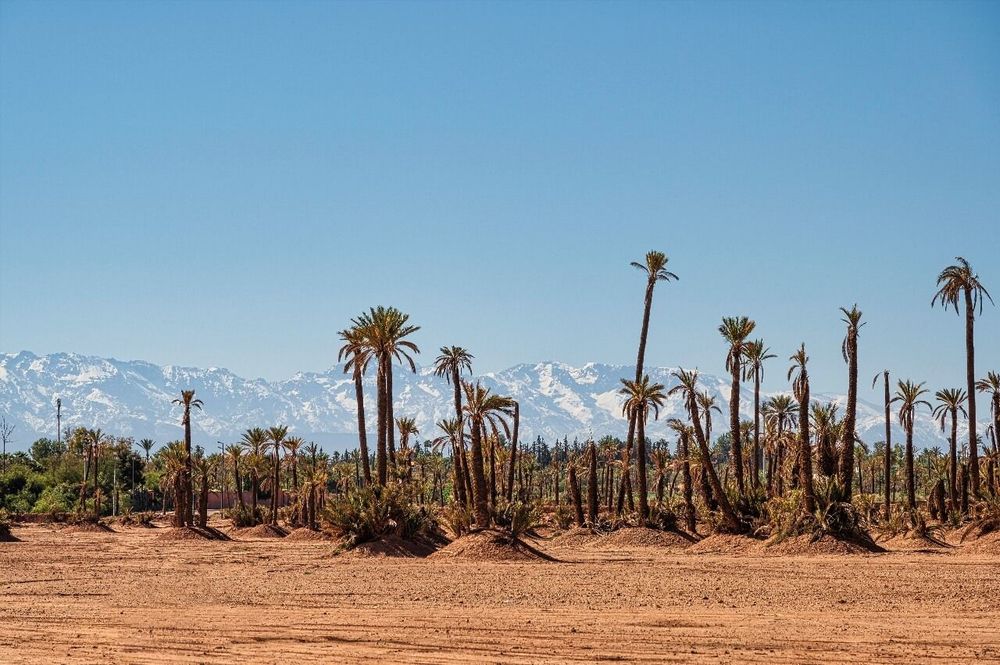
The Marrakech Palm Grove (Route de Fès, 40000 Marrakech, rated 4.1/5 on Google across 104 reviews) is not an oasis in the strict geographical sense: it is a vast palm grove that once counted as many as 150,000 date palms at its peak — around 100,000 today — and encircles the city to the north-east across nearly 15,000 hectares, irrigated since the 11th century by a network of khettaras, underground galleries dug under the Almoravids to capture meltwater from the Atlas. A hydraulic system nearly a thousand years old, much of which has now silted up.
What makes the Palm Grove unique is its duality. On one side, a living agricultural space where families still cultivate dates and orange trees between the trunks. On the other, a prestigious setting: several riads and villas have established themselves over the decades, and camel rides wind along sandy tracks between the palms. The quintessential Marrakech paradox — tradition and modernity coexisting beneath the same canopy.
The best way to enjoy it is an early morning bike ride. Leave the medina around 7 a.m.: the temperature is still cool, the dirt tracks are almost deserted, and the golden light filtering through the palms is worth the early wake-up on its own. Rental agencies operate from the Bab Doukkala gate — allow two hours for a basic circuit or four to reach the most remote areas where the palm grove regains its wild character. By horse-drawn carriage from Jemaa el-Fna, budget 150 to 200 DH (negotiable).
A word of caution: the Palm Grove has lost nearly 50,000 trees since its peak, under the combined pressure of real-estate development, drought, and bayoud, a parasitic fungus that attacks the roots. Visiting it today means photographing an ecosystem in slow transformation. For more detail, the Ryo article on the Marrakech Palm Grove covers the best entry points and activities available by season.
2. The Ourika Valley, a Cool Green Corridor 30 km Away
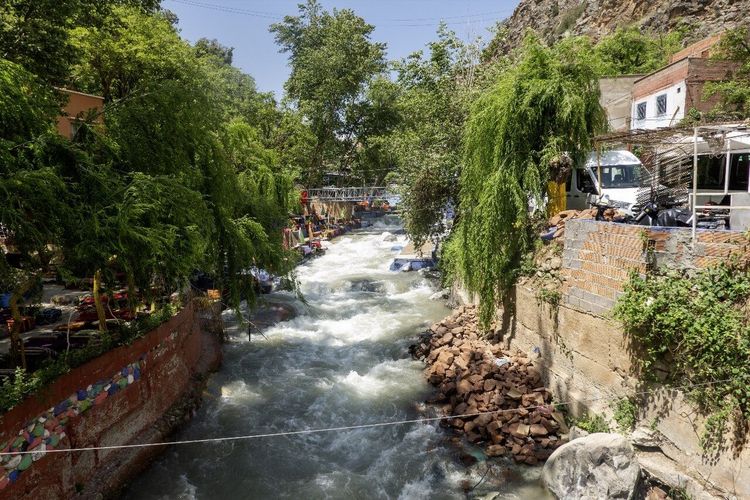
Thirty kilometres south of Marrakech, the road leaves the plain and enters a green corridor carved by the Ourika river. The Ourika Valley (Ourika, Province Al Haouz, Morocco, rated 4.3/5 on Google across 349 reviews) is the most popular nature escape around the city, and rightly so. The vegetation changes abruptly: willows, walnut trees, and terraced crops replace the red dust of the plain, and the air drops by several degrees within just a few kilometres.
The valley stretches for around forty kilometres, dotted with Berber villages clinging to the flanks of the Atlas. The village of Setti Fatma, at its far end, is the natural terminus for most visitors: it nestles at around 1,500 metres above sea level, and a series of seven waterfalls cascade above it, spanning nearly 700 metres of elevation gain up to 2,200 metres. The first, reached after around 30 to 45 minutes' walk along a rocky path, is the most spectacular. The ones that follow reward those who push on to the end.
One crucial point before you go: the valley can be closed between June and September due to flash floods. Storms over the Atlas swell the river within hours, making certain passages impassable. Check weather conditions before planning your outing, and never ford the river if the water level has risen. Caution is not paranoia — incidents occur every summer.
Along the road, several inns offer meals overlooking the river: tagines, herb-grilled chicken, Berber mezze. The terraces suspended above the current are a local institution that Marrakchis themselves frequent on weekends. Shared taxis depart regularly from Bab Rob for 40 to 70 DH per person to Setti Fatma.
3. The Moulay Brahim Valley, the Forgotten Sanctuary
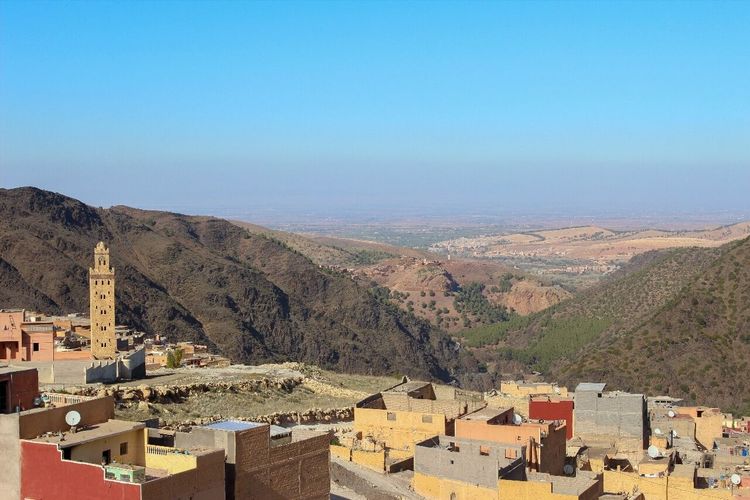
About forty kilometres south-west of Marrakech, the Moulay Brahim Valley (Moulay Brahim, Province Al Haouz, Morocco, rated 4.4/5 on Google across 3,100 reviews) is far less well known than the Ourika — which is precisely its appeal. It takes its name from the local sanctuary of the same name, an important pilgrimage site for people from the region, surrounded by dense vegetation and a narrow gorge through which a stream flows year-round.
The village is worth the visit: ochre-fronted houses stack up on the rocks, threaded by alleyways so narrow that two people can barely pass side by side. On weekends, stalls set up to sell sfenj, doughnuts fried in argan oil, still hot and served with local honey. A treat at 3 or 4 DH each.
The valley's vegetation differs from the Ourika: olive trees dominate here, interspersed with carob trees and wild fig trees. The path running alongside the stream into the heart of the gorge is poorly marked — bring water and shoes with a good grip. The round trip takes between 2h and 3h30 depending on your pace, with rocky sections that require a minimum of care without being technically demanding. The advantage over the Ourika: you can walk the trails for a full hour without crossing another hiker.
To get there, shared taxis from Marrakech (direction Asni) serve Moulay Brahim in around 1 hour, for 50 to 70 DH per person.
4. The Menara Olive Grove, Ten Minutes from the Medina
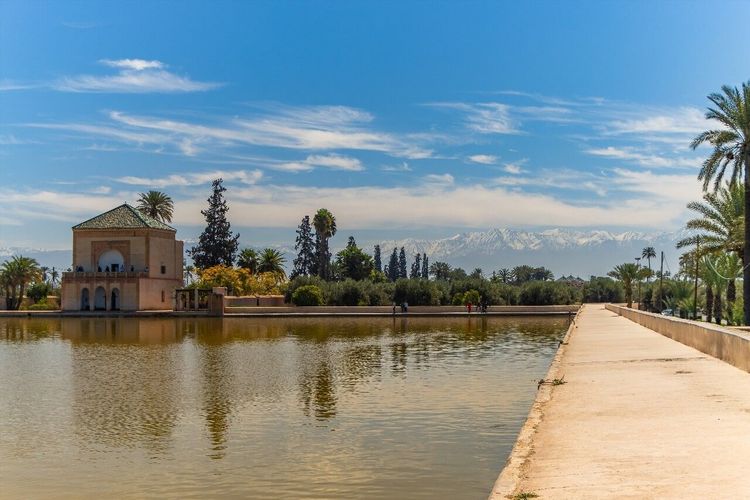
Unlike the other sites in this guide, the Menara olive grove requires no excursion: it sits just 3 km from Jemaa el-Fna, reachable by bike or horse-drawn carriage in around fifteen minutes. It is the most accessible of the beautiful oases near Marrakech, and probably the most underrated.
The garden was created in the 12th century under the Almohads. Its concept is elegant in its simplicity: a basin of nearly 3 hectares (195 metres by 160) fed with water from the Atlas via a network of seguias (irrigation canals), surrounded by an olive grove of 100,000 olive trees across 100 hectares. The Menara Pavilion, a small green-and-white pyramidal-roofed building reflected in the basin, is one of the most reproduced images in Morocco.
What the photos don't show: this is a living, deeply local space. Marrakchis come here in the afternoon to walk in the shade of century-old olive trees, families picnic on the grass, and herds of goats sometimes graze in the garden's more remote corners. Entry is free; the pavilion costs 20 DH.
At sunset, if the weather is clear, the snow-capped Toubkal appears as a backdrop to the basin: one of the most accessible panoramas without a car in Marrakech. Opt for October–November or March–April. In the height of summer, the perimeter of the main basin lacks sufficient shade to be comfortable during the central hours of the day.
5. The Ouzoud Waterfalls, Morocco's Highest Waterfall
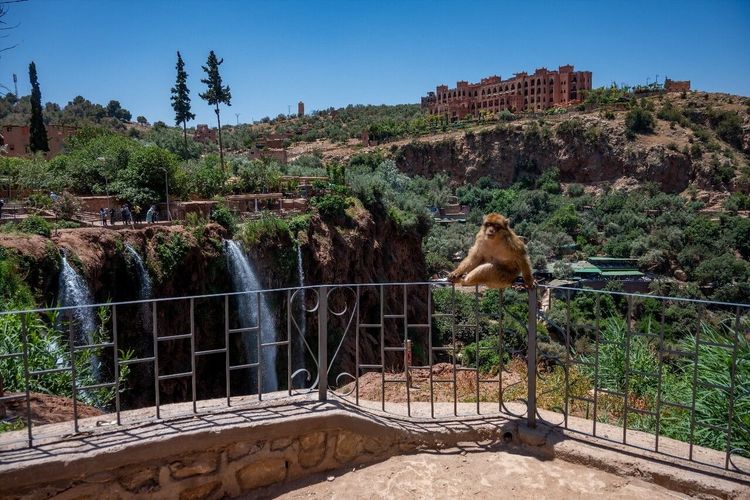
Some 150 km north-east of Marrakech, the Ouzoud Waterfalls (Ouzoud, Province Azilal, Morocco, rated 4.6/5 on Google across 19,604 reviews) form the highest waterfall in Morocco and North Africa: 110 metres of drop across three successive tiers, set amid wild fig and olive trees. This is probably the most spectacularly lush spot reachable in a day from the city.
The scene is striking from the moment you arrive: three main jets fall into a turquoise pool surrounded by a permanent mist that cools the air for dozens of metres around. And then there are the monkeys. Barbary macaques that have come down from the hills bathe nonchalantly in the eddies, indifferent to the visitors photographing them. Around thirty individuals have lived around the site for decades, accustomed to humans but unpredictable. Avoid feeding them: some will not hesitate to rummage through bags.
Allow 2h30 to 3h of travel from Marrakech, depending on the route taken. Organised excursions depart daily from the city for 200 to 350 DH per person, usually departing around 7–8 a.m. By rental car, the road passes through High Atlas scenery that deserves stops along the way.
On site, trails lead down to the foot of the falls and along the river to natural pools that see fewer visitors — perfect for swimming between April and October. Entry to the site is free. Allow at least half a day. One night in one of the small hotels in the village of Ouzoud lets you explore the site early in the morning, before the excursion groups have arrived and when the light on the waterfalls is at its finest. Back in Marrakech, our audio walking tour of the medina makes an easy day of it after the drive.
6. The Tafilalet Palm Grove, at the Gates of the Sahara
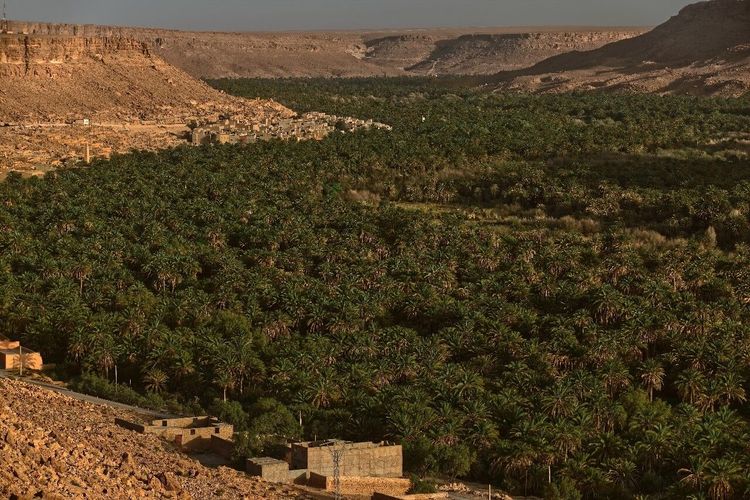
This is the most ambitious oasis in this guide. The Tafilalet palm grove (Erfoud, Province Errachidia, Morocco, rated 4.7/5 on Google across 17 reviews), in the Drâa-Tafilalet region, stretches between Erfoud and Rissani, around 550 km from Marrakech — six to seven hours by road or an overnight bus. This is not a day trip: it is a journey into a different Morocco.
The Tafilalet is one of the country's largest palm groves, with hundreds of thousands of date palms stretching along the Ziz and Ghéris rivers for more than 100 km. This is where trans-Saharan caravans stopped since the Middle Ages. It is also the region of origin of the Alaoui kings, founders of the reigning dynasty. Rissani, a few kilometres from Erfoud, is the birthplace of the royal family: a sanctuary and mausoleum there perpetuate this dynastic memory.
The region is most naturally explored from Merzouga, which gives access to the dunes of Erg Chebbi, those orange dunes that rise to 150 metres and represent the quintessential desert image. Most travellers combine the palm grove with a night bivouacking in the dunes, with a sunrise over the ochre horizon that makes the journey worthwhile on its own.
From Marrakech, the journey is best organised over 3 to 4 days by car, via the Tichka Pass (2,260 m altitude), the Dadès Gorges, and the Valley of Roses. This circuit passes through some of Morocco's most breathtaking landscapes. Before you set off, Ryo's tips on the best riads in Marrakech will help you choose your base before heading south.
How to Plan Your Excursion from Marrakech
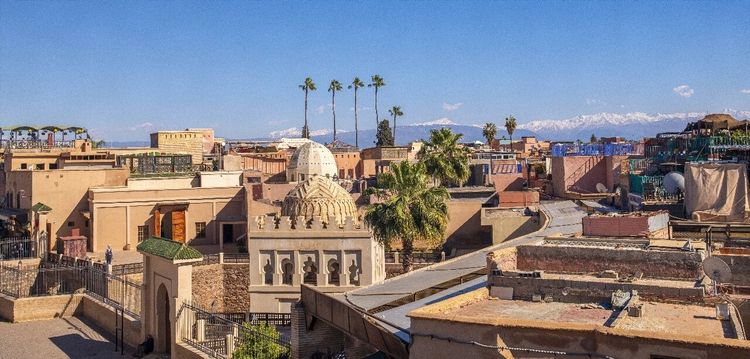
Exploring the most beautiful oases near Marrakech requires a minimum of planning. Here are the practical points to know before you leave.
Transport: for nearby destinations (the Palmeraie, the Menara, the Ourika), shared taxis from Bab Rob or the spice market are the most economical option. For the Ouzoud Waterfalls, organised excursions offer the best convenience-to-price ratio — no driving required, and the local guide included in some packages enriches the visit. For the Tafilalet, a rental car or the overnight CTM bus from the bus station.
Best time: from late September to late November and from March to mid-May. Temperatures range between 22 and 32°C, the vegetation is often at its best after the rains, and the sites are less crowded. Summer is manageable for high-altitude valleys (the Ourika from 1,200 m), much less so for sites on the plain or at the bottom of gorges.
Estimated budget per excursion:
- Palmeraie: 50–200 DH (bike or carriage depending on duration)
- Ourika Valley: 40–70 DH by shared taxi
- Moulay Brahim Valley: 50–70 DH by shared taxi
- Menara: free (20 DH for the pavilion)
- Ouzoud Waterfalls: 200–350 DH on an organised excursion
- Tafilalet: independent travel budget, minimum 3–4 days
Water and preparation: always bring extra bottles. Popular sites have local restaurants, but hiking trails sometimes have no infrastructure for several hours of walking. For the Ouzoud Waterfalls and the Moulay Brahim Valley, shoes with a good grip are essential — wet rocks can be slippery.
Which Oasis to Choose Based on Your Profile?
Not enough time to see everything? Among these beautiful oases near Marrakech, here is how to decide based on your profile.
You have half a day and no car: the Menara olive grove is ten minutes from the medina, entry is free, and a sunset over the basin with the Toubkal in the background is well worth the trip.
You are looking for cool air and greenery within an hour: the Ourika Valley is the obvious choice. Head up to Setti Fatma for the waterfalls if your legs allow — the first one is enough, the ones that follow reward your persistence.
You want to escape the tourists: head for the Moulay Brahim Valley, far less frequented than the Ourika, with an unspoilt village atmosphere and a trail alongside a stream that you will often have entirely to yourself.
You want something spectacular with water and wildlife: the Ouzoud Waterfalls are in a league of their own. Monkeys, rainbows, and turquoise pools — allow the whole day.
You have a week and want to see the desert: include the Tafilalet palm grove in a circuit heading south. It is a journey in itself, with the Dadès Gorges, the Valley of Roses, and the Erg Chebbi dunes thrown in for good measure.
FAQ
What is the best time to visit the beautiful oases near Marrakech?
The ideal window runs from mid-September to mid-November, then from March to mid-May. Temperatures are mild (22–32°C), the vegetation is often lush after the rains, and the sites are less crowded. Summer remains manageable for high-altitude valleys like the Ourika (Setti Fatma sits at around 1,500 m), but the Marrakech plain and low-altitude palm groves are stifling between June and August. Winter is pleasant with clear days, though nights in the valleys can be chilly.
Can you visit the Ouzoud Waterfalls in a single day from Marrakech?
Yes, as long as you leave early. The journey takes 2h30 to 3h each way, leaving around 4 to 5 hours on site if you depart at 7 a.m. Organised excursions from Marrakech cover exactly this itinerary. To truly make the most of the site — swimming in the pools, walking along the river downstream, watching the monkeys at a quiet hour — one night in one of the small hotels in the village of Ouzoud transforms the day trip into a real stay.
How do you get to the Ourika Valley without a car?
Shared grand taxis depart regularly from Bab Rob, one of the medina's gates. The journey to Setti Fatma costs around 40 to 70 DH per person. Organised minibuses also depart from the Place des Ferblantiers, with more frequent departures in the morning. By rental car, the day trip comes to 250 to 350 DH (excluding fuel), with the freedom to stop in Berber villages along the way.
Are the oases around Marrakech suitable for children?
Generally yes, with some nuances. The Menara and the Palmeraie are suitable for all ages with no particular effort. The Ourika Valley up to the first waterfall (about 30 minutes' walk) is accessible from ages 6–7. The Ouzoud Waterfalls are manageable with children who can walk, but watch out for wet and slippery rocks near the pools. The Moulay Brahim Valley requires more stamina and has a less well-marked trail: reserve it for children comfortable with hiking.
Do you need to book excursions in advance?
For the Palmeraie, the Menara, and the valleys (Ourika, Moulay Brahim), no booking is needed — you can leave whenever you like by shared taxi. For the Ouzoud Waterfalls on an organised excursion, booking the day before is advisable in high season (April–May, October–November) to secure a seat in a minibus with a guide. For the Tafilalet, an organised tour or a pre-booked rental car is essential.
These six beautiful oases near Marrakech trace a breathing arc around the city — the greenery the medina cannot give you, the calm that Jemaa el-Fna does not have, and sometimes, when the road heads south, something that feels like another life among the Saharan palm groves.
To make the most of your stay in Marrakech before venturing out to these oases, the Ryo audio-guided tour of Marrakech gives you all the keys to navigating the medina, understanding the history of its neighbourhoods, and spotting the must-sees. Its 22 stops make it the natural starting point, before setting off to explore these green escapes that make the region so distinctive.
À lire également