© Shutterstock
 Votre guide Ryo
Things to Do in Bath: 16 Must-Have Experiences in 2026
Bath isn't a city you visit as a distant observer: its golden stone streets, arranged like a Georgian theatre set, are made for strolling and quiet contemplation alike. Wondering what to do in Bath is almost like wondering where to begin, as the city packs into less than three square kilometres a UNESCO-listed ancient site, an urban crescent considered a pinnacle of 18th-century architecture, and one of the only natural thermal spas in the United Kingdom still in operation. At Ryo, we love cities that tell a story through their stones — and Bath has plenty of them: quite literally, since its waters have been rising at 46°C for more than 2,000 years.
This article details 16 places and experiences to fill a full day or a complete weekend: from the steaming pools of the Roman Baths to the terraced gardens of Prior Park, by way of a house where the same bread has been baked since 1680 and a museum dedicated to Jane Austen set on the very street where she once lived. You'll also discover why the Royal Crescent has exactly 114 columns, where to find the best free viewpoint over the city, and why swimming is banned in the ancient pools but permitted just a few streets away, on a rooftop open to the skies.
1. The Roman Baths
The Roman Baths (Abbey Church Yard, Bath BA1 1LZ, rated 4.6/5 on Google from 40,001 reviews) are the best-preserved Roman public bathing site outside Italy. Built around AD 70 around a natural hot spring, they already drew water at 46°C — water that the Romans attributed to the goddess Sulis Minerva. The complex included a temple, a sacred spring and several pools at different temperatures, a layout that remains almost entirely intact beneath the level of the modern street.
The Romans did not discover the spring themselves: local Celtic peoples already venerated this water source in the name of the goddess Sulis, long before the legions arrived in Britain in the 1st century. The conquerors simply merged this local deity with their own Minerva, creating the hybrid cult of Sulis Minerva that gave the city its Latin name: Aquae Sulis.
The visit follows a circular route: first the raised terrace, added in the 19th century and lined with statues of emperors that actually have no historical connection to the site, then the still-steaming sacred spring, visible through a ground-level window. The Great Bath, open to the sky, is 1.6 metres deep and remains filled with its natural greenish, untreated water — which is why swimming has been banned here since the 1970s on health grounds. An audio guide included with the ticket explains each room, from the ancient changing areas to the remains of the hypocaust underfloor heating system.
If you enjoy this kind of narrated discovery, it follows the same principle as Ryo's audio-guided tours offered in other European cities, where every street becomes a chapter of history.
The adjoining museum holds more than 12,000 Roman coins thrown into the spring as offerings, as well as a gilded bronze Gorgon's head that once adorned the temple pediment. History enthusiasts will linger over the curse tablets: lead sheets engraved by angry Romans calling on the gods to punish thieves who had stolen their clothing or jewellery — an amusing reminder that petty crime is nothing new.
Allow at least 90 minutes for a thorough visit, longer if you stop at every information panel. Book a time slot online to avoid the queue, which grows noticeably between 11am and 3pm in high season. Summer months offer evening openings until 10pm, with torchlit lighting that completely transforms the atmosphere of the site — almost deserted, and far more mysterious than during the day.
The standard ticket is often bundled with entry to the Fashion Museum or a guided city tour, an interesting option if you plan to visit several sites in the same day. Also bring non-slip shoes: the stones around the pools have been polished by two thousand years of foot traffic and become slippery after rain, which is frequent in Bath.
2. The Royal Crescent
The Royal Crescent (Royal Crescent, Bath BA1 2LS, rated 4.7/5 on Google from 8K reviews) is a row of 30 Georgian townhouses arranged in a sweeping arc facing a gently sloping lawn, completed in 1774 by architect John Wood the Younger. The 150-metre-long façade lines up 114 identical Ionic columns — a surprisingly precise figure for an ensemble designed to appear natural and effortless, unlike its more rigidly formal neighbour, the Circus.
Unlike the uniform, perfectly symmetrical façade, the rear of the buildings remained heterogeneous: each 18th-century owner built his house however he pleased behind the shared wall — a detail only a stroll through the adjacent lanes can reveal. The sloping lawn stretching out in front of the Crescent once served as grazing land for sheep, before becoming an open public space with no fence or opening hours.
You may recognise this backdrop if you have watched the series Bridgerton, partly filmed here, or if you have ever glanced at one of the luxury hotels installed in two of the original houses. The Royal Crescent Hotel, in particular, has a tea room open to non-residents for those who wish to linger without booking a room costing several hundred pounds a night.
Built from Bath stone quarried at Combe Down, the Crescent shares its honey-coloured tone with most of the historic centre — a chromatic consistency imposed as far back as the 18th century and still observed today under local planning regulations. The ensemble has been a UNESCO World Heritage Site since 1987, along with the whole of the Georgian city.
To grasp the scale of the property development the Crescent represented in 1774, it is worth remembering that not one of these 30 houses was ever built by the same owner: Wood sold the plots separately, imposing only the shared façade — a planning principle almost modern in its workings.
The best time to photograph the façade is early morning, before the groups arrive and cars park along the kerb. Late in the day, the golden light that gives Bath stone its name strikes the façade head-on — a free spectacle well worth the fifteen-minute walk from the city centre.
3. Thermae Bath Spa
The Thermae Bath Spa (Hot Bath Street, Bath BA1 1SJ, rated 4.2/5 on Google from 10,505 reviews) is the only establishment in the United Kingdom where you can legally bathe in natural thermal water in the heart of the city. Unlike the Roman Baths, whose ancient pools are now closed to bathers, this modern facility, opened in 2006, draws from the same spring at several different points around the city.
Before the modern complex was built, Bath residents bathed in two much older public pools — the Cross Bath and the Hot Bath, both dating from the 18th century and long frequented for their supposed healing properties against rheumatism, a reputation that shaped the city's thermal image for more than two centuries before the rise of seaside tourism.
The highlight is the rooftop pool, open to the sky whatever the weather, where you swim looking out over the rooftops and the abbey tower, lit up in the evening. The water, kept at around 33–36°C, makes a pleasant contrast with the cool English air, especially during evening winter sessions when steam rises above the bathers beneath an often cloudy sky. Two buildings make up the complex: the New Royal Bath, modern, with its rooftop and hot tubs, and the Cross Bath, smaller and historic, fed by a separate spring and available only for private hire.
Allow around two hours for a standard spa session (steam room, indoor pool, outdoor pool), and book several weeks ahead for a Saturday evening, the most in-demand slot of the week. Treatments (massages, wraps) are booked separately and extend your visit accordingly. Access is restricted to over-16s — a point that regularly disappoints families who arrive with young children and haven't checked the admission policy in advance.
The site's recent history is turbulent: the opening, originally planned for 2003, was postponed three times after a potentially dangerous amoeba was discovered in the pipework, requiring a complete overhaul of the filtration system. The project ultimately cost more than £45 million — almost double the original budget — before finally opening its doors to the public in 2006.
For visitors who simply want to take in the view without bathing, the top-floor restaurant offers a similar outlook over the city's rooftops, with no entry surcharge and no need to book a treatment. One detail that often surprises first-time visitors: swimwear is not provided, unlike the robes and sandals included in the package. Remember to bring your own, or buy one on site at a premium.
4. Bath Abbey
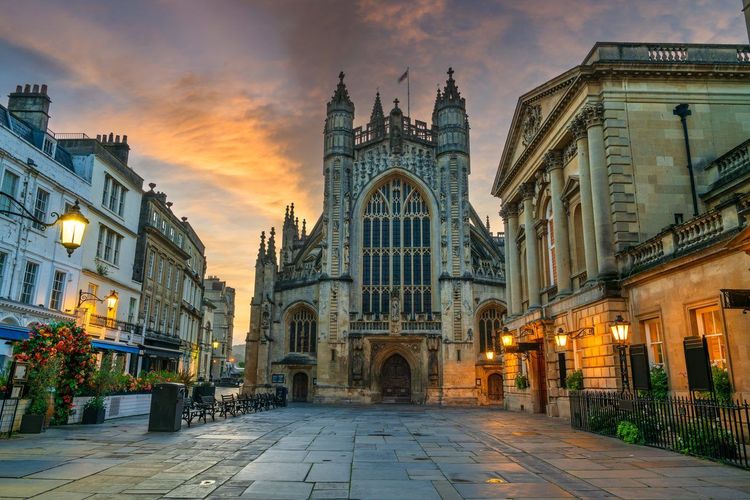
Bath Abbey (Abbey Church Yard, Bath BA1 1LT, rated 4.6/5 on Google from 7,264 reviews) stands just a few metres from the Roman Baths — a proximity that neatly sums up the city's history: a place of worship has occupied this site without interruption since Anglo-Saxon times, long before the current building was constructed, completed for the most part between 1499 and 1616.
The west façade immediately draws the eye with its sculptures of angels climbing ladders towards the heavens, a direct reference to the founding dream of Bishop Oliver King, who reportedly saw angels ascending and descending a ladder before ordering the reconstruction of the abbey in 1499. Inside, the fan vault of the nave, added in the 19th century by Sir George Gilbert Scott, is considered one of the finest in England, with a network of stone ribs that seems to unfurl like an open fan.
Entry to the interior remains free, funded by visitor donations — typically around £5–6 suggested at the door. For the more curious, the Tower Tour climbs 212 steps to the top, with rare access to the bells and mechanical clock, as well as an unobstructed view over the city's rooftops and the Royal Crescent in the distance.
The abbey floor is almost entirely covered with memorial stones — more than 1,200 commemorative plaques engraved between the 17th and 19th centuries, some so worn by the footfall of visitors as to become illegible.
Avoid Saturday mornings, often reserved for wedding ceremonies that temporarily close certain areas to the public. Weekday visits in the late afternoon generally offer the quiet needed to appreciate the stained glass, particularly luminous when the sun comes through the large east window.
5. The Circus
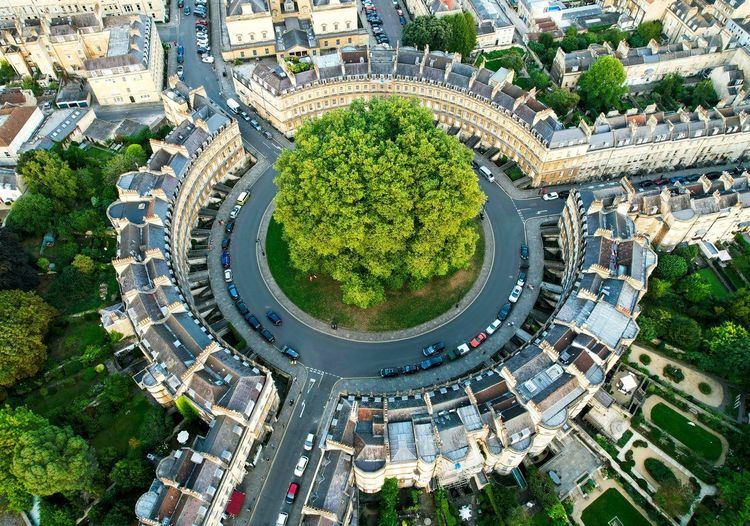
The Circus predates the Royal Crescent by a few years and shares the same architect, John Wood the Elder, who never lived to see his project completed. Three matching rows of houses form a perfect circle around a central square planted with majestic plane trees — a geometry inspired, according to some historians, by the Colosseum in Rome turned inside out: the columns here decorate the exterior rather than the interior.
Each of the three storeys of the façade uses a different order of columns — Doric, then Ionic, then Corinthian — a classical architectural hierarchy borrowed directly from Italian Renaissance treatises. Above the ground-floor columns, more than 500 carved emblems (serpents, acorns, musical instruments) decorate the frieze, without any apparent logic or clearly established symbolism, which still fuels debate among local guides.
The painter Thomas Gainsborough and the writer William Pitt both lived at the Circus — a pedigree that comes as no surprise given that the address remains one of the most coveted in the city. The square takes only a few minutes to see, but deserves a proper stop: unlike the Royal Crescent, so often photographed from the lawn below, the Circus is best appreciated by walking all the way around it, each angle revealing a slightly different perspective on the circle.
A discreet passage connects the Circus directly to the Royal Crescent in a few minutes' walk, making it easy to visit both sites back to back without detouring via the main road.
6. Pulteney Bridge
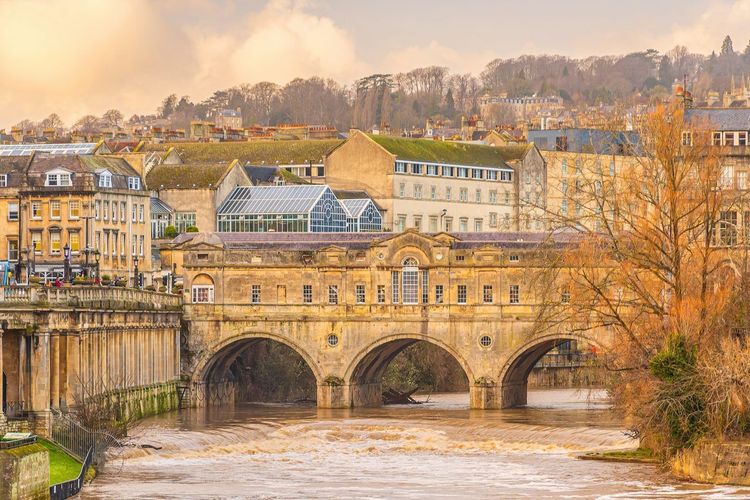
Pulteney Bridge (Pulteney Bridge, Bath BA2 4AT, rated 4.6/5 on Google from 10,097 reviews) is one of only four bridges in the world entirely lined with shops on both sides, alongside the Ponte Vecchio in Florence and the Rialto in Venice. Built in 1774 by Robert Adam, it spans the River Avon and links the historic centre to the Bathwick district, which was then undergoing rapid development.
From street level, the bridge looks like any ordinary shopping street lined with shopfronts; it is only from the riverbank, or from the neighbouring bridge, that its true architectural nature is revealed. Just below, the Pulteney Weir, a horseshoe-shaped weir built in the 19th century to regulate the level of the Avon, offers one of the most photographed viewpoints in the city, particularly after heavy rain when the flow swells spectacularly.
The best views are from Grand Parade on the opposite bank, or by booking an electric boat trip from Pulteney Bridge Boating Station — a pleasant option for drifting along the Avon to Bathwick Meadows without effort. Allow around 30 minutes for a leisurely return trip by boat, longer if you plan a picnic on the riverbank.
Robert Adam drew inspiration from Palladio's unrealised designs for a similar bridge in Venice, which were never built in his lifetime — making Pulteney Bridge one of the rare realisations of this type of project in Europe.
In the evening, the lit shopfronts of the bridge reflect in the water of the weir — a contrast that completely transforms the atmosphere of the place compared to the busier, more tourist-heavy daytime.
7. Prior Park Landscape Garden
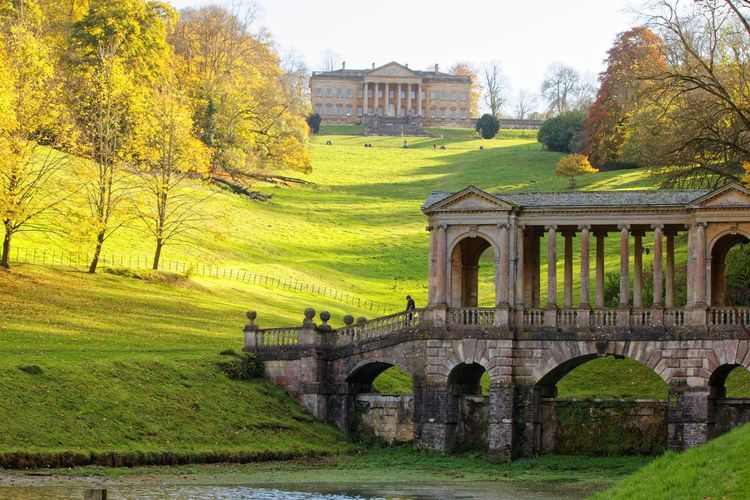
Prior Park Landscape Garden (Ralph Allen Drive, Bath BA2 5AH, rated 4.4/5 on Google from 1,941 reviews) spreads across the heights to the south of the city, laid out in the 18th century by Alexander Pope and Capability Brown for Ralph Allen, the entrepreneur who made his fortune quarrying stone at Combe Down — the same golden stone that clads the entire historic centre.
The garden's name recalls that a medieval priory once occupied the site, long before Ralph Allen bought the land to build his manor and show off the view over his own quarries below — a choice as aesthetic as it was strategic, designed to impress influential visitors with the quality of his stone.
The garden unfolds across three cascading lakes linked by small bridges, including the famous Palladian Bridge — one of only four examples in the world of this 18th-century architectural model, alongside replicas at Wilton House and Stowe. Unlike the rigid, symmetrical French formal garden, Prior Park exemplifies the English landscape style: perspectives that appear natural but are entirely calculated to reveal, from specific vantage points, a clear view over the rooftops of Bath below.
The walk from the city centre takes around 30–40 minutes of continuous uphill walking, an effort that puts off some visitors but guarantees noticeably fewer crowds than the sites in the centre. No car parking is available on site: only access on foot or by local bus is possible, a deliberate decision by the National Trust, which manages the garden, to preserve the tranquillity of the place.
Wear sturdy shoes: the sloping lawns become slippery after rain, which is frequent year-round in Bath, and some paths are unpaved. Entry is paid for non-members of the National Trust, but noticeably cheaper than most paid sites in the city centre, making it a good option for a quiet afternoon away from the crowds.
The best viewpoint over the Palladian Bridge and the lakes is from the lawn just in front of the manor house, now a private school and closed to the public, but whose façade remains visible from the garden. A café in the old stables serves homemade pastries — a welcome break before heading back down into the city.
8. The Jane Austen Centre
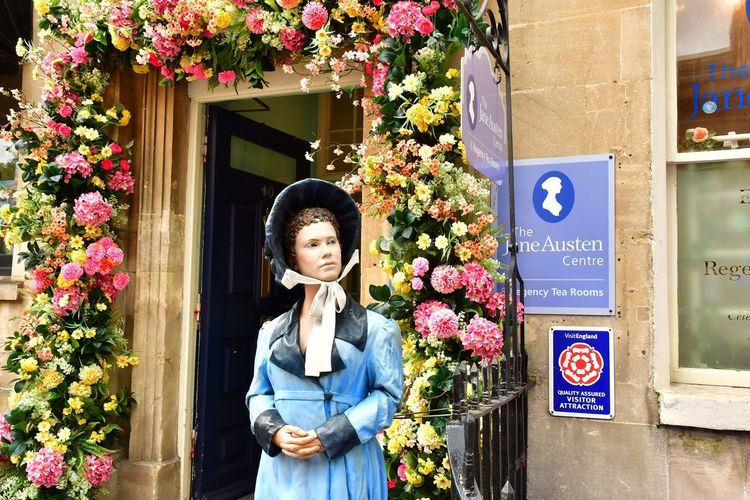
The Jane Austen Centre (40 Gay Street, Bath BA1 2NT, rated 4.3/5 on Google from 4,743 reviews) occupies a Georgian townhouse on Gay Street, just a few numbers away from the one where the author actually lived between 1801 and 1805. Contrary to popular belief, Jane Austen never particularly liked Bath: her letters describe a noisy, sociable and exhausting city — a view that sits in sharp contrast to the current tourist image of Bath as the ideal setting for a novel.
The guided tour, led by an interpreter in period costume, traces the author's time in Bath and its influence on novels such as Persuasion and Northanger Abbey, both set partly in the city. A permanent exhibition presents reproductions of costumes, letters and first editions, as well as a wax figure of the author whose realism divides opinion among visitors.
The adjoining tearoom, the Regency Tea Room, serves a themed afternoon tea with pastries named after characters from the novels — an experience particularly enjoyed by the author's most devoted fans. Allow around an hour for the full visit, a little longer if you stay for tea.
Every September, the Jane Austen Festival transforms the city-centre streets into a costumed procession, with several hundred participants in Regency dress walking up Gay Street to the Circus. Tickets must be booked online in advance during the festival period, when visitor numbers are three times their usual level.
9. The American Museum and Gardens
The American Museum and Gardens (Claverton Manor, Bath BA2 7BD, rated 4.5/5 on Google from 1,295 reviews) remains a curiosity little known to passing visitors, housed in a 19th-century manor house fifteen minutes by bus from the city centre. Founded in 1961, it is the only museum of American art and culture located outside the United States, with furnished period rooms fitted with authentic 18th-century pieces imported directly from North America.
Claverton Manor, the building that houses the museum, was itself designed by architect Jeffry Wyatville, also known for his renovation work on Windsor Castle — a pedigree that explains the care taken over the interior proportions and volumes.
The collections cover Amish craftsmanship, traditional quilts and the history of indigenous peoples, spread across several themed rooms each corresponding to a distinct region or period. The gardens, partly designed in imitation of a colonial Virginia garden, offer an open view over the Avon valley — particularly pleasant in late spring when the flower beds are in full bloom.
Allow half a day to enjoy both the museum and the gardens, especially if you plan lunch at the on-site café, which is well regarded for its American-style pie slices. The museum generally closes from November to March — a seasonal closure to check before planning a visit outside high season. This site is one of the few on the list that requires a bus or car journey from the centre.
The venue also organises occasional historical re-enactments, such as quilt-weaving demonstrations or colonial cooking workshops, usually announced on the official website several weeks in advance. Combined tickets for the gardens only, without the museum, are available at a reduced rate for visitors short on time.
10. The Holburne Museum
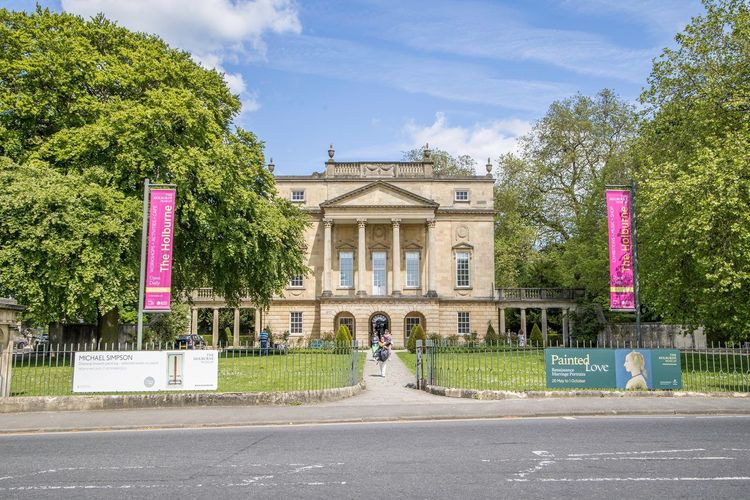
The Holburne Museum (Great Pulteney Street, Bath BA2 4DB, rated 4.4/5 on Google from 1,853 reviews) closes the vista of Great Pulteney Street, the widest Georgian avenue in the city, in a building constructed in 1796 as a hotel before becoming a museum in 1916. The collection brings together the works and objects assembled by Sir William Holburne, including portraits by Gainsborough painted while he was still living in Bath, before his move to London.
A contemporary glass extension, added in 2011 by architect Eric Parry, sits alongside the listed Georgian façade — an architectural contrast that sparked considerable local controversy at the time of its construction, though it is now widely accepted by residents. Entry to the permanent collections remains free, with only temporary exhibitions being ticketed.
The adjoining garden, Sydney Gardens, was frequented by Jane Austen herself during her time in Bath; it is now a public park crossed by the Kennet and Avon Canal, pleasant for a picnic after a visit to the museum.
The museum café, set in the former ballroom, serves homemade pastries overlooking the garden — a simple break before resuming the walk back to the city centre. The porcelain and silverware collections occupy the first floor, less crowded than the ground floor, a wise choice for anyone seeking a quieter moment.
11. Royal Victoria Park
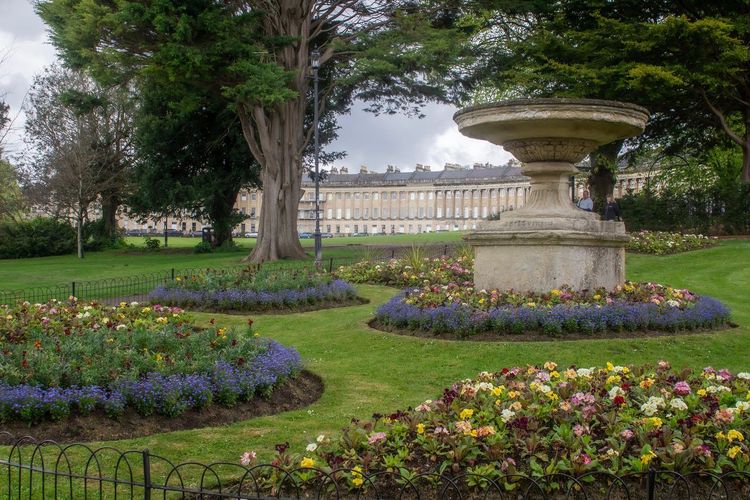
Royal Victoria Park (Marlborough Lane, Bath BA1 2NQ, rated 4.6/5 on Google from 8,469 reviews) covers 23 hectares just behind the Royal Crescent, inaugurated in 1830 by the future Queen Victoria, then aged 11, in her very first official public appearance. The park remains the city's main green space today, with a rose garden of more than 2,000 rose bushes and one of the largest children's play areas in the United Kingdom.
The free botanic garden displays a collection of limestone-tolerant plants, in direct reference to the local geology, as well as an authentic miniature Egyptian temple — a relic of a 19th-century travelling exhibition that was never dismantled. In summer, the park also hosts the Bath Festival and open-air concerts, a programme that draws locals and visitors alike.
For families, the playground caters to a range of ages with separate wooden structures and a seasonal mini-golf course. The park is open from sunrise to sunset, with no admission fee, making it a pleasant and free pause between two paid attractions in the city centre.
From the central lawn, the view of the rear of the Royal Crescent — less photographed than the front — reveals the heterogeneity of the extensions built over the centuries by each successive owner.
12. No.1 Royal Crescent
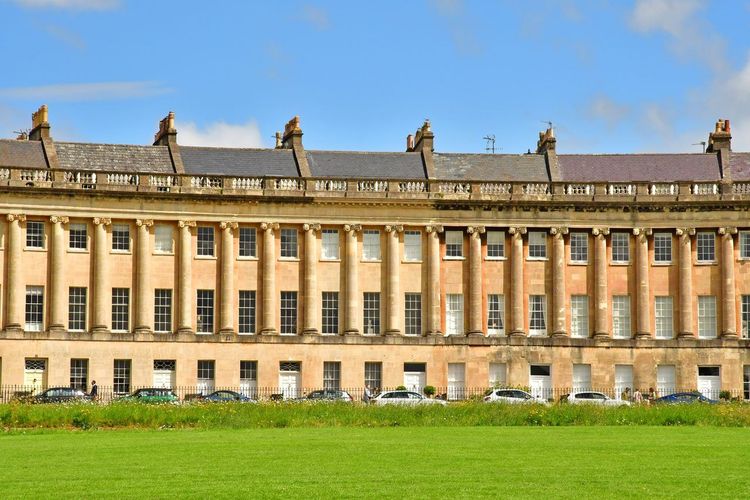
No.1 Royal Crescent (1 Royal Crescent, Bath BA1 2LR, rated 4.5/5 on Google from 2,674 reviews) occupies the first house in the Crescent, restored and furnished to recreate the interior of a Georgian townhouse as it would have been lived in during the 1770s.
Each room, from the kitchen to the private apartments, faithfully reproduces the period furniture and tableware. The visit lasts around 45 minutes and ends in the basement kitchens, where the domestic staff spent most of their time out of sight of the guests upstairs.
Book online during high season: the number of simultaneous visitors is deliberately limited to protect the fragile furniture displayed without protective cases.
13. Sally Lunn's House
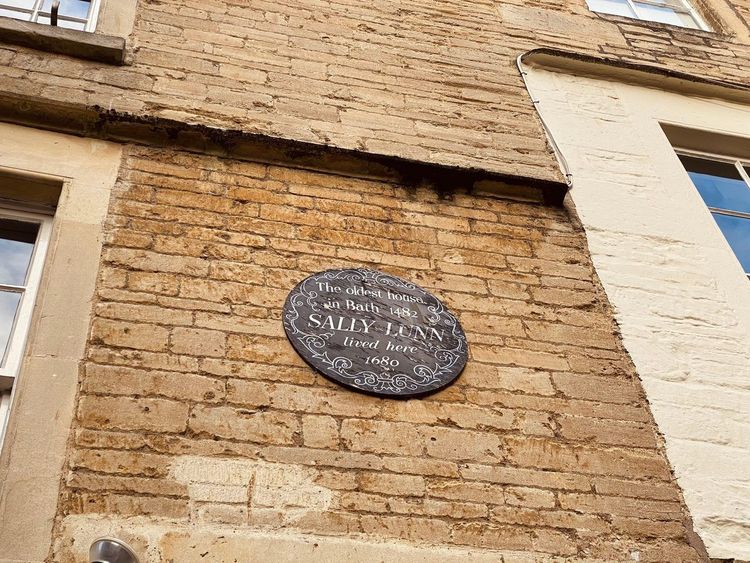
Sally Lunn's House (4 North Parade Passage, Bath BA1 1NX, rated 4.4/5 on Google from 6,279 reviews) lays claim to the title of Bath's oldest house, with foundations dated to the 11th century and a current façade dating from 1482. The establishment owes its fame to a brioche-style bun, the Sally Lunn Bun, whose exact recipe has been a closely guarded secret since its supposed creation in 1680.
A small free museum occupies the vaulted cellar, with Roman and medieval foundations visible through glass, along with the original oven still occasionally used for demonstrations. The upstairs tearoom serves the famous bun, sweet or savoury, with a variety of toppings — a stop that draws a regular queue at lunchtime.
14. The Parade Gardens
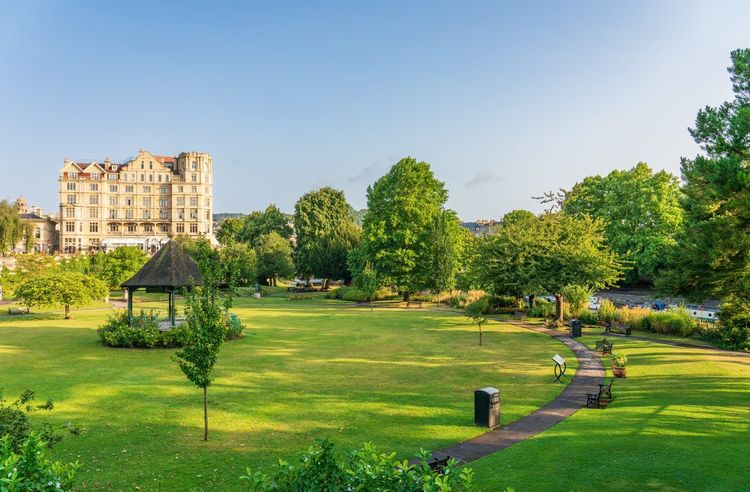
The Parade Gardens (Grand Parade, Bath BA2 4DE, rated 4.5/5 on Google from 1,234 reviews) run along the River Avon below the abbey — an English garden kept in permanent bloom by the city council, with flower beds renewed several times a year according to the seasons.
Entry costs a few pounds in summer and is free for the rest of the year, a policy that funds the constant upkeep of the flower beds. Deckchairs scattered across the lawn let you settle in facing Pulteney Weir, one of the best free viewpoints over the weir without having to climb onto the bridge itself. A bandstand hosts free concerts on certain summer Sundays, a simple event that draws mainly local families.
15. Alexandra Park and the Bath Skyline
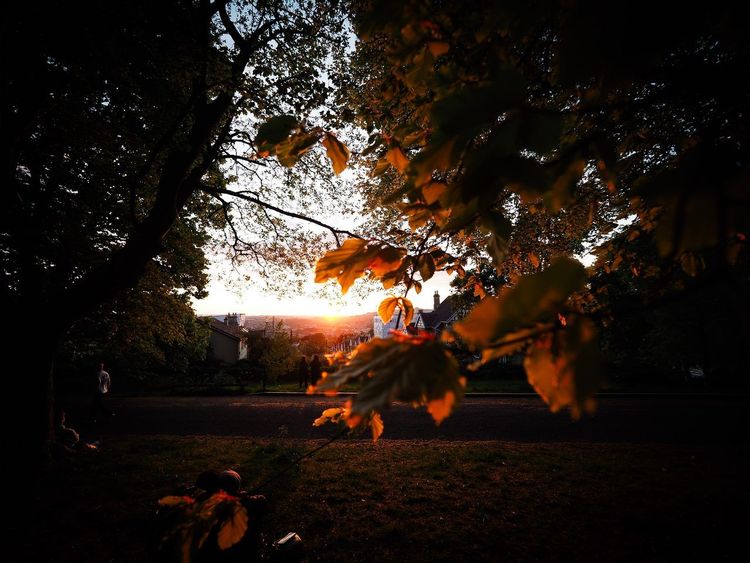
For an overview of the city, head to Alexandra Park (Alexandra Park, Bath BA2 4RA, rated 4.6/5 on Google from 500 reviews), an elevated lawn to the south of the river, reachable on foot in around twenty minutes from the centre. The view takes in the abbey, the golden stone rooftops and the surrounding hills — a free panorama often overlooked by visitors in a hurry who settle for the viewpoints in the city centre.
For more committed walkers, the Bath Skyline, a 10-kilometre waymarked trail managed by the National Trust, circles the entire city along the surrounding hills, through woodland, farmland and a succession of viewpoints. Allow around three hours for the full loop, achievable without any specialist equipment beyond sturdy walking shoes.
Much like the principle championed by the Ryo audio guide elsewhere in Europe, this trail allows each viewpoint to be placed in its historical context thanks to the interpretation panels installed by the National Trust along the route. This option is particularly suited to visitors staying several days who are looking for an outdoor activity away from the crowds at the paid sites in the centre.
16. The Theatre Royal
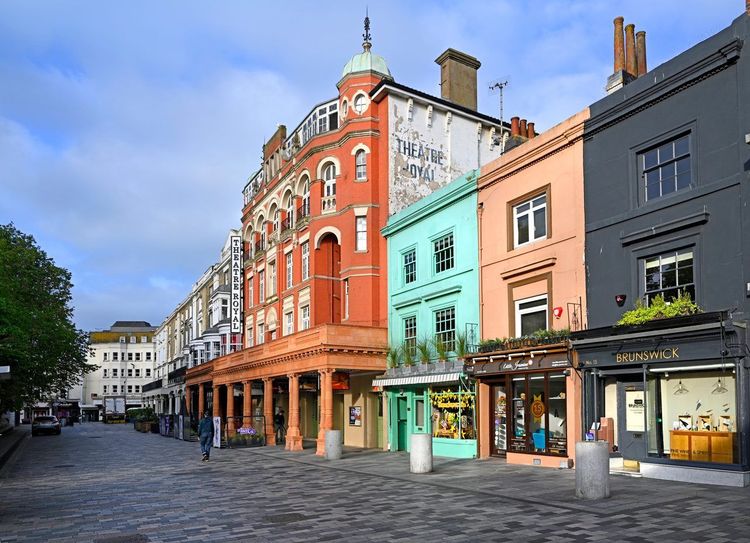
The Theatre Royal has been open since 1805, making it one of the oldest continuously operating theatres in the United Kingdom, with a regular programme of productions ahead of their national tours or runs in London's West End.
Local legend has it that the auditorium is haunted by the Grey Lady, a ghost associated with a 19th-century actress who died in circumstances that were never explained — a story the actors themselves enjoy telling before each performance. The Georgian façade, restored after a fire in 1862, contrasts with the richly redecorated Victorian interior, all red velvet and gilding.
Book several weeks in advance for the most popular productions, as the auditorium holds only around 900 seats — considerably fewer than the large London venues.

FAQ
How much time should you allow to visit Bath?
A full day is enough to see the highlights: the Roman Baths, the abbey, the Royal Crescent and the Circus. To add the spa, Prior Park or the American Museum, allow two full days instead, with an overnight stay so you can also enjoy the city in the evening, which is noticeably quieter once the day-trippers have headed back to London or Bristol.
Is Bath easy to visit as a day trip from London?
Yes, the direct train from London Paddington takes around 1h30, making a day trip perfectly feasible. That said, plan to leave early: queues at the Roman Baths grow noticeably after 11am, and heading back in the late afternoon leaves little time for a second major attraction.
What is the best time to visit the Roman Baths?
Opening time, from 9am on weekdays, is the quietest slot, well before the organised groups arrive. In summer, evening openings until 10pm offer a different atmosphere, lit by torchlight, with visitor numbers generally lower than during the day.
Is Bath an expensive city to visit?
The main paid attractions (Roman Baths, Thermae Bath Spa, No.1 Royal Crescent) each cost between £15 and £45 depending on the season. On the other hand, several free experiences are available: the Royal Crescent, the Circus, Royal Victoria Park and the abbey, whose interior is accessible without a fixed ticket — only suggested donations.
Can you swim in the Roman Baths?
No, swimming in the ancient pools has been banned since the 1970s for health reasons, as the water is no longer treated. To swim in natural thermal water, head to Thermae Bath Spa, just a few hundred metres away — the only establishment in the city where bathing is permitted.
How do you get around Bath?
The historic centre is entirely walkable, with most attractions clustered within a one-kilometre radius. For out-of-centre sites such as the American Museum or Prior Park, local buses are the simplest option, with no need to hire a car.
What is there to do in Bath with children?
Royal Victoria Park, with its playground and seasonal mini-golf course, is the easiest option for keeping younger visitors entertained. The Roman Baths also captivate history-curious children, while Thermae Bath Spa is restricted to over-16s — a point worth checking before planning your day.
Bath stands out for the density of its listed sites within a small area: in a well-organised day, it is possible to combine an ancient site, a masterpiece of Georgian architecture and a thermal bathing experience — a rare combination for a city of just 100,000 inhabitants. Visitors who extend their stay to two or three days will also discover the terraced gardens of Prior Park, the intimate atmosphere of the Holburne Museum and the free viewpoints of Alexandra Park, often overlooked by those limiting themselves to a day trip from London.
Ryo continues to expand its catalogue of audio-guided tours across Europe, and a city as historically rich as Bath would clearly have its place among the next destinations to join it. Whether you come for a quick day trip from London or a full long weekend, the city is easily explored without a car, at the pace of golden facades and terraced gardens.