





Walk
Between Ancient Shadows and Hilltop Views
Gjirokastër, Albania
Walk
Between Ancient Shadows and Hilltop Views
Gjirokastër, Albania
2.2 km
Distance
1h00
Durée
21
Audios
Loop
Parcours
Shutterstock
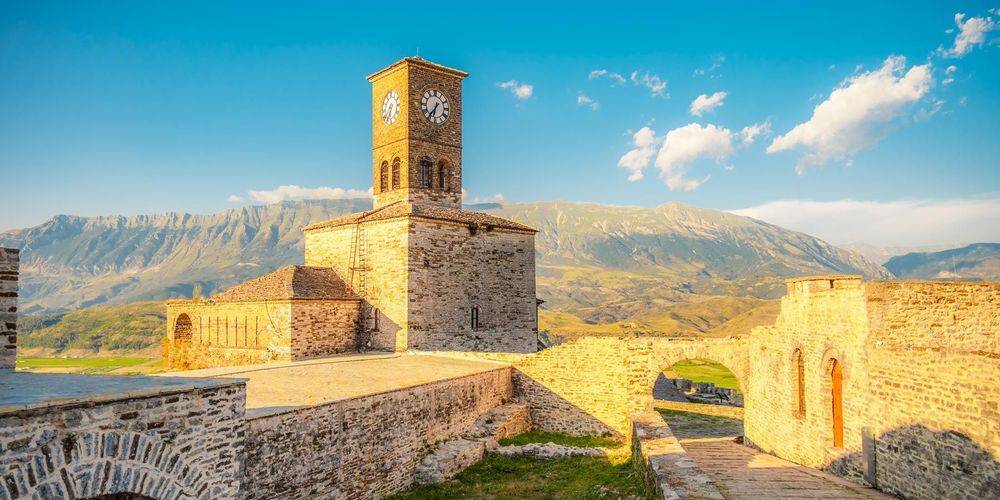
You are discovering Gjirokastër, one of the great historic cities of southern Albania, set high above the Drino Valley, not far from the Greek border. Its story begins in the Middle Ages, around the hill crowned by the fortress, whose earliest structures date back to the twelfth century. From the start, the town grew as a strategic stronghold, controlling key routes linking the Adriatic coast to the heart of the Balkans.
From the fifteenth century onwards, Gjirokastër came under Ottoman rule and entered a long period of prosperity, becoming an important administrative and commercial centre. It was during these centuries that the city’s distinctive character took shape, with its tall stone tower houses, thick defensive walls and slate roofs, buildings designed both to live in and to protect their inhabitants. In the eighteenth and nineteenth centuries, Gjirokastër also emerged as a major cultural centre in southern Albania, with the creation of schools and the spread of the ideas of the Albanian National Renaissance, focused on language, education and national identity.
After Albania gained independence in 1912, the city went through a particularly unstable period. In 1913 and 1914, it was occupied by Greek troops during the Northern Epirus conflict, creating strong local tensions. During the First World War, control of the region shifted several times, with Greek forces returning briefly until 1916 before other administrations linked to the wider conflict took over.
During the Second World War, Gjirokastër was occupied by fascist Italy from 1939 and became a strategic point, especially during the Italo-Greek War of 1940–1941. In 1943, after Italy’s surrender, German forces took control of the city until 1944, a period marked by harsher repression and operations against the resistance. At the same time, deep internal political divisions tore through Albanian society, leading to violence and reprisals whose memory is still very present in Gjirokastër.
After the war, the communist regime placed the historic centre under strict protection, which largely explains its exceptional state of preservation today. In 2005, Gjirokastër was listed as a UNESCO World Heritage Site, recognised as a remarkable example of an Ottoman town preserved almost intact, still clearly readable in its cobbled streets, stone houses and the powerful silhouette of its castle overlooking the valley.
Aucun avis pour le moment
