





Walk
Where colours reinvent history
Tirana, Albania
Walk
Where colours reinvent history
Tirana, Albania
5 km
Distance
2h00
Durée
22
Audios
Loop
Parcours
Shutterstock
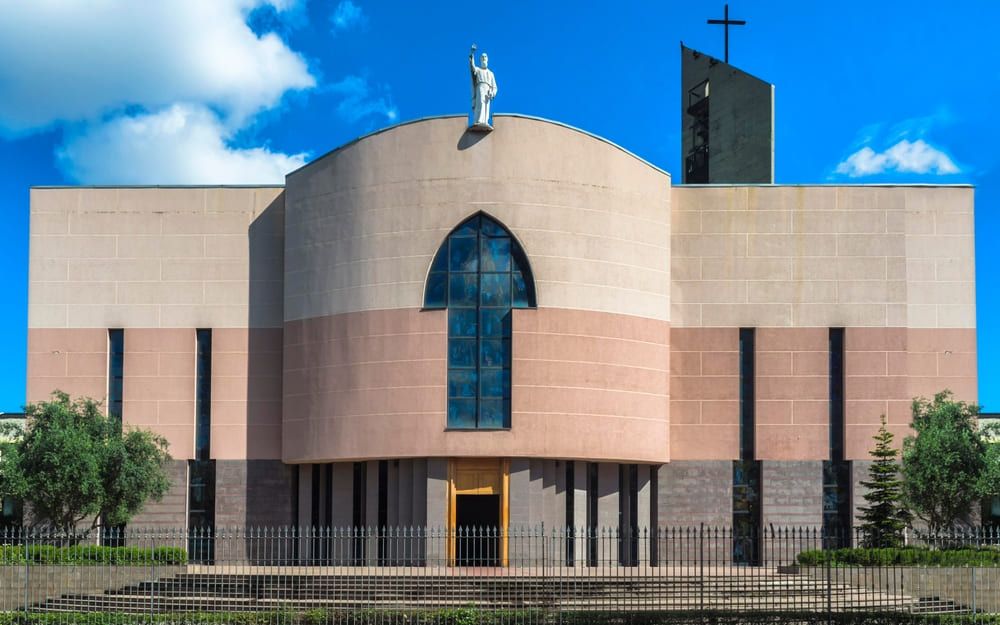
On the Boulevard Jeanne d'Arc, which runs along the Lana, the Catholic cathedral of Saint Paul displays a contemporary architecture, plain and luminous. It contrasts with the city's historic buildings and reflects a desire for openness and modernity. The Tirana audio-guided tour stops here to evoke the regained religious freedom of Albania, long officially atheist.
Inaugurated at the very start of the 2000s, the cathedral is dedicated to Saint Paul, a figure of travel and dialogue, whose statue is found at its top. Its construction marks the return of freedom of worship after decades of an atheist regime. It also recalls Albania's strong link with Mother Teresa, born into an Albanian family, who became a universal figure of charity.
The building appeals through its modern outline and interior brightness, worlds away from old cathedrals. Its plainness and contemporary lines make it a testimony to today's Albania, turned towards the future and religious pluralism. Nearby, other places of worship, mosques and churches, illustrate the coexistence of faiths, one of the characteristics of Tirana.
Saint Paul's Cathedral lies on the Boulevard Jeanne d'Arc, in the centre of Tirana, reachable on foot. A working place of worship, it can be visited with respect for services and the faithful; opening hours may vary with the season and celebrations, to be checked before visiting. Appropriate dress is required inside.
It was inaugurated at the very start of the 2000s, marking the return of freedom of worship in Albania after decades of an atheist regime.
It is dedicated to Saint Paul, a figure of travel and dialogue, whose statue crowns the building; the place also recalls Albania's link with Mother Teresa.
Aucun avis pour le moment
