



Walk
The City in the Sky
La Paz, Bolivie
Walk
The City in the Sky
La Paz, Bolivie
Distance
2.7 kmDurée
1h15Audios
16Parcours
Loop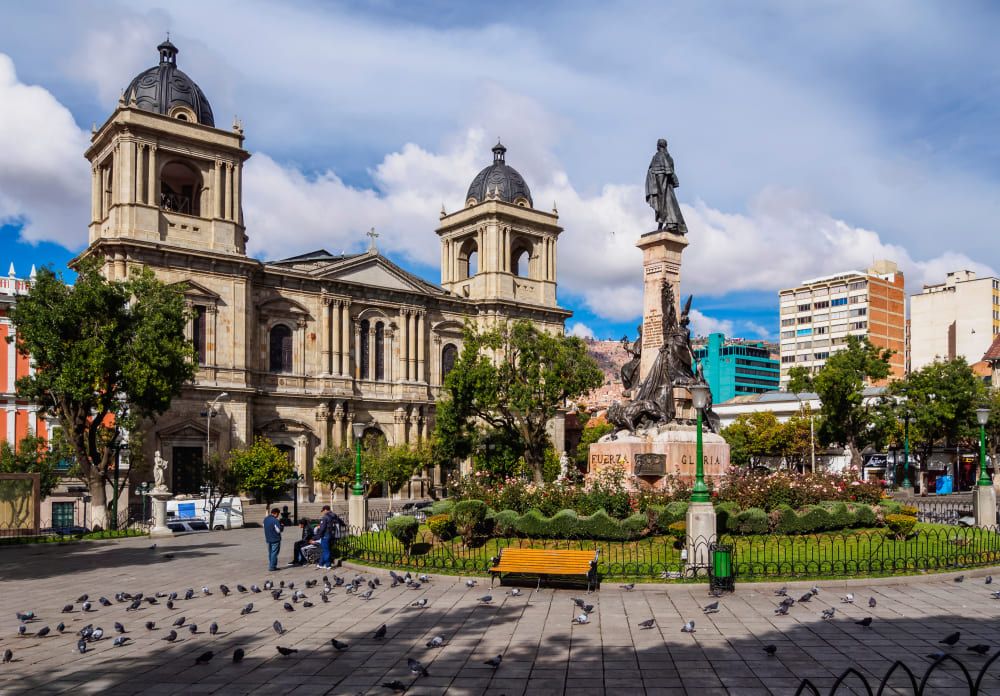
Shutterstock
You are now at the heart of La Paz — or perhaps I should say, at the bottom of La Paz, with the city nestled in a basin more than 3,600 meters (11,800 feet) above sea level, at the foot of the Altiplano. Look around you. Much of the city’s history was written right here, and there are countless stories to tell about Plaza Murillo, starting with the man it honors: Pedro Domingo Murillo. Seeing him today on his pedestal, surrounded by the seats of political power, it’s hard to imagine that the authorities of his time considered him a dangerous criminal. Murillo was neither a president nor a great general. He was a local notable of Spanish descent, born here in La Paz in 1757. A bit of a rebel, he had had enough of Spanish rule. So, on July 16, 1809, taking advantage of the turmoil in Europe after Napoleon had invaded Spain, Murillo and his companions took up arms and formed an independent junta. This was not yet Bolivia’s final independence, but it marked the beginning of the struggle. The Spanish authorities did not take kindly to the uprising and responded brutally, turning Murillo into a warning to others. Captured, Murillo was hanged right here on the square in 1810. Legend has it that, with the noose around his neck, he called out to the crowd with a phrase that would become legendary: “The torch I leave burning, no one will ever be able to extinguish.” Whether he said those exact words or history embellished them hardly matters. The metaphor did its work. By executing him on this square, the colonial authorities thought they could extinguish the rebellion. Instead, they turned him into a martyr and a symbol of Bolivian freedom. In a way, he had the last word: today, his name is everywhere — on banknotes, in history books, on street signs, and, of course, on this square.
Aucun avis pour le moment
