



Walk
The City in the Sky
La Paz, Bolivie
Walk
The City in the Sky
La Paz, Bolivie
Distance
2.7 kmDurée
1h15Audios
16Parcours
Loop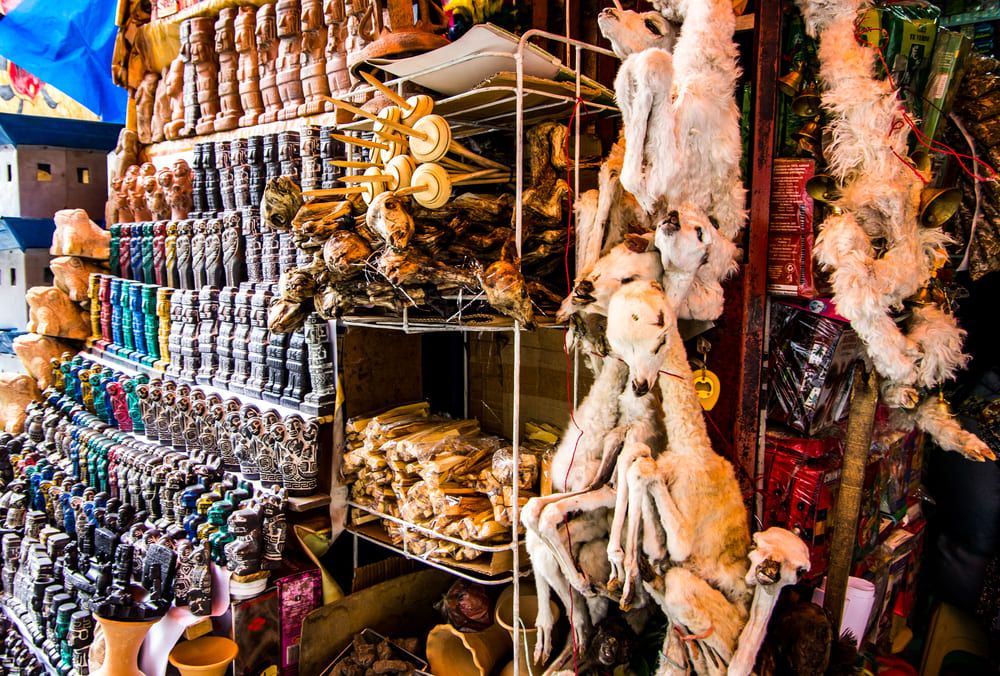
Shutterstock
Forget the pointed hats, black cats, and flying broomsticks! You’re now at the heart of the “Witches’ Market,” the domain of the Yatiris. In Aymara, this word refers to wise people who specialize in ritual practices and traditional medicine. People come here to seek protection, have their future read in coca leaves, or prepare a mesa, a ceremonial tray filled with colorful offerings, aromatic plants, and symbolic sweets. Look up at the stalls, and one detail is sure to catch your attention: those small dried bodies hanging above the doorways. They are sullus, llama fetuses. In the Andes, the earth isn’t simply the ground beneath your feet. It is Pachamama, Mother Earth, a living entity deserving of respect. When a Bolivian builds a house, they will often bury a sullu beneath the foundations to thank the earth and ask for its protection. This is the essence of ch’alla, an offering ritual in which alcohol is poured onto the ground or a gift is placed on the earth to maintain a relationship of balance and gratitude with Pachamama. Naturally, a place this mysterious has inspired its share of urban legends. You may hear people in the city whisper that, for La Paz’s enormous skyscrapers, a simple llama fetus wasn’t enough, and that human sacrifices had to be buried beneath the concrete. A chilling story, to be sure, but one that belongs more to popular mythology and tourist folklore than to historical fact. What is certain is that this quest for the favor of Mother Earth has inspired a dazzling array of colorful celebrations and traditions. Take the Alasitas festival at the end of January, when people eagerly buy miniatures representing their deepest wishes: a miniature car, a miniature house, or even tiny banknotes. Spirituality also comes alive in monumental celebrations such as the unmissable Oruro Carnival, which rivals Rio’s Carnival for the sheer number of dancers and the splendor of its costumes. Among them, the figure of the devil plays a central role, recalling ancient deities of the underworld and the mining world. But Bolivia’s identity is also expressed in everyday life, in the streets where you’re bound to encounter cholitas. Once marginalized, these Indigenous women proudly wear their pollera, or full skirt, a shawl, and two braids beneath a bowler hat. Today, they embody elegance, economic success, and social power. Some even step into the ring as cholitas luchadoras, competing in spectacular wrestling matches and transforming their traditional clothing into a symbol of strength. It’s a spectacle not to be missed, combining laughter with admiration for these remarkable women who are reshaping the image of women in countless ways — even climbing peaks nearly 7,000 meters (23,000 feet) high! Convinced yet? But Bolivia extends far beyond the stark landscapes of the high plateau. To the east, across vast plains and tropical forests, live the Guarani, Chiquitano, and Mojeño peoples. There, history took a very different course, giving rise to other customs and traditions. From intimate rituals like the ñatitas, human skulls honored within families on November 8 to watch over the home, to the celebration of Willkakuti, the Aymara New Year celebrated at the winter solstice in Tiwanaku, Bolivia refuses to fit into any single stereotype. It is a diverse, living country, deeply proud of its roots.
Aucun avis pour le moment
