





Walk
Between Marble and the Mediterranean
Split, Croatia
Walk
Between Marble and the Mediterranean
Split, Croatia
2 km
Distance
1h00
Durée
18
Audios
Loop
Parcours
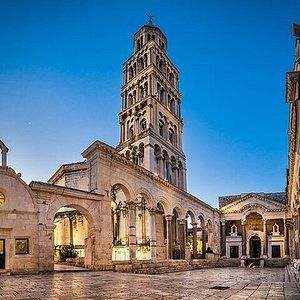
The Split audio-guided tour presents you with the Cathedral of Saint Domnius, one of the symbols of the city and one of the most astonishing cathedrals in the world.
This circular building, adorned with Corinthian columns, was built in the fourth century as the mausoleum of the emperor Diocletian, who was to rest there for eternity. In the seventh century, the Christians of the region transformed the imperial tomb into a cathedral, a highly symbolic reconversion: Diocletian had remained famous for having harshly persecuted the Christians. By a turn of history that one evokes with gravity, the building is today dedicated to Saint Domnius, a bishop martyred under his reign. The heart of the building preserves its ancient Roman architecture, columns, dome and friezes; inside remain Corinthian capitals and period elements.
The Cathedral of Saint Domnius invites contemplation in its former Roman mausoleum become a Christian sanctuary, mixing ancient columns, dome and sacred art. Its bell tower offers, for the brave, a magnificent view over Split and the sea. A place of worship with an extraordinary destiny, it is one of the most moving and symbolic monuments of the city.
The Cathedral of Saint Domnius is in the heart of the Palace of Diocletian, in Split. A place of worship, it can be visited with respect for the services, according to hours to be checked on site; access to the bell tower is generally subject to a charge and includes many steps.
The mausoleum of the emperor Diocletian, built in the fourth century, transformed into a cathedral in the seventh century.
To Saint Domnius, a bishop martyred under the reign of Diocletian, whose mausoleum became the sanctuary.
Aucun avis pour le moment
