





Walk
The City of Six Harbors
Lorient, France
Walk
The City of Six Harbors
Lorient, France
4.5 km
Distance
1h50
Durée
24
Audios
Loop
Parcours
Générée par Intelligence Artificielle
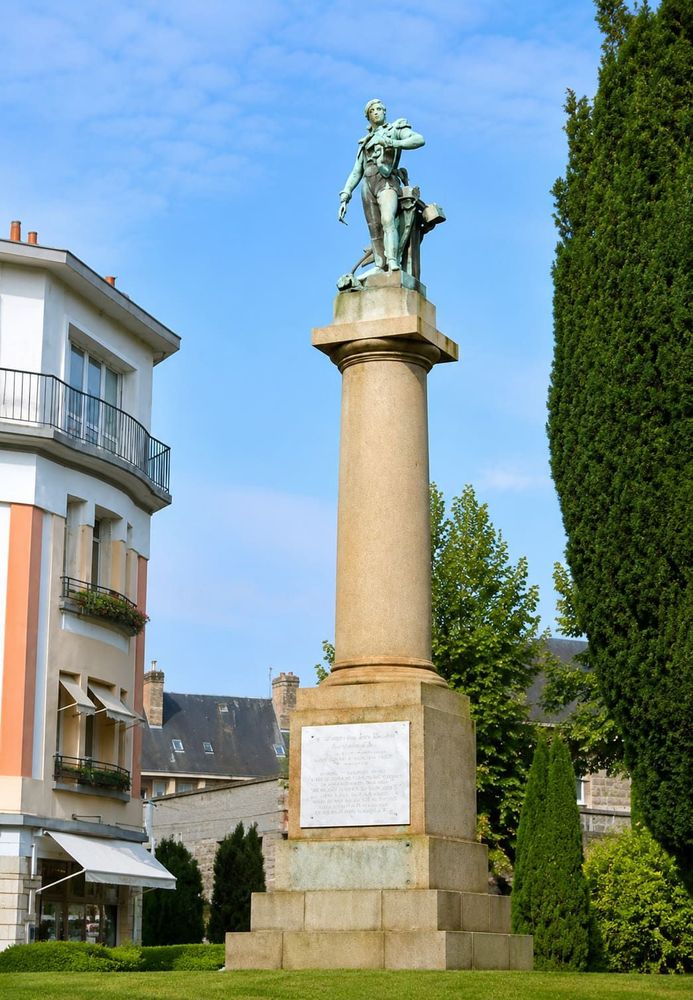
Look up at Hippolyte-Magloire Bisson, standing high on his pedestal, 10 meters (33 feet) above the ground. To understand what he holds in his hand, we need to travel back to November 4, 1827, and the Aegean Sea off the coast of Greece.That day, a 31-year-old Breton sailor commands the Panayoti, a two-masted sailing ship that is soon surrounded by Turkish pirates. Seeing that his ship is about to be overrun, Bisson orders his men to evacuate.
He remains alone on board, a fuse in his hand, and courageously ignites the gunpowder. The ship explodes, taking the young hero and his attackers with it. That ultimate act of self-sacrifice inspired this monument, which captures Bisson at the precise moment of his heroic deed, holding the burning fuse.
Unveiled in 1833 on the former Place Bisson, the monument would pass through a century of history before facing an equally dramatic fate during World War II. In 1941, the Vichy government and the German occupation authorities ordered bronze statues to be requisitioned and melted down. While most of Lorient’s monuments were sent to wartime foundries, Bisson’s statue became the subject of a prolonged administrative battle.
Successive mayors appealed directly to the highest levels of government to save the naval hero. Although the statue was taken down in August 1943, it narrowly escaped destruction with the secret help of the naval firefighters at Lorient Arsenal. They cleverly concealed it in their cellars until the Liberation.
The statue returned to its pedestal on November 11, 1945, then moved to its present location in 1953 as the city was rebuilt. Having survived both the bombs and the threat of being melted down, This heroic figure remains an enduring symbol of courage, standing silent guard over Lorient’s maritime past.
Aucun avis pour le moment
