





Walk
The City of Six Harbors
Lorient, France
Walk
The City of Six Harbors
Lorient, France
4.5 km
Distance
1h50
Durée
24
Audios
Loop
Parcours
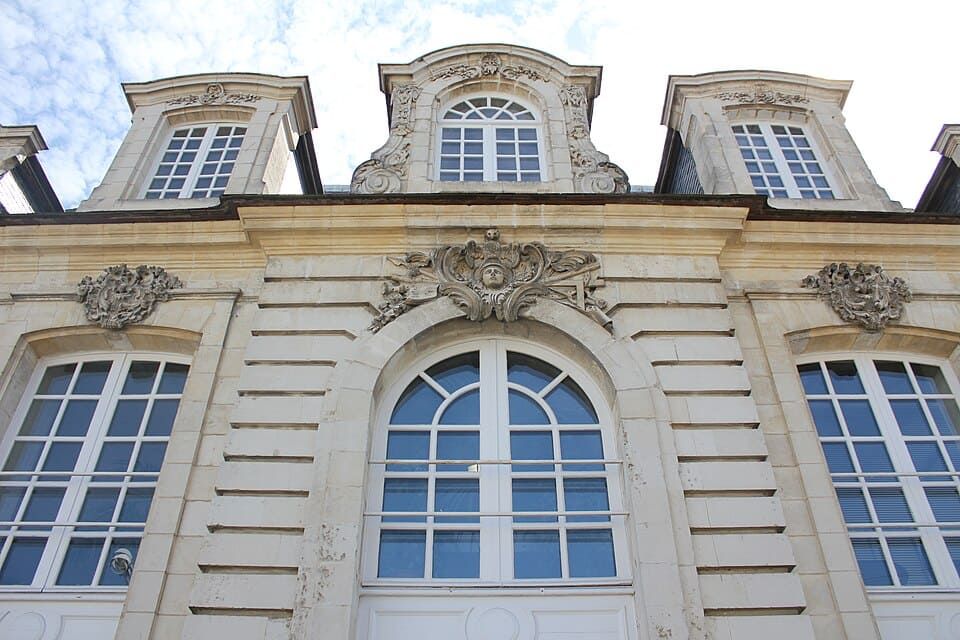
©XIIIfromTOKYO, CC BY 3.0 httpscreativecommons.orglicensesby3.0, via Wikimedia Commons
Welcome to the Enclos du Port, the historic heart and walled harbor district of Lorient. Standing before you is Hotel Gabriel, a masterpiece of 18th-century classical architecture that has been listed as a Historic Monument since 1930. Jacques V Gabriel, First Architect to King Louis XV, designed the building in 1731 as the main auction house of the powerful French East India Company.
A closer look at the architecture reveals a surprising detail. The U-shaped complex consists of two symmetrical pavilions, but there is no central building between them. The original design called for an enormous main structure linking the two wings.
However, in order to meet the strict deadline for the major autumn auctions of 1734, the architect was forced to scale back his ambitions. The central section was never built, leaving the complex with an unusual symmetry based entirely on its two pavilions—a very rare composition at the time. Take a moment to admire the stonework before you.
The building combines three materials typical of Brittany: a sturdy granite base designed to withstand the region’s sea spray and damp conditions, pale tuffeau limestone above it for finely carved decoration, and, finally, a traditional slate roof. The most fascinating details are the sculpted masks above the central bays of each pavilion. On the eastern pavilion, the god Hermes, wearing his winged cap, watches over merchants and ships setting sail.
On the western pavilion, Athena appears in a less familiar guise. While still carrying her traditional helmet and spear, she is also surrounded by scientific instruments, including a compass, a set square, and a telescope. This marked the first time in the history of French classical art that shipbuilding tools had been immortalized on the facade of an official monument.
Over the centuries, Hotel Gabriel has served many different purposes. Under the Ancien Régime, it hosted auctions of silk, coffee, spices, and porcelain. It was also a place where the slave trade was conducted and slavery was organized.
The French East India Company alone deported more than 95,000 people to the Americas and the islands. This trade ended when the French Royal Navy took control of the port in 1770. Hotel Gabriel then became the headquarters of the maritime prefecture for almost two centuries.
During World War II, the German occupying forces even built a bunker and cellar beneath the central courtyard. Quite a number of roles for a single building, however emblematic it may be. Before continuing your walk, consider circling the building and wandering through its magnificent 16-hectare (40-acre) formal French garden, officially designated as a “Remarkable Garden.”
Aucun avis pour le moment
