





Walk
Between Fire and the River
Hennebont, France
Walk
Between Fire and the River
Hennebont, France
2 km
Distance
1h00
Durée
16
Audios
Loop
Parcours
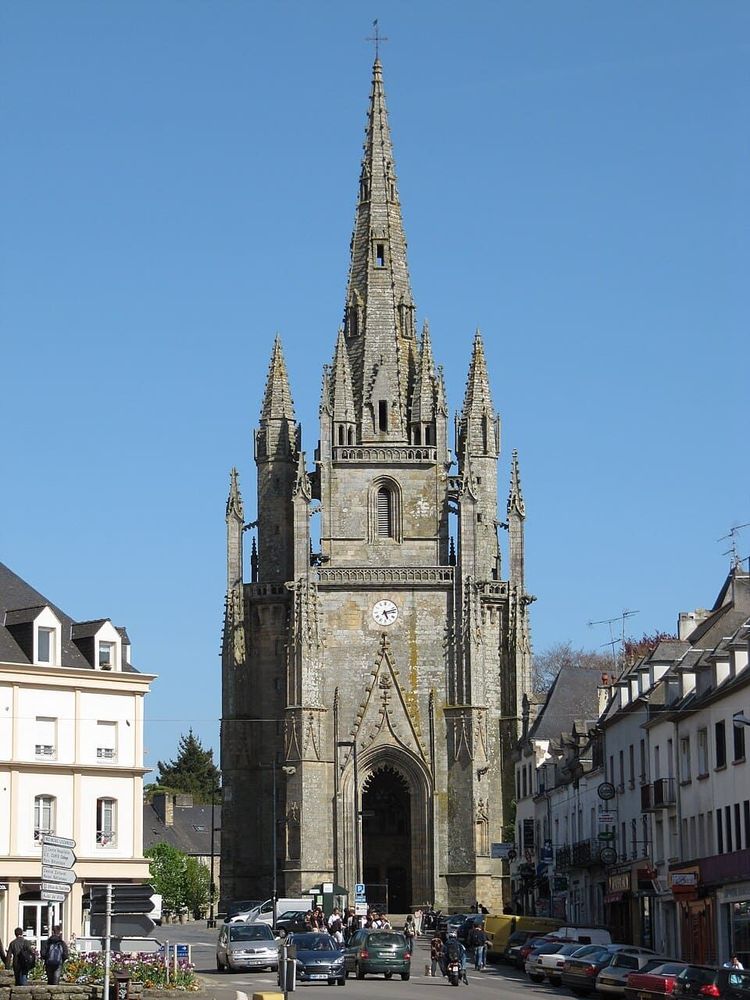
©Wikicaro, CC BY-SA 3.0 httpscreativecommons.orglicensesby-sa3.0, via Wikimedia Commons
Look up. Rising high above the rooftops of Hennebont is Notre-Dame-de-Paradis Basilica, crowned by a spire that reaches 65 meters, or about 213 feet, into the sky. For centuries, that spire did more than dominate the skyline.
Sailors and travelers approaching the area used it as a vital landmark to find their way. So how did a basilica this impressive end up here? The story begins in 1507, when Anne of Brittany passed through Enn-bon and stopped to pray at a modest oratory on Paradis Hill.
Her visit helped give momentum to a much more ambitious idea: replacing that small place of worship with the magnificent church you see today. Construction officially began in 1514, but the man leading the project wasn’t some celebrated architect. He was a local blacksmith named François Michard.
He rallied the townspeople, collected their donations, and kept the enormous undertaking moving forward. It wasn’t always smooth sailing. There were tensions along the way, and even some money that seems to have mysteriously vanished from the accounts.
Still, by around 1554, the church was almost complete. Much later, in 1913, it was elevated to the rank of minor basilica. Now, step inside.
The stained-glass windows are likely to catch your eye first. They’re the work of master glassmaker Max Ingrand, and they exist because of one of the darkest chapters in Hennebont’s modern history. The basilica itself miraculously survived the devastating bombings of August 1944, but the force of the explosions shattered the earlier windows.
Between 1951 and 1965, Ingrand created their replacements, filling the church with brilliant color while telling the story of the town. As you make your way through the nave, look for a silvered-bronze statue of the Virgin Mary. It stands at the heart of one of Hennebont’s best-known traditions: the Vow of 1699.
That year, a terrible epidemic swept through the town. The people made the Virgin a promise: if the outbreak came to an end, they would offer her a statue made entirely of silver. Miracle or coincidence, the epidemic subsided—and the people kept their word.
Their promise also gave rise to the great Festival of the Vow, still celebrated at the end of September. The original silver statue, however, didn’t survive the French Revolution. It was taken to Nantes and melted down.
In 1818, the people of Hennebont replaced it with the statue you see before you today.
Aucun avis pour le moment
