





Walk
The Peninsula That’s a Breath of Fresh Air
Quiberon, France
Walk
The Peninsula That’s a Breath of Fresh Air
Quiberon, France
2.2 km
Distance
1h00
Durée
12
Audios
Through route
Parcours
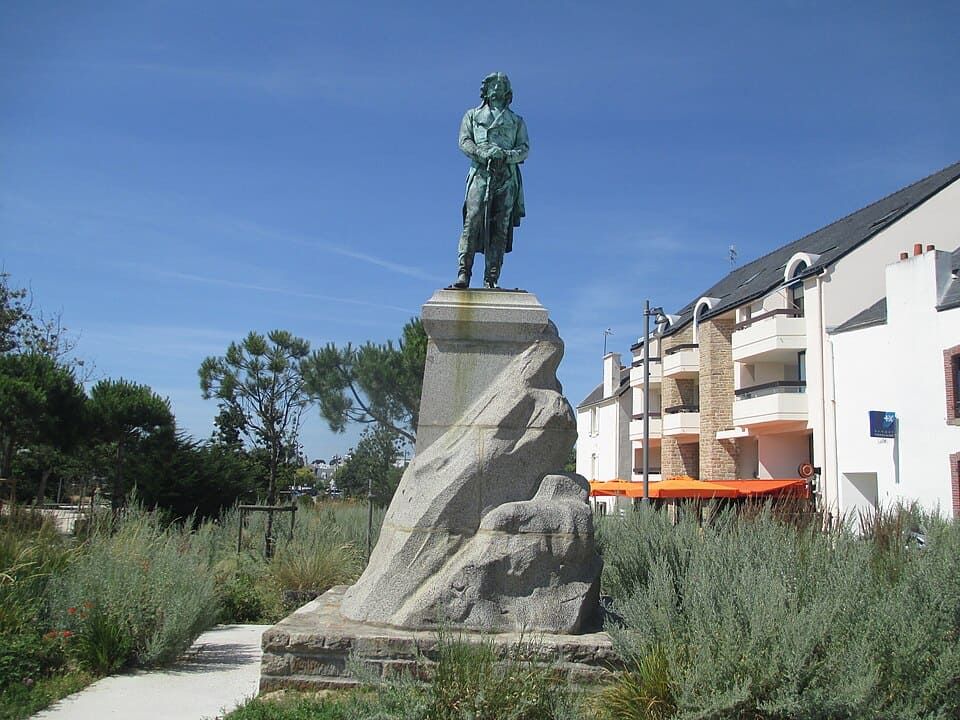
©Avi1111 dr. avishai teicher, CC BY-SA 4.0 httpscreativecommons.orglicensesby-sa4.0, via Wikimedia Commons
From the top of his pedestal, Lazare Hoche gazes out toward the horizon. Quiberon may seem like a peaceful seaside town today, but this square tells a very different story. In fact, Hoche’s statue stands at the center of a long-running political battle over how the past should be remembered.
To understand why, we need to go back to the summer of 1795, in the midst of the French Revolution. More than 5,000 Royalist exiles attempted to land on the coast with support from the British and the Chouans, local Royalist insurgents who defended the monarchy and traditional religion. Their goal was to overthrow the Republic.
The operation began at Carnac but quickly stalled, forcing the Royalists—known as the “Whites”—to retreat to Fort Penthièvre on the narrow isthmus leading into Quiberon. Waiting for them was the young General Hoche, commander of the Republican “Blues.” During the night of July 20 to 21, Hoche launched an assault, retook the fort, and crushed the attempted landing. What followed was brutal.
After the Royalists surrendered, nearly 750 of them were executed by firing squad. A century later, the wounds of 1795 still hadn’t healed. Royalist supporters wanted to build a chapel honoring those they regarded as martyrs, while the Republicans answered with a nationwide fundraising campaign to erect a monument to their victorious general.
Writer Anatole France supported the project, and renowned sculptor Jules Dalou was chosen to create the statue, which was unveiled in 1902. The Republicans went even further by replacing the square’s former name with Hoche’s, quite literally setting their version of history in stone. It’s hard to imagine today, but peaceful Quiberon was once the setting for one of the bloodiest episodes of the French Revolution.
Aucun avis pour le moment
