





Walk
A Thousand Years of History Along the Mayenne
Laval, France
Walk
A Thousand Years of History Along the Mayenne
Laval, France
3 km
Distance
1h15
Durée
18
Audios
Loop
Parcours
Shutterstock
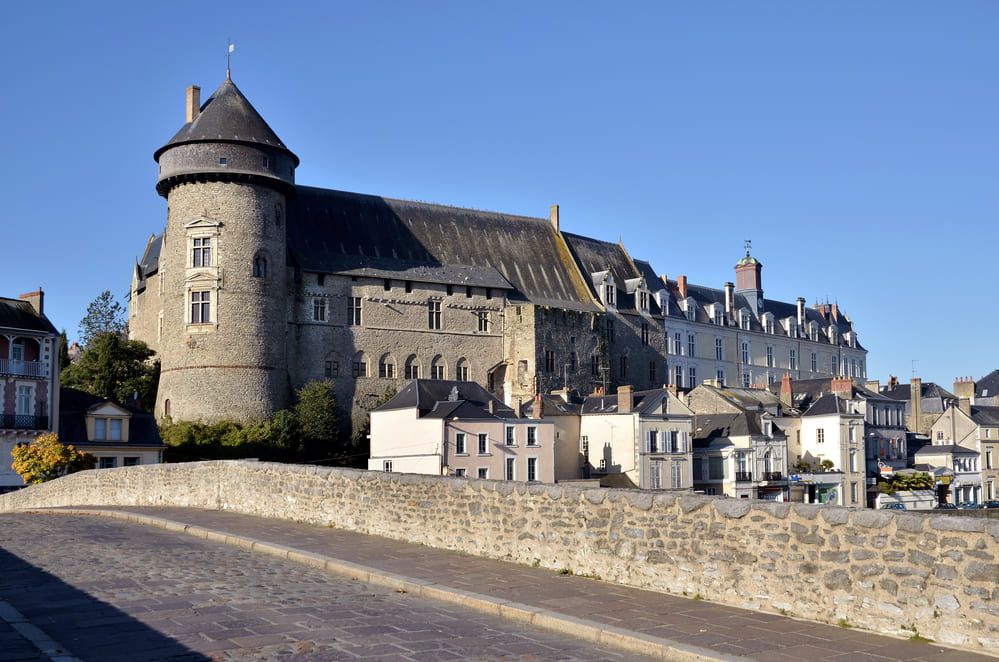
The Vieux-Château is the beating heart of the history of Laval, a medieval fortress born around the year 1020. The Laval audio-guided tour stops here to evoke this cradle of the town, dominated by its famous Romanesque keep, there where a lord installed a motte castle to control the passage of the Mayenne.
You are in front of the Vieux-Château, the beating heart of the history of Laval. It is here that everything began, around the year 1020, when a lord, Guy de Laval, decided to install a motte castle to control the passage of the Mayenne, this strategic point of crossing of the river. Around this first fortification gradually developed the town, that took the name of Laval and grew in the shadow of its castle and its lords. Over the centuries, the primitive wooden fortress was replaced by a powerful stone castle, whose most remarkable element is its Romanesque keep, an imposing cylindrical tower raised in the twelfth century, that still dominates the town and the river. This keep keeps an exceptional rarity: its hoarding, a wooden gallery overhanging at the summit, intended for the defence, one of the rare ones preserved in France, a precious witness of medieval military architecture. The castle was the residence of the counts of Laval, a powerful family that marked the history of the region. Today restored, the Vieux-Château shelters a museum, notably of naive art, in tribute to the painter Henri Rousseau, native of the place. A medieval fortress and a cradle of the town, the Vieux-Château is a must-see stop of the discovery of Laval.
You admire the cradle of Laval, a fortress born around the year 1020 when the lord Guy de Laval installed a motte castle to control the passage of the Mayenne; its most remarkable element is its Romanesque keep of the twelfth century, that keeps its wooden hoarding at the summit, one of the rare ones of France, and the castle, residence of the counts of Laval, today shelters a museum of naive art in tribute to Henri Rousseau. The Vieux-Château is the heart of the history of Laval. It is a must-see stop, to be explored on foot.
The Vieux-Château stands in the heart of old Laval, dominating the Mayenne, reachable on foot. You admire its exterior and its keep from the town; the visit of the castle and the museum follows its own hours and conditions, which vary according to the season, and entry may be paid. It is best to check them before coming.
Everything began around the year 1020, when the lord Guy de Laval installed a motte castle to control the passage of the Mayenne; around this first fortification developed the town, and the wooden fortress was replaced by a stone castle whose Romanesque keep of the twelfth century, one of the rare ones of France to keep its wooden hoarding, still dominates the town.
In the heart of old Laval, dominating the Mayenne, in France.
Aucun avis pour le moment
