






Walk
Visiting the Queen of the Danube
Budapest, Hungary
Walk
Visiting the Queen of the Danube
Budapest, Hungary
8.5 km
Distance
3h30
Durée
24
Audios
Loop
Parcours
Shutterstock
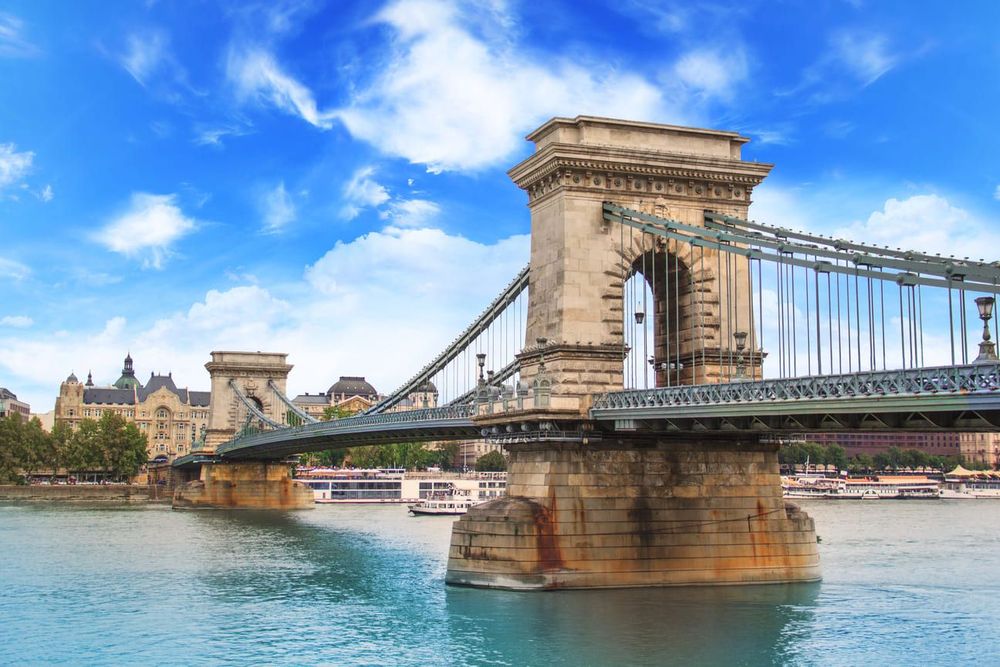
The Chain Bridge, or Széchenyi Bridge, is one of the strongest symbols of Budapest, the first permanent bridge to link Buda and Pest, inaugurated in 1849. The Budapest audio-guided tour stops here to evoke this technical feat, one of the first suspension bridges of continental Europe, guarded by its famous stone lions, destroyed in 1945 then rebuilt identically.
The Chain Bridge, or Széchenyi Bridge, is one of the strongest symbols of Budapest. The first permanent bridge to link Buda and Pest, it was inaugurated in 1849, at a time when the crossing of the Danube was still done by boat or, in winter, on foot on the ice. It was a technical feat for the era, imagined by the count István Széchenyi, great moderniser of Hungary, and realised by the English engineer William Tierney Clark. With its three hundred and eighty metres long, its imposing stone towers in the shape of a triumphal arch and its metallic chains, it is one of the very first suspension bridges of continental Europe. Unfortunately, like all the bridges of Budapest, it was dynamited by the German troops during their retreat, in 1945, a painful episode of the end of the Second World War. But it was reborn from its ashes identically from 1949. Even today, it keeps its original appearance, that recent renovation works have revived. If you look well at its two extremities, you will see the famous stone lions that watch over the passage: a legend tells that the sculptor, mocked for having supposedly forgotten to carve them a tongue, is said to have thrown himself into the Danube out of despair, an anecdote that has remained attached to the monument. Linking the two banks in the heart of the city, the bridge offers a magnificent view, especially illuminated at night. A suspension bridge and a symbol of the city, the Chain Bridge is a fine stop of the discovery of Budapest.
Here you cross the first permanent bridge between Buda and Pest, inaugurated in 1849, one of the very first suspension bridges of continental Europe, three hundred and eighty metres long and imagined by the count Széchenyi; guarded by its famous stone lions, dynamited in 1945 then rebuilt identically, it offers a magnificent view over the Danube, especially illuminated at night. The Chain Bridge is a symbol of Budapest. It is a fine stop, to be explored on foot.
The Chain Bridge spans the Danube, linking Buda and Pest, in the heart of Budapest, reachable on foot. It is a bridge freely accessible, that you cross on foot to enjoy the view over the two banks; it is particularly beautiful illuminated at night. You discover it during a walk along the river.
Because it was the first permanent bridge to link Buda and Pest, inaugurated in 1849, at a time when the Danube was still crossed by boat; a technical feat imagined by the count Széchenyi, it is one of the first suspension bridges of continental Europe. Dynamited in 1945 then rebuilt identically, guarded by its stone lions, it has become a symbol of the city.
Over the Danube, linking Buda and Pest, in the heart of Budapest, in Hungary.
Aucun avis pour le moment
