







Walk
Short Tour - From Celtic charm to dynamic streets
Dublin, Irlande
Walk
Short Tour - From Celtic charm to dynamic streets
Dublin, Irlande
4.2 km
Distance
1h40
Durée
17
Audios
Loop
Parcours
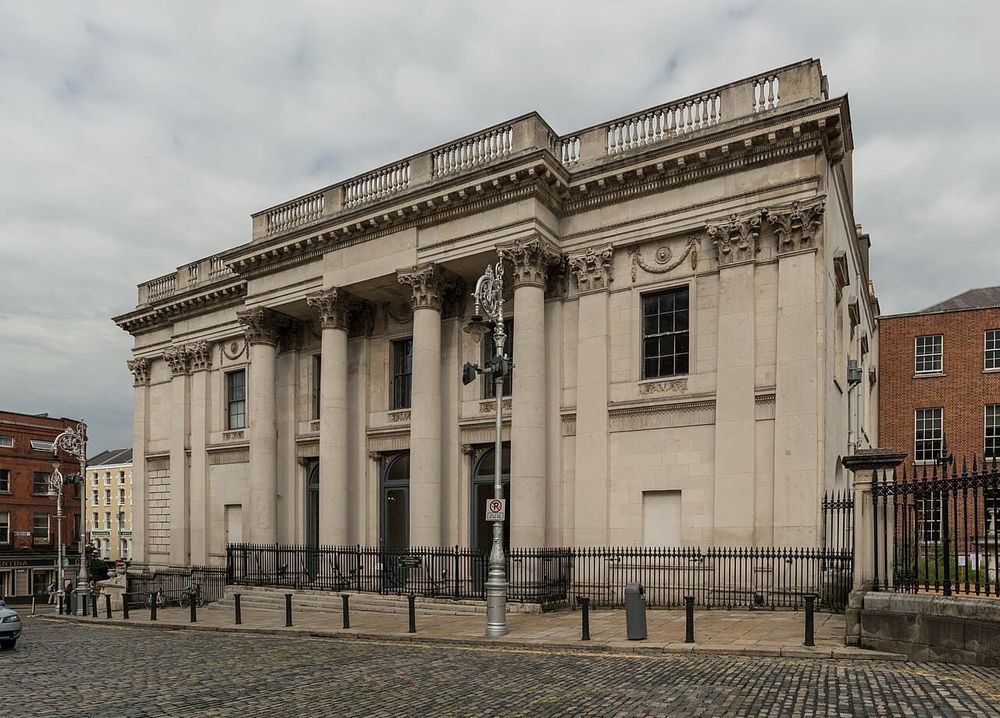
©DXR CC BY-SA 4.0. <https://creativecommons.org/licenses/by-sa/4.0/deed.fr>via Wikipedia Commons
The Dublin audio-guided tour leads you before the imposing Dublin City Hall, a neoclassical building with a solemn colonnaded façade. Built in the eighteenth century for the merchants' corporation, it originally served as the seat of the chamber of commerce.
Built between 1769 and 1779 to the designs of the architect Thomas Cooley, the City Hall is one of the finest examples of Georgian architecture in Dublin. First the Royal Exchange, a place of trade for merchants, it became the city hall in the nineteenth century. The building testifies to the prosperity of the Irish capital in the Age of Enlightenment.
Do not be intimidated by the façade: interior access is free. The Rotunda Hall, a circular vestibule covered by a dome and adorned with frescoes and columns, is a true jewel. There you also discover statues and an exhibition on the city's history. It is an elegant stop in the heart of the historic centre, next to Dublin Castle.
Dublin City Hall is at the corner of Dame Street and Parliament Street, in the heart of Dublin, near the castle. Interior access is generally free during opening hours; opening times may vary. The Rotunda Hall is one of its highlights.
It was built between 1769 and 1779 to the designs of Thomas Cooley, first as the Royal Exchange, before becoming the city hall in the nineteenth century.
It is the circular vestibule of the City Hall, covered by a dome and adorned with frescoes and columns, considered a jewel of Georgian architecture.
Aucun avis pour le moment
