





Walk
The Eternal City
Roma, Italy
Walk
The Eternal City
Roma, Italy
6.7 km
Distance
2h40
Durée
24
Audios
Loop
Parcours
Shutterstock
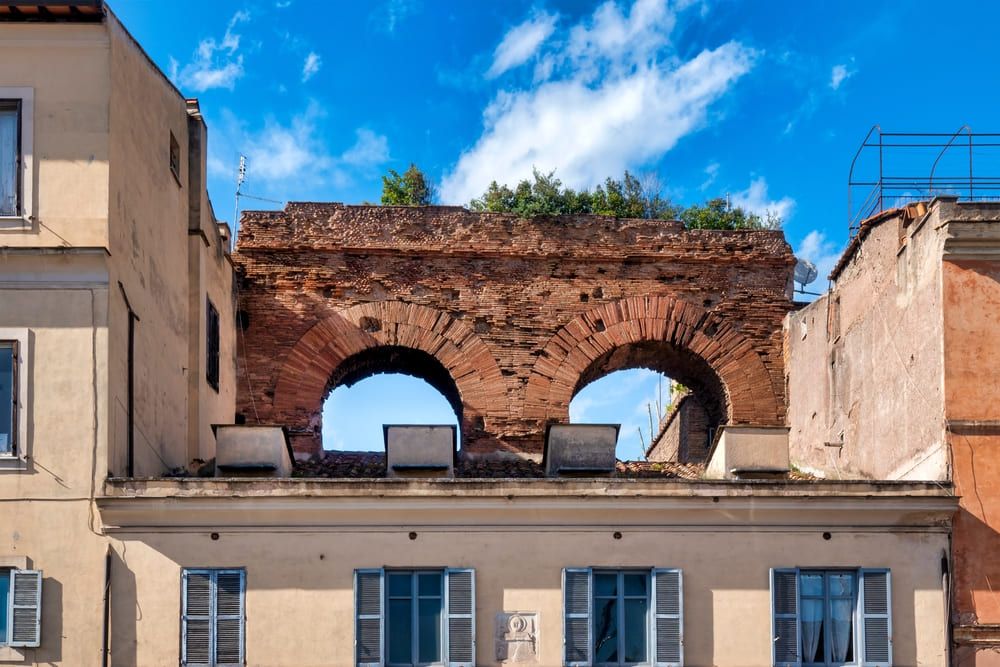
The Rome audio-guided tour has you pass under an arch of the ancient Aqua Claudia aqueduct, which supplied the ancient city with drinking water.
The Aqua Claudia is among the most famous of the aqueducts that supplied ancient Rome. Begun under the emperor Caligula, it was completed under the reign of Claudius, in the first century after Jesus Christ, then extended under Nero to serve a greater number of districts. Its waters came from springs located in the valley of the Aniene, a tributary of the Tiber, and supplied the Palatine hill, the hills of the Aventine and the Caelian, as well as the district of Trastevere, on the other side of the river. Distributed by a network of water castles and according to a precise allocation, the water was reserved partly for the emperor, for private individuals and for public uses such as basins and places of spectacle. The imposing arches still visible bear witness to the hydraulic genius of the Romans, which was the admiration of the ancient world.
The Aqua Claudia aqueduct impresses with its monumental arches, vestiges of Roman hydraulic genius. It recalls how water, captured far away in the valleys, supplied the hills and the districts of the ancient city. It is an evocative stage of the ingenuity of imperial Rome.
Arches of the Aqua Claudia aqueduct are visible at several points in Rome; some can be discovered freely outdoors, along the walk. The archaeological parks that preserve large sections of it may have their own hours, to be checked on site.
Under the reign of the emperor Claudius, in the first century after Jesus Christ, after having been begun under Caligula.
From springs located in the valley of the Aniene, a tributary of the Tiber, conveyed to the hills of Rome.
Aucun avis pour le moment
