





Walk
Through ramparts and secret alleyways
Lucca, Italy
Walk
Through ramparts and secret alleyways
Lucca, Italy
3.5 km
Distance
1h30
Durée
17
Audios
Loop
Parcours
Shutterstock
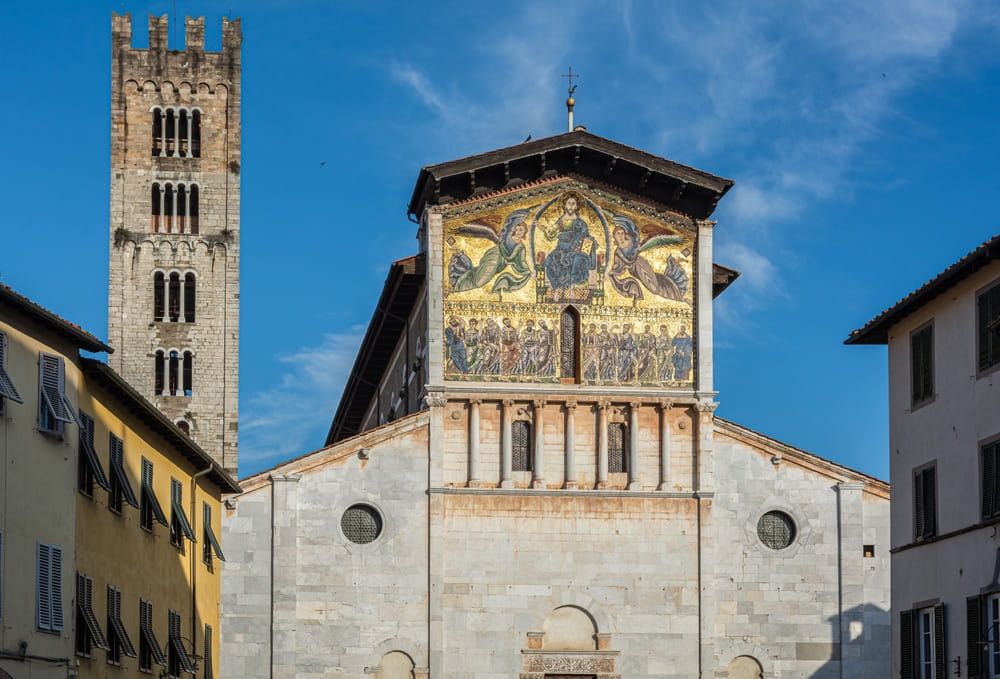
The Basilica of San Frediano is one of the finest Romanesque churches of Lucca, famous for the golden mosaic of its façade. The Lucca audio-guided tour stops here, with respect, to evoke this major sanctuary, which sparkles in the Tuscan sun.
The Basilica of San Frediano is one of the most remarkable sanctuaries of Lucca. This Romanesque church, whose origins date back to the early Middle Ages and which was rebuilt in the twelfth century, stands out by the magnificent golden mosaic that adorns the top of its façade. In Byzantine style, it represents the Ascension of Christ and shines in the Tuscan sun. Inside, the basilica keeps precious works of art, including an ancient sculpted baptismal font, frescoes and adorned chapels, as well as the venerated body of Saint Zita, a beloved figure of the town. A sanctuary of great devotion, the Basilica of San Frediano is discovered with respect.
You admire, with respect, the Romanesque church and its magnificent golden mosaic in Byzantine style representing the Ascension of Christ, which shines on the façade, as well as its sculpted baptismal font, its frescoes and the venerated body of Saint Zita. The Basilica of San Frediano is a major sanctuary of Lucca. It is a stop to be discovered with respect.
The Basilica of San Frediano lies in the heart of the old town of Lucca, near the Amphitheatre Square, reachable on foot. A place of worship, it can be visited with respect for services; access and hours follow their own conditions, which vary. It is best to check them before coming and to respect the sacred character of the place.
Its magnificent golden mosaic in Byzantine style, which adorns the top of its façade and represents the Ascension of Christ; this Romanesque church also keeps a sculpted baptismal font and the venerated body of Saint Zita.
In the heart of the old town of Lucca, in Italy.
Aucun avis pour le moment
