





Walk
The town that watches over Saint Nicholas
Bari, Italy
Walk
The town that watches over Saint Nicholas
Bari, Italy
3.5 km
Distance
1h30
Durée
20
Audios
Loop
Parcours
Shutterstock
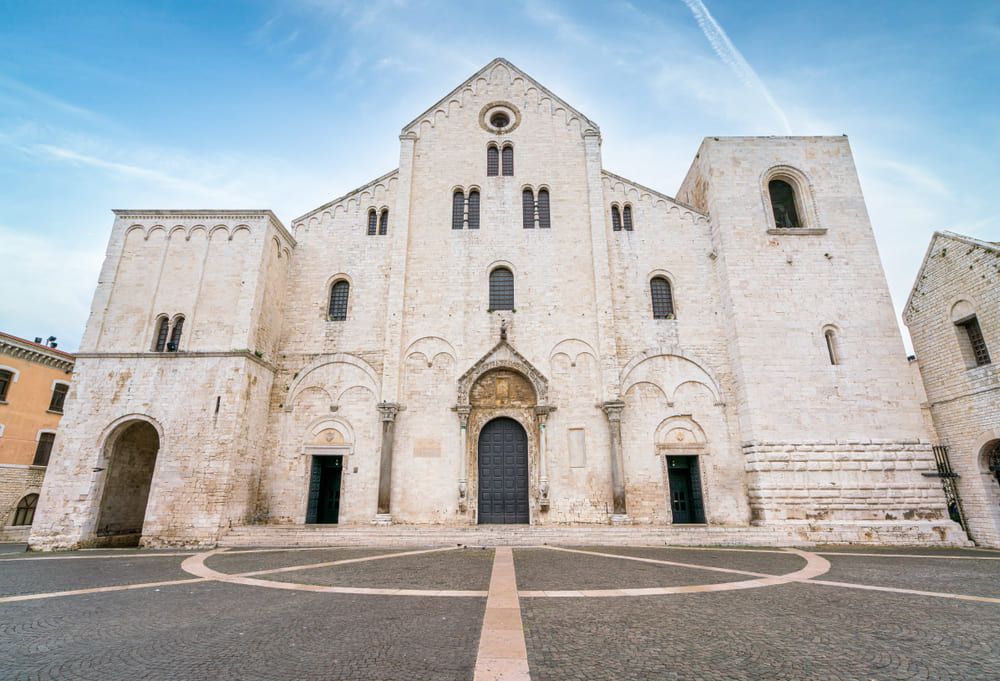
St Nicholas Basilica is one of the most important monuments of Bari and a great place of pilgrimage. The Bari audio-guided tour stops here, with respect, to evoke this Romanesque sanctuary, which houses the relics of St Nicholas.
St Nicholas Basilica is a major example of the Romanesque architecture of Apulia. It was built at the end of the eleventh century to house the relics of St Nicholas, brought to Bari. Venerated by Catholic as well as Orthodox faithful, the saint makes the basilica a great place of pilgrimage and a link between the Christianities of East and West. Its crypt keeps the tomb of the saint.
You admire the Romanesque architecture of Apulia, the interior of the basilica and the crypt that houses the tomb of St Nicholas, in an atmosphere of contemplation. A major place of pilgrimage, the basilica unites the Christianities of East and West. It is a must-see stop of Bari, to be discovered with respect.
St Nicholas Basilica lies in the heart of Bari Vecchia, reachable on foot. A working place of worship and a place of pilgrimage, it can be visited with respect for services; entry is generally free, but hours vary with celebrations. Appropriate dress is required. It is best to enquire before coming and to respect the sacred character of the place.
Because it houses the relics of St Nicholas, venerated by Catholics and the Orthodox; it is a great place of pilgrimage and a major example of Apulian Romanesque.
In the heart of Bari Vecchia, the old town of Bari.
Aucun avis pour le moment
