





Walk
The Eternal City
Roma, Italy
Walk
The Eternal City
Roma, Italy
6.7 km
Distance
2h40
Durée
24
Audios
Loop
Parcours
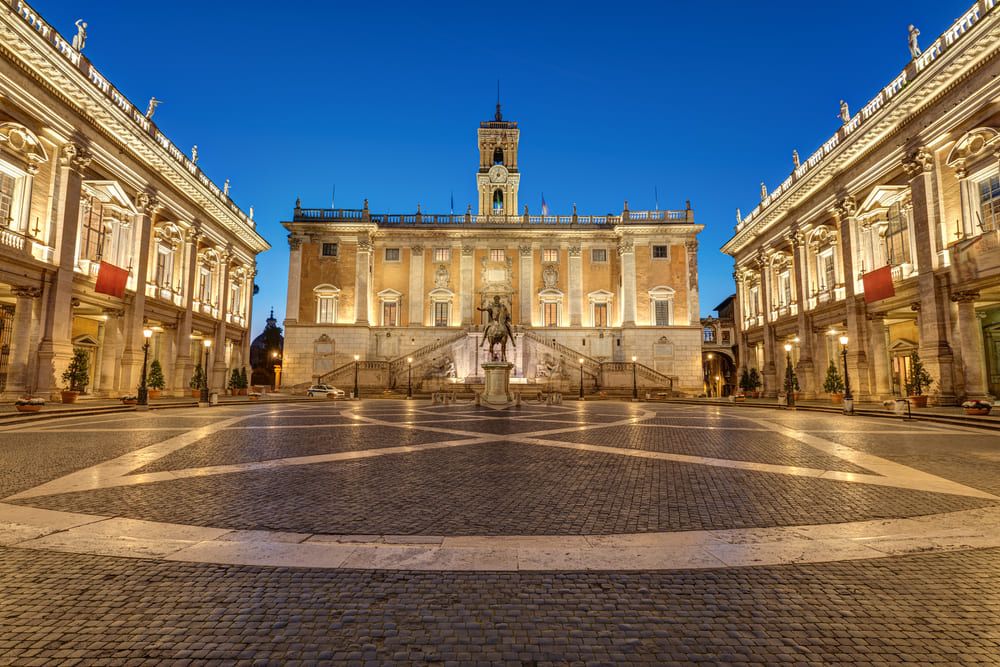
Shutterstock
The Rome audio-guided tour takes you to the heart of the city, at the top of the Capitoline, the smallest of the seven hills, where stretches the majestic square designed by Michelangelo.
From Antiquity, the Capitoline hill housed a fortified square, symbol of the political and religious power of Rome, open onto the Forum. In 1536, in anticipation of the visit of the emperor Charles V, Pope Paul III, judging the place to be in poor condition, entrusted Michelangelo with designing a new square. The architect oriented it towards St Peter's Basilica, then the political heart of sixteenth-century Rome, and had laid out in this direction the Cordonata, the monumental ramp by which one still accesses today, once open to pedestrians as well as to riders. At the top, the visitor is welcomed by the statues of the Dioscuri, Castor and Pollux, the twins of mythology. At the centre of the square stands the famous equestrian statue of Marcus Aurelius, framed by the palaces that compose this harmonious ensemble, one of the masterpieces of Renaissance urban planning.
The Capitoline Square charms with its harmonious design by Michelangelo, its Cordonata ramp and the statues of the Dioscuri that frame it. At its centre, the equestrian statue of Marcus Aurelius is a true jewel, surrounded by the palaces that today house the Capitoline Museums. It is one of the most beautiful monumental ensembles of Rome, at the top of the historic hill.
The Capitoline Square is at the top of the Capitoline hill, in Rome, and is reached by the Cordonata ramp. In free access on foot at all hours, it gives access to the palaces that house the Capitoline Museums, whose visit is generally subject to a charge, according to hours to be checked on site.
Michelangelo, from 1536, at the request of Pope Paul III, in anticipation of the visit of the emperor Charles V.
The famous equestrian statue of Marcus Aurelius, surrounded by the palaces that today house the Capitoline Museums.
Aucun avis pour le moment
