






Walk
The town that watches over Saint Nicholas
Bari, Italy
Walk
The town that watches over Saint Nicholas
Bari, Italy
3.5 km
Distance
1h30
Durée
20
Audios
Loop
Parcours
©Francesco Falconetti, CC BY-SA 4.0. <https://creativecommons.org/licenses/by-sa/4.0/deed.fr>via Wikipedia Commons
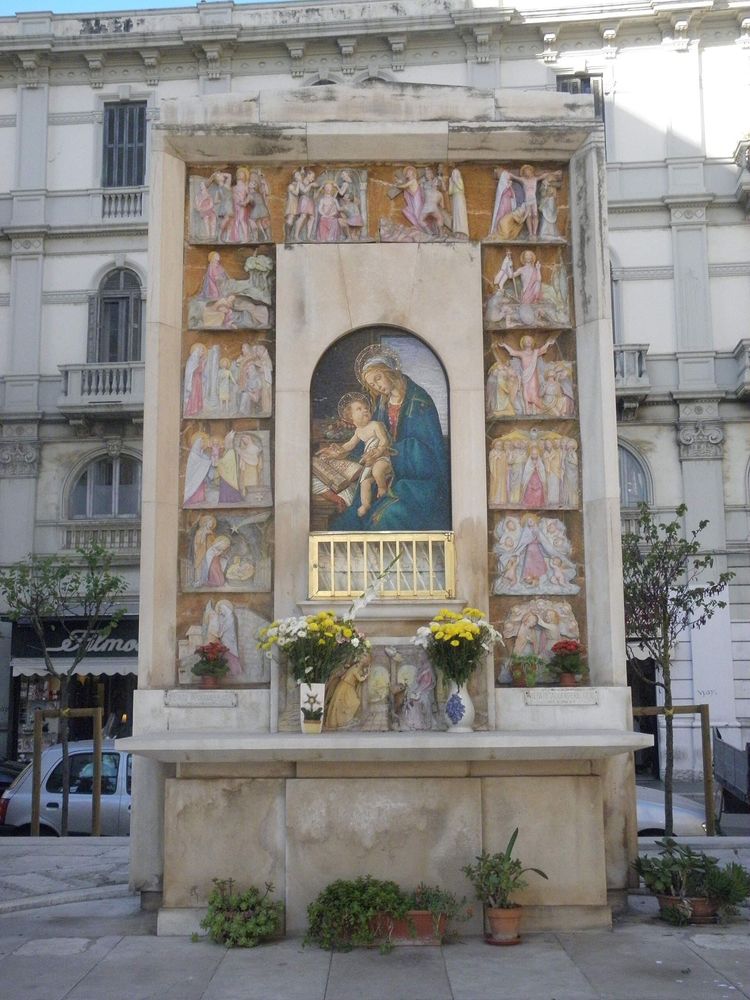
Walking through the lanes of Bari Vecchia, you discover the edicole votive, those small sacred niches that adorn the walls. The Bari audio-guided tour stops here, with respect, to evoke these testimonies of popular devotion that punctuate the old town.
The edicole votive are small religious niches or tabernacles, placed on the walls of the lanes of Bari Vecchia. Housing holy images, statues of the Virgin or of saints, adorned with flowers and lights, they testify to the popular devotion deeply rooted in the old town. Watched over by the inhabitants, they are an integral part of the setting and the soul of Bari Vecchia.
Here you discover, along the lanes, the sacred niches adorned with images, statues, flowers and lights, which line the walls of the old town. The edicole votive illustrate the popular devotion of Bari Vecchia. It is a stop for those curious about traditions and authentic atmosphere, to be walked with respect.
The edicole votive are discovered in the lanes of Bari Vecchia, reachable on foot. They are open-air elements, freely visible from the public space, with no ticket office. You admire them during a walk in the old town, with respect for their sacred character and the life of the district.
They are small religious niches or tabernacles placed on the walls of the lanes of Bari Vecchia, testimonies of popular devotion.
In the lanes of Bari Vecchia, the old town of Bari.
Aucun avis pour le moment
