






Walk
The town that watches over Saint Nicholas
Bari, Italy
Walk
The town that watches over Saint Nicholas
Bari, Italy
3.5 km
Distance
1h30
Durée
20
Audios
Loop
Parcours
Shutterstock
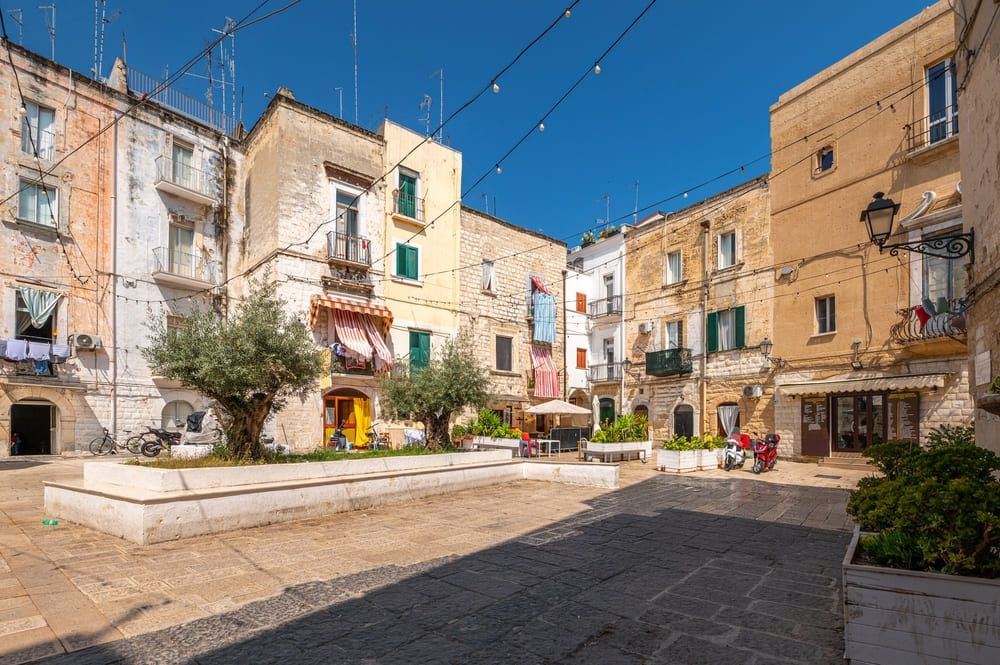
Largo Albicocca, also called the Square of Lovers, is one of the most charming and photogenic squares of Bari Vecchia. The Bari audio-guided tour stops here to evoke this small picturesque corner, nestled along the lanes.
Largo Albicocca, whose name is said to come from an apricot tree now gone, is a charming little square of Bari Vecchia. Nicknamed the Square of Lovers, Piazza degli Innamorati, it charms by its intimate atmosphere, its weathered façades and its picturesque staircase. Among the most photogenic corners of the old town, it invites strolling and reverie along the lanes.
You admire the charming little square, its weathered façades and its picturesque staircase, in the intimate atmosphere of Bari Vecchia. Largo Albicocca is one of the most photogenic corners of the old town. It is a stop full of charm, to be discovered along the lanes.
Largo Albicocca lies in the heart of Bari Vecchia, reachable on foot. It is a public space open at all times, freely accessible; you discover it along the lanes of the old town. It is best to go there on foot and to respect the calm and the daily life of the inhabitants of the district.
It is said to come from an apricot tree now gone; the little square is also nicknamed the Square of Lovers, Piazza degli Innamorati.
In the heart of Bari Vecchia, the old town of Bari.
Aucun avis pour le moment
