




Walk
Through ramparts and secret alleyways
Lucca, Italy
Walk
Through ramparts and secret alleyways
Lucca, Italy
3.5 km
Distance
1h30
Durée
17
Audios
Loop
Parcours
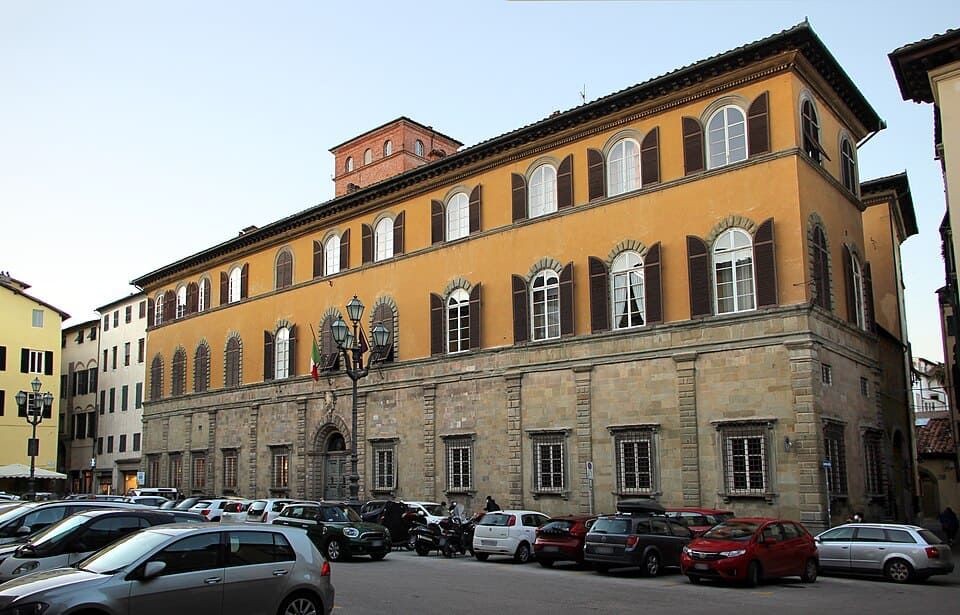
©Sailko, CC BY 3.0
The Bernardini Palace is an elegant Mannerist palace of Lucca, inspired by the great Florentine residences. The Lucca audio-guided tour stops here to evoke this imposing residence, a witness of the refinement of the town in the Renaissance.
The architecture of the Bernardini Palace stands out by its Mannerist style, inspired by the great Florentine residences of the Renaissance. Its imposing façade is characterised by its rusticated stones on the ground floor, which give it a solid base, by its flat pilasters integrated into the wall, inspired by the Doric style of Greek antiquity, and by its adorned windows. Built for a great family of Lucca, this palace testifies to the wealth and the taste of the aristocracy of the town, which rivalled the neighbouring cities like Florence. With its elegance and its nobility, the Bernardini Palace is one of the finest civil buildings of Lucca and a witness of its golden age.
You admire the imposing Mannerist façade with rusticated stones on the ground floor, flat pilasters of Doric inspiration and adorned windows, the residence of a great family inspired by the Florentine residences, a witness of the golden age of Lucca. The Bernardini Palace is one of the finest civil buildings of the town. It is a stop for those curious about architecture, to be explored on foot.
The Bernardini Palace lies in the heart of the old town of Lucca, on the square of the same name, reachable on foot. You mainly admire its façade from the square; it is a building whose access follows its own uses. You discover it during a walk in the historic centre.
Its Mannerist architecture inspired by the great Florentine residences, with its façade with rusticated stones on the ground floor, its flat pilasters of Doric inspiration and its adorned windows, a witness of the aristocracy of the town.
In the heart of the old town of Lucca, in Italy.
Aucun avis pour le moment
