


Piazza Mercantile

Shutterstock

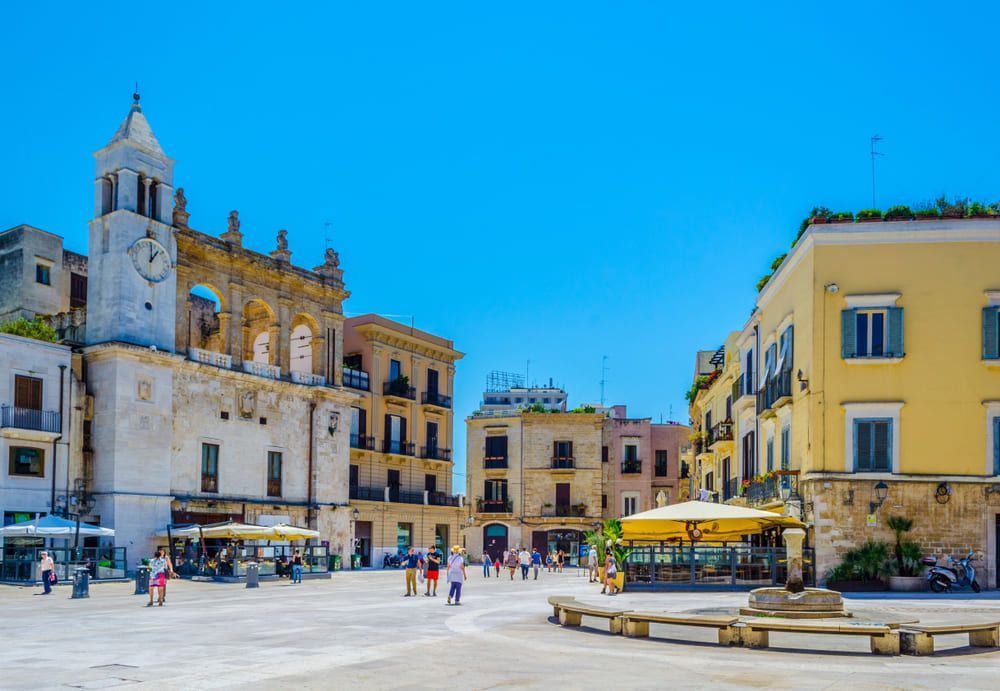
After following a stretch of the Via Francigena del Sud, tracing the path of the pilgrims who passed through Bari, you have arrived at Piazza Mercantile, the political, commercial, and judicial heart of the city since the Middle Ages. This is where the market was held, business was concluded, justice was rendered, and public punishments took place. Look ahead, in a corner of the square. On a small platform of four steps, a crouching stone lion grips a shield between its paws. Around its neck, a Latin inscription reads: Guardian of Justice. This is the Colonna della Giustizia, known locally as the Colonna della Vergogna or the "Column of Shame." And with good reason! For centuries, insolvent debtors and bankrupts were brought here, stripped from the waist down, seated astride the lion, their hands bound to the pillar, offered up for the gaze and insults of the entire square. A kind of social death, one from which there was no recovery at the time. As for the lion's age, Roman, Norman, or Spanish? Historians still debate. The most fascinating theory suggests that it is a Roman funerary lion from the 1st century, recovered from a tomb in Puglia and reused by the Normans in the 12th century to embody the power of royal justice. Now, let’s move closer to the façade of the Palazzo del Sedile, with its clock and four busts. This building housed the first parliament of Bari, constructed on the ruins of an ancient chapel until its explosion! In 1601, on a Sunday in Lent, a small fire broke out in a neighboring warehouse. The wind was strong that day. The flames reached the city's arsenal, and two barrels of gunpowder exploded. The Palazzo was razed, causing the deaths of sixty people. The city rebuilt it in less than a year, and to mark this rebirth, it had a clock imported from Germany installed: the first in Puglia to chime not only the hours but also the quarters. A marvel still heard today. Look up to the upper part. You’ll see four busts that seem to be gazing at you from above. Noble faces? No, they are actually double-faced flower vases, a typical trompe-l'œil of Neapolitan Rococo style. They were commissioned in 1722 by Stefano Fabbri, a Ferrara merchant who had purchased this space and gave his name to the neighboring Piazza del Ferrarese. The small statuettes around the clock’s dial symbolize concord among the citizens, representing what are probably the allegories of justice, prudence, strength, and peace. Before leaving the square, take a look at the building behind you. It was here, at number 2, that on January 16, 1728, the composer Niccolò Piccinni was born, the most illustrious child of Bari, author of over 140 operas and revered in courts across Europe. And despite a small, barely visible plaque, his house is now abandoned and was even almost turned into a pub. This is what Piazza Mercantile is: a square where power, shame, music, and stone intersect.

+1 million de voyages avec Ryo

Explore cities with our audio guides. Wander the most beautiful streets, savor every story.

Google Play

Your pace, our audio guides

Google Play