



Piccinni Theater
Shutterstock
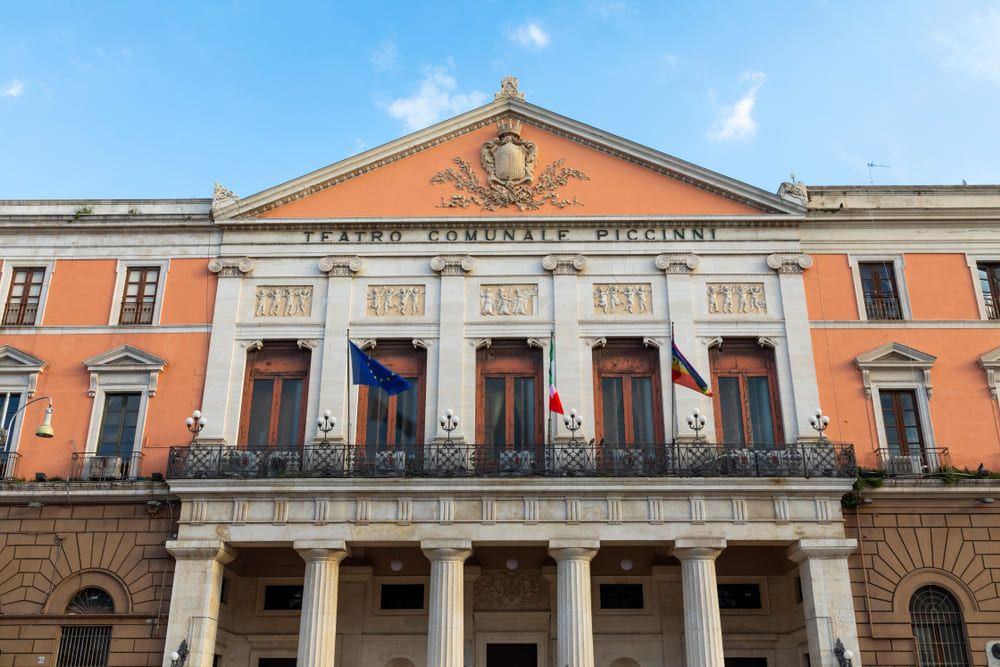
At first glance, this square might seem unremarkable, but it holds many secrets, much like the city of Bari itself. Let’s begin with what stands out right away: the impressive Palazzo Diana with its striking brick-red façade, towering over three floors. Built in 1838, it’s home to one of the city’s most stunning inner courtyards, protected by a glass roof that lets natural light pour in, casting a beautiful glow on the black-and-white checkered marble floor. Today, it belongs to a local family and houses the regional administrative court. Now, take a look upwards, and you’ll notice the statue of Niccolò Piccinni, a beloved son of Bari, born in 1728 in a small alley in the old town. At just 26, he composed his first opera in Naples, then another, and then over a hundred more. He became known as the Prince of Opera. His work Cecchina was performed all across Europe and even, so the story goes, at the Emperor of China’s palace. Not bad for a guy from Puglia, right? In 1776, the King of France invited him to Paris, where he became Marie-Antoinette’s personal singing teacher. But in Paris, he found himself in the middle of a musical rivalry: on one side, his supporters, the Piccinni fans, and on the other, the followers of Gluck, the Gluckists. Piccinni earned massive fame, but it was Gluck who eventually triumphed. The French Revolution wasn’t kind to him either: his pension was revoked, and he was briefly imprisoned because of his daughter’s marriage to a Jacobin. After some time in Naples, he returned to Paris, where finally, Napoleon, a great admirer of his, offered him a position as an inspector at the Conservatory. He passed away in 1800 at the age of 72. Back in Bari, the theater bears his name, and in Paris, there’s still a street named after him. Speaking of which, have you seen the theater? It’s right behind you, with its pink façade and four large white columns framing its entrance. Opened in 1854, it’s Bari’s oldest theater, and even the legend of the old guardian who supposedly haunts its backstage can’t stop opera lovers from enjoying its incredible acoustics. But this square also holds a darker memory. On November 28, 1977, it was here, at the very corner of this square, that an 18-year-old man was murdered. Benedetto Petrone, or "Benny" to his friends, was a communist activist from a poor family in Bari Vecchia. Since childhood, he had a slight limp due to polio. During the political tensions between the far-right and far-left in 70s Italy, around forty neo-fascists emerged from a nearby street. That night, his comrades managed to escape. He couldn’t run fast enough. He was caught and stabbed. The next day, thirty thousand people took to the streets of Bari, and the city declared an official day of mourning. Tributes were held all across Italy, and the first memorial ceremony in his honor took place at Teatro Piccinni, right here. A crossroads rich in history!