
San Sabino Cathedral
Shutterstock
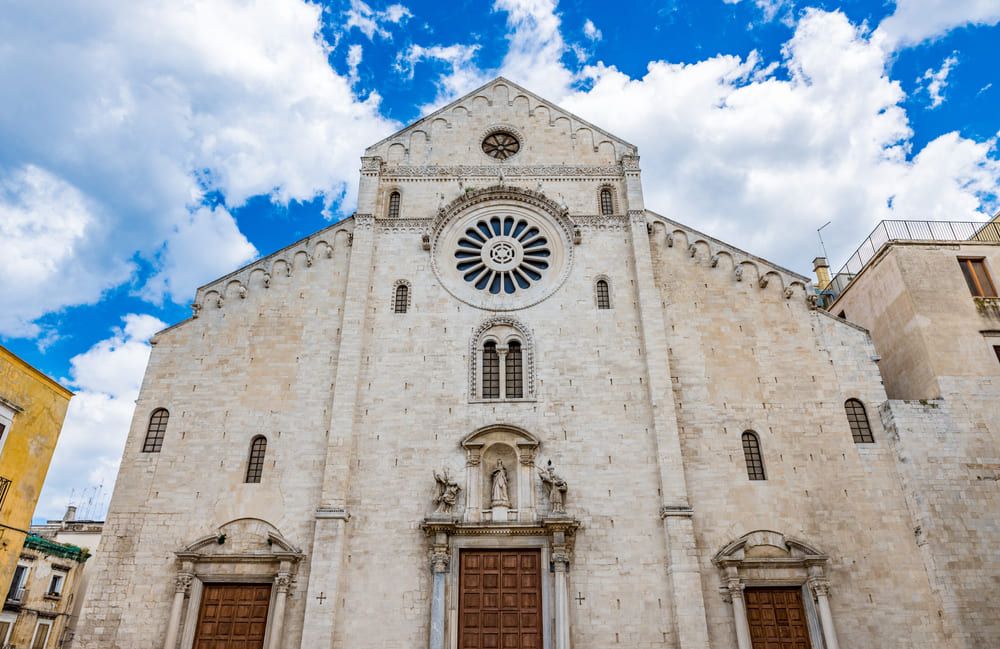
You are now standing on Piazza dell'Odegitria, in front of the majestic San Sabino Cathedral, one of Bari's most important religious landmarks, though often overshadowed by the Basilica of Saint Nicholas, which has drawn visitors for over nine centuries. But this cathedral truly deserves your attention. First, take a look at the façade, made of white-gray limestone. The style is modest, with no gold or unnecessary adornments. Three 11th-century doors open on the ground floor, framed by slender columns with sculpted capitals. Above, a large rose window casts a circle of light onto the floor tiles inside. But the real hidden detail, often overlooked by visitors, lies just above the rose window: a sculpted lintel featuring monsters and mythical creatures—half-lions, half-snakes—intertwined in the stone. This site has been inhabited since the 4th century. A Norman cathedral was first built here in the 11th century, but it was demolished by William the Bad in 1156, along with much of the city. Archbishop Rainaldo had it rebuilt stone by stone at the end of the 12th century, using materials from the original structure. Consecrated in 1292, the cathedral then adopted the Romanesque Apulian style, similar to the Castello Svevo you may have visited. Beneath the cathedral, you can explore a fascinating series of archaeological digs that reveal a hidden city six meters below ground. At the lowest level, Roman black-and-white mosaics, with clearly visible geometric patterns, reveal an ancient street that existed here long before the church was even built. One level higher, you can discover the remains of a 6th-century early Christian basilica, slightly offset from the current building, as shown by the angle of the walls. In one of the floor mosaics, archaeologists even found the name of Bishop Andrea, who served between 758 and 761. More than 1,260 years later, his name is still visible beneath your feet. In the neighboring museum, another treasure awaits: the Exultet, an illuminated Byzantine manuscript from the 11th century. This hymn, sung in Latin during Easter Mass, is unique for its reversed miniatures. This isn’t an error, but rather medieval ingenuity: when a priest unrolled the scroll during the Latin reading, the images were visible the right way for the congregation, who didn’t always understand Latin. A clever way to make the reading accessible while keeping the attention of the faithful. But the care for the people didn’t stop at the church doors. If you continue your visit and step off the main path to see the back of the cathedral, you’ll spot a discreet stone well at the base of the bell tower. This is the Cisterna Bona Sforza, the last remaining of twelve cisterns built in the 16th century by Bona Sforza, Duchess of Bari and Queen of Poland, to address the chronic water shortage faced by locals. On its façade, this Latin inscription is engraved: “Poor thirsty ones, come with joy and without money: drink the water that Bona, Queen of Poland, has prepared for you.” For over four centuries, the people of Bari drew their water from it. Restored in 2023, this cistern now stands as a testament to the generous and enlightened administration of this extraordinary woman.