





Walk
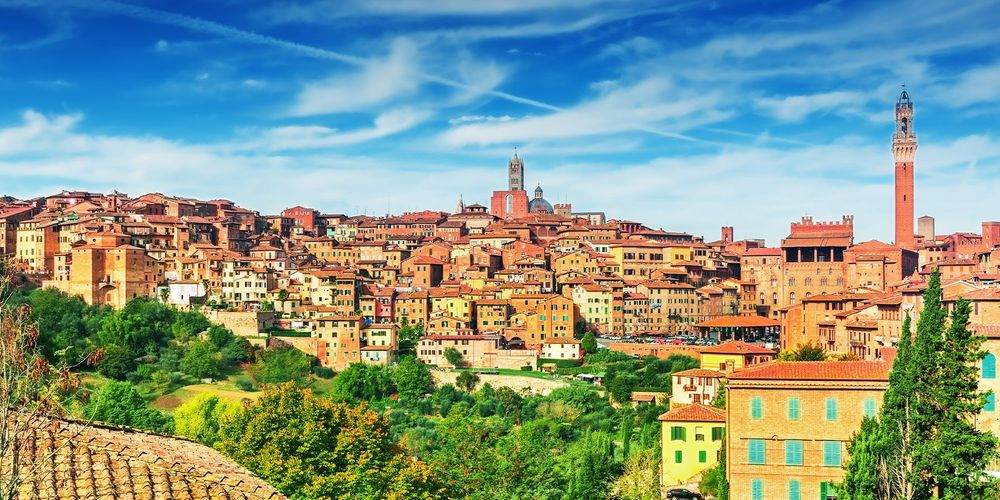
Timeless Medieval Beauty
Siena, Italy
Walk
Timeless Medieval Beauty
Siena, Italy
3 km
Distance
1h30
Durée
21
Audios
Loop
Parcours
Shutterstock
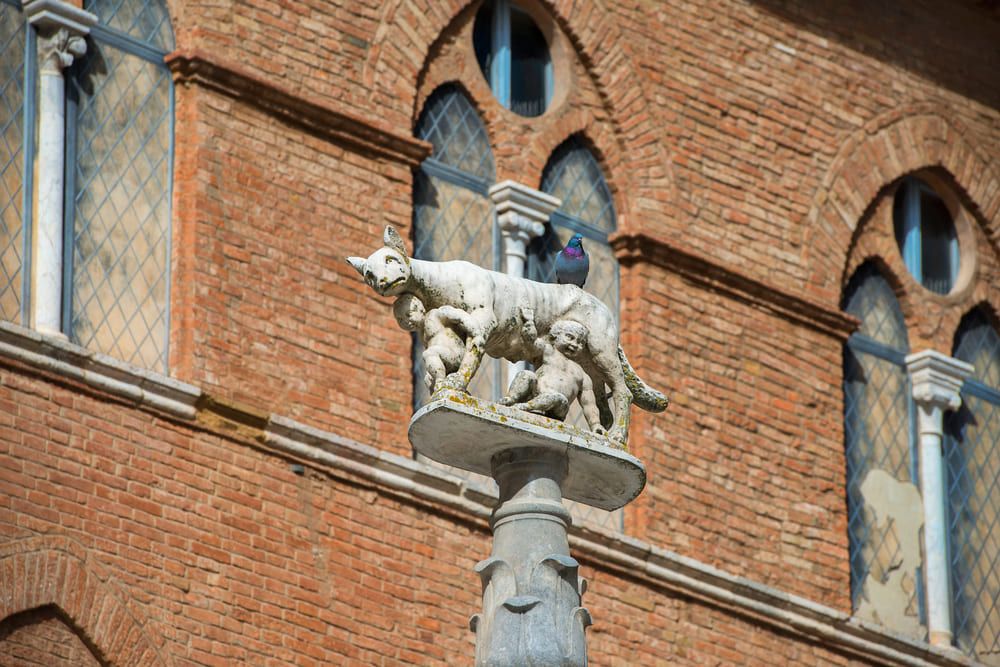
The she-wolf of Siena, perched at the top of a column, is the inseparable symbol of Siena, linked to the legend of its foundation. The Siena audio-guided tour stops here to evoke this emblem, which links the town to Rome and to the legend of Romulus and Remus.
On this square, a column topped with the She-wolf immediately attracts attention: it is the inseparable symbol of Siena, found everywhere in the town. The she-wolf recalls of course the famous Roman legend of Romulus and Remus, suckled by a she-wolf, but here the story takes a local turn. According to tradition, Siena was founded by the sons of Remus, who are said to have fled Rome after the murder of their father by Romulus, taking with them the statue of the nursing she-wolf. The town thus adopted this animal as an emblem, asserting its mythical link with Rome while claiming its own identity. The she-wolf of Siena is found on numerous columns, fountains and façades of the town, where she suckles the twins, as a constant reminder of this founding legend. An emblem laden with history and pride, the she-wolf of Siena is a must-see symbol of the discovery of Siena.
You admire the column topped with the She-wolf suckling the twins, the inseparable symbol of Siena, linked to the legend according to which the town was founded by the sons of Remus, who are said to have fled Rome with the statue of the nursing she-wolf; it is found on numerous columns, fountains and façades of the town. The she-wolf of Siena is a must-see emblem of Siena. It is a stop to be discovered, to be explored on foot.
The she-wolf of Siena is discovered on a column in the heart of Siena, and on numerous fountains and façades of the town, reachable on foot. They are open-air elements, freely visible. You discover them during a walk in the historic centre.
According to the legend, Siena was founded by the sons of Remus, who are said to have fled Rome after the murder of their father by Romulus, taking the statue of the nursing she-wolf; the town adopted this animal as an emblem, asserting its mythical link with Rome.
On a column and numerous fountains and façades of the heart of Siena, in Tuscany, in Italy.
Aucun avis pour le moment
