



Walk
Short tour -The Eternal City
Roma, Italy
Walk
Short tour -The Eternal City
Roma, Italy
4.4 km
Distance
1h45
Durée
19
Audios
Loop
Parcours
@Shutterstock
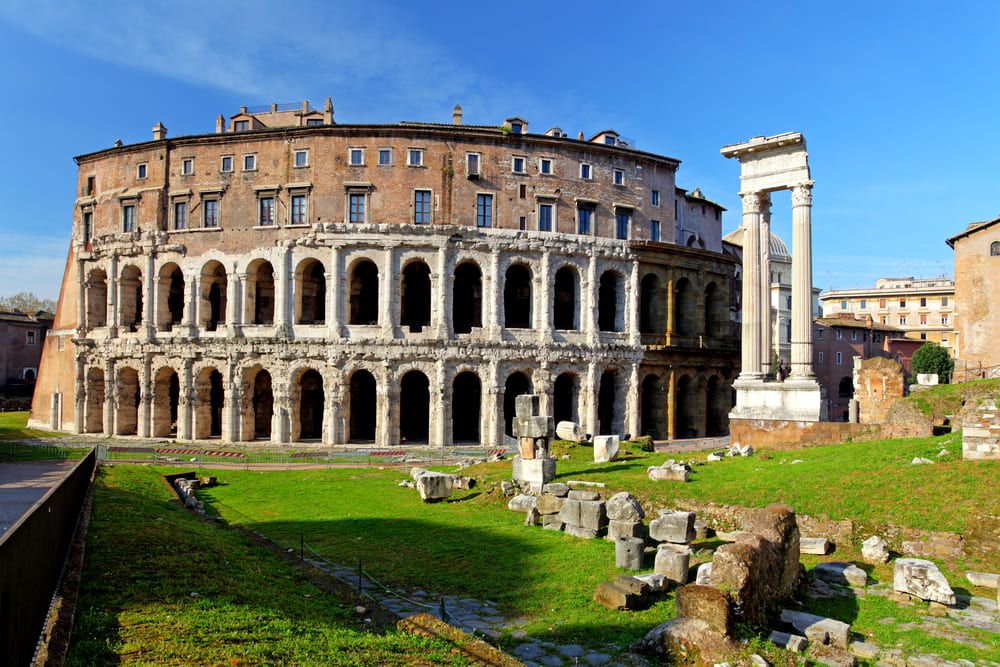
You may feel as though you are looking at a smaller version of the Colosseum. The resemblance is striking, but don’t be fooled: the Theatre of Marcellus is a century older, and it served a completely different purpose. There were no gladiator fights here.
Instead, audiences came to watch plays, musical performances and major public ceremonies. Its semicircular shape also sets it apart from the Colosseum, which completely enclosed its central arena. The project was launched by Julius Caesar, who had no hesitation in clearing a large part of the neighbourhood to make room for it.
He never saw the finished result, however, as he was assassinated before the work was completed — for entirely unrelated reasons! It was Augustus who eventually finished and inaugurated the theatre towards the end of the first century BC. He named it after Marcellus, his nephew and son-in-law, who had died at the age of just 19.
The young man had been considered a possible heir to the emperor, and his premature death deeply affected the imperial family. At its height, the theatre could accommodate around 15,000 spectators. Its monumental façade had three levels of arches and would later help inspire the design of the Colosseum.
Today, the first two ancient levels are still clearly visible. The upper section looks more like a palace because, after the fall of the Roman Empire, the theatre was converted first into a fortress and later into a residence for powerful Roman families.So what you see before you is almost two thousand years of history stacked one above the other: an ancient theatre, a medieval fortress and a Renaissance palace. It would be hard to find a better summary of Rome!
The archaeological area also contains three imposing columns from the Temple of Apollo Sosianus. Their position beside the theatre is no coincidence. Think back to your mythology lessons: Apollo was, among other things, the god of music and the arts.
A little farther away once stood the Temple of Bellona, the Roman goddess of war. Only part of its raised platform survives today, but a rather unusual ceremony once took place in front of it. To declare war officially on a distant people, a priest would throw a spear towards a column that symbolically represented enemy territory.
This meant the Romans could perform the required ritual before attacking a land hundreds of miles away—without having to travel all that way just to throw the spear!
Aucun avis pour le moment