





Walk
Tuscany’s hidden surprise
Pistoia, Italy
Walk
Tuscany’s hidden surprise
Pistoia, Italy
3 km
Distance
1h20
Durée
23
Audios
Loop
Parcours
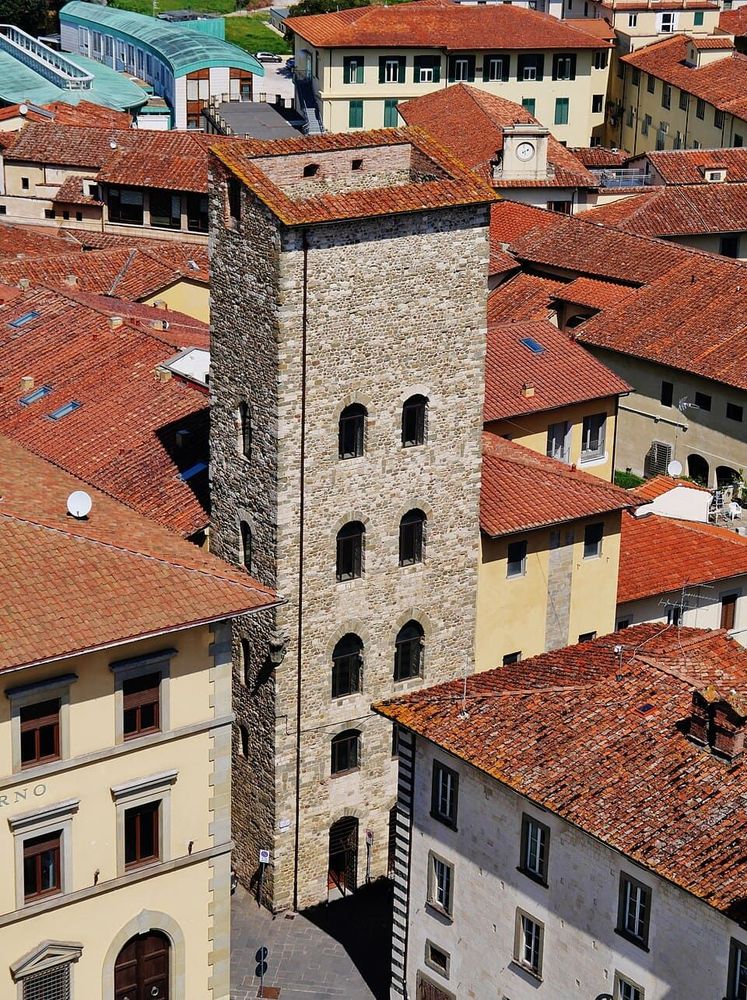
©Zairon, CC BY 4.0. <https://creativecommons.org/licenses/by-sa/4.0/deed.fr>via Wikipedia Commons
This more modest tower is actually much older than the grand monuments of Piazza del Duomo. It’s known as the Torre di Catilina. Originally, it stood even taller than it does today, rising well above the rooftops of the city.
Its exposed stone, simple and solid, reflects its original defensive role, back when Pistoia was a fully fortified stronghold. But what really makes this tower stand out is its name, which goes back to a much earlier figure: Catiline. This Roman senator from the 1st century BC is best known for attempting to overthrow the Roman Republic.
Ambitious and repeatedly defeated in his bids to become consul, notably against Cicero, he eventually turned to force. He organized a conspiracy to assassinate several senators, create unrest in Rome, and rally those who felt left behind. But the plot was uncovered, and in 63 BC, Cicero publicly denounced him.
Forced to flee, Catiline took refuge in Etruria, present-day Tuscany, where he gathered an army of supporters. According to legend, he died in battle near Pistoia the following year, fighting to the very end, surrounded by his enemies, an ending that helped shape his lasting image as both a conspirator and a fearless leader. During the Middle Ages, locals came to believe that his body was buried right here, on the site of this tower.
That belief even gave its name to the nearby street, Via della Tomba di Catilina, the Street of Catiline’s Tomb. In reality, historians tend to place the battle outside the city, and there’s no real proof that he was buried here. But the story has endured.
It’s exactly this mix of history and legend that gives the tower its character, as a witness to more than a thousand years of history.
Aucun avis pour le moment
