





Walk
A world of art
Florence, Italy
Walk
A world of art
Florence, Italy
7.8 km
Distance
3h10
Durée
26
Audios
Loop
Parcours
Shutterstock
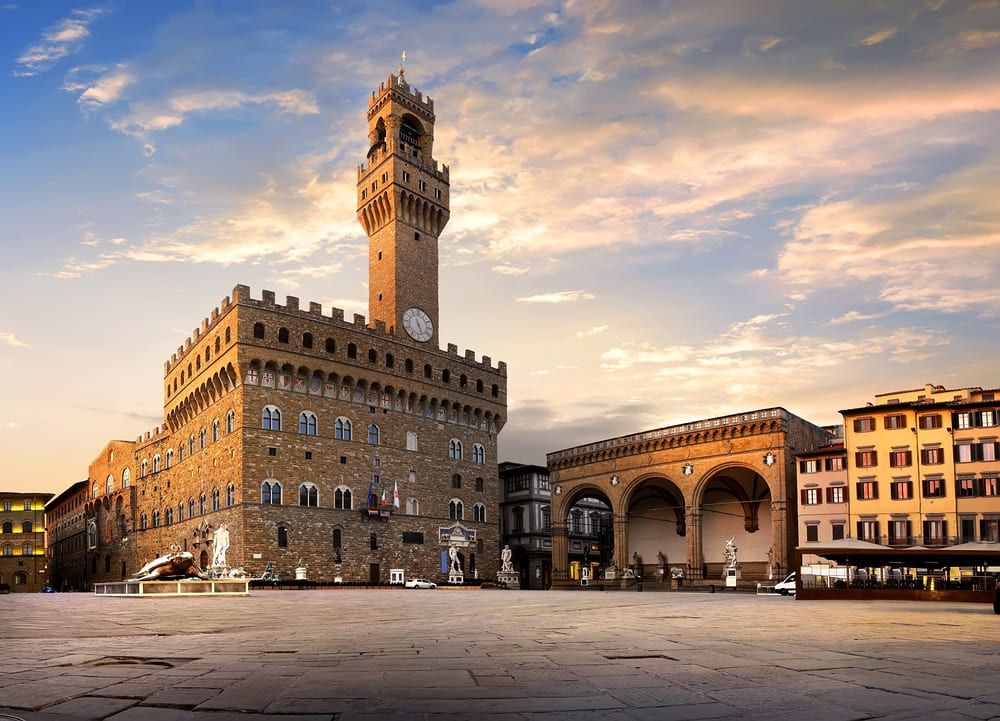
The Palazzo Vecchio and the Piazza della Signoria form the political heart of Florence, a true open-air museum of sculpture. The Florence audio-guided tour stops here to evoke this fortress-palace with a high tower and this square adorned with masterpieces.
The Palazzo Vecchio is the town hall of Florence and the symbol of its political power since the Middle Ages. Built from the end of the thirteenth century, this massive fortress-palace, surmounted by its high crenellated tower, the Arnolfo Tower, was the seat of the Signoria, the government of the Florentine Republic, then the residence of the Medici become grand dukes. Inside, you admire sumptuous decorated halls, including the immense Hall of the Five Hundred, adorned with frescoes by Vasari. In front of the palace extends the Piazza della Signoria, the historic and political heart of the town, a true open-air museum of sculpture: there you see a copy of Michelangelo's David, the Neptune Fountain, the equestrian statue of Cosimo I, and the Loggia dei Lanzi, sheltering masterpieces like Cellini's Perseus. The beating heart of Florence, the Palazzo Vecchio and the Piazza della Signoria are a major stop.
You admire the fortress-palace town hall with the high crenellated Arnolfo Tower, the former seat of the Signoria and residence of the Medici, its decorated halls including the Hall of the Five Hundred, and the Piazza della Signoria, an open-air museum of sculpture with the copy of the David, the Neptune Fountain and the Loggia dei Lanzi sheltering Cellini's Perseus. The Palazzo Vecchio is the political heart of Florence. It is a major stop, to be explored on foot.
The Palazzo Vecchio and the Piazza della Signoria lie in the heart of Florence, reachable on foot. The square and its sculptures are freely accessible; the visit of the palace and the tower follows its own hours and conditions, which vary, and the site is very busy. It is best to check the arrangements before coming.
The town hall of Florence, a fortress-palace with the high Arnolfo Tower, built from the end of the thirteenth century, which was the seat of the Signoria then the residence of the Medici; it shelters decorated halls including the Hall of the Five Hundred, and faces the Piazza della Signoria.
In the heart of Florence, in Italy.
Aucun avis pour le moment
