





Walk
The Eternal City
Roma, Italy
Walk
The Eternal City
Roma, Italy
6.7 km
Distance
2h40
Durée
24
Audios
Loop
Parcours
Shutterstock
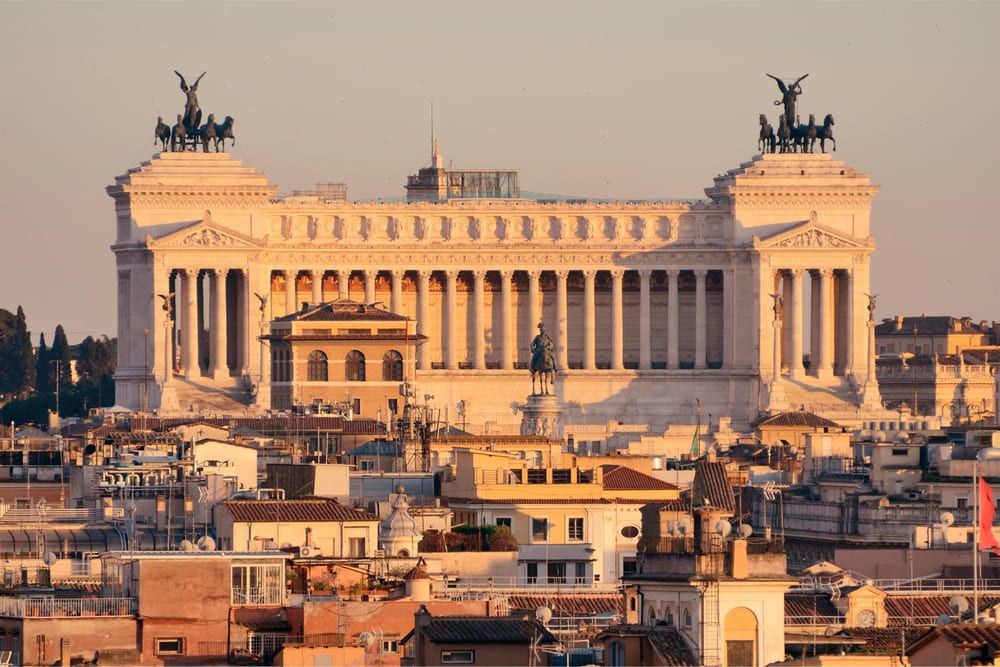
The Rome audio-guided tour presents you with the imposing monument to Victor Emmanuel II, raised on the Piazza Venezia, in tribute to the first king of unified Italy.
Before diving into the Rome of the emperors, this monument pays tribute to a more recent figure: Victor Emmanuel II of Savoy, first king of unified Italy, nicknamed the father of the homeland. Italy as we know it has only existed since the end of the nineteenth century; the territory was previously fragmented into independent provinces, gradually reunited during the Italian unification, led by three key figures: the Count of Cavour, Garibaldi and Victor Emmanuel II. In 1861, the deputies of almost all of Italy gathered to vote the creation of the kingdom of Italy. On 20 September 1870, the Italian troops took Rome, and a plebiscite confirmed shortly after its annexation to the kingdom. After Turin then Florence, Rome finally became the capital. The vast white marble monument, raised on the Piazza Venezia between the end of the nineteenth and the beginning of the twentieth century, celebrates this national unity.
The monument to Victor Emmanuel II impresses with its monumental white marble façade and its equestrian statue of the first king of Italy. Nicknamed the Altar of the Homeland, it dominates the Piazza Venezia and offers beautiful views over Rome. It is a major symbol of Italian unity, on an imposing scale.
The monument to Victor Emmanuel II is on the Piazza Venezia, in the heart of Rome. Its façade and its esplanades can be discovered freely; some spaces and panoramic terraces can generally be visited under paid access, according to hours to be checked on site.
The first king of unified Italy, nicknamed the father of the homeland, an actor of the Italian unification in the nineteenth century.
The unity of Italy, achieved in the nineteenth century, of which Rome became the capital after Turin and Florence.
Aucun avis pour le moment
