






Walk
Japan’s lively and food-loving scene
Osaka, Japan
Walk
Japan’s lively and food-loving scene
Osaka, Japan
4 km
Distance
1h45
Durée
19
Audios
Loop
Parcours
Shutterstock
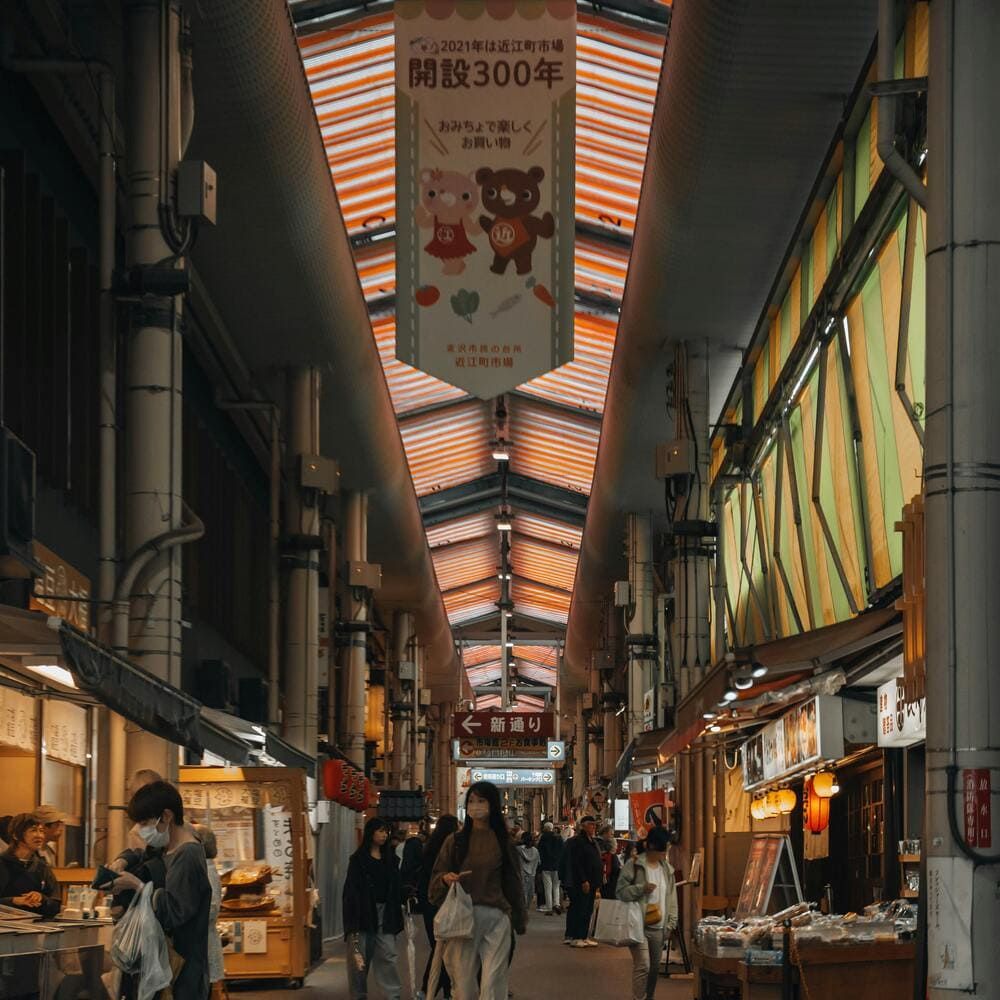
The Osaka audio-guided tour has you discover the Kuromon Market, also called Kuromon Ichiba, one of the most emblematic places of the city, nicknamed for more than two centuries "the kitchen of Osaka".
Under this long covered gallery of about six hundred metres, one enters a market born at the beginning of the nineteenth century, at the end of the Edo period, when fish merchants gathered near the large black gate of the Enmyōji temple, now disappeared, which gave its name to the place. Remaining an essential supply place for the chefs of Osaka, Kuromon today lines up nearly one hundred and fifty stalls: fishmongers, butchers, fruit and vegetable stalls, small restaurants and street food stands.
Seafood occupies a central place there: tunas cut on the spot, crabs, sea urchins and sashimi prepared to order. One also tastes there the great specialities of Osaka, such as takoyaki, balls of dough filled with octopus, okonomiyaki, a kind of thick pancake, or kushikatsu, breaded and fried skewers. One eats on the go there, in small portions; it is customary to stop near the stall rather than to walk while eating, and to take care not to block the passage.
The Kuromon Market is in the Nipponbashi district, in Osaka, under a covered gallery. The stalls generally open during the day, according to their own hours; the market is particularly lively in the middle of the day and at the weekend. Access is on the level. It is appropriate to respect local customs and the cleanliness of the place.
From the large black gate of the Enmyōji temple, now disappeared, near which fish merchants once gathered.
Ultra-fresh seafood, but also takoyaki, okonomiyaki and kushikatsu, great popular specialities of Osaka.
Aucun avis pour le moment
