





Walk
Japan’s lively and food-loving scene
Osaka, Japan
Walk
Japan’s lively and food-loving scene
Osaka, Japan
4 km
Distance
1h45
Durée
19
Audios
Loop
Parcours
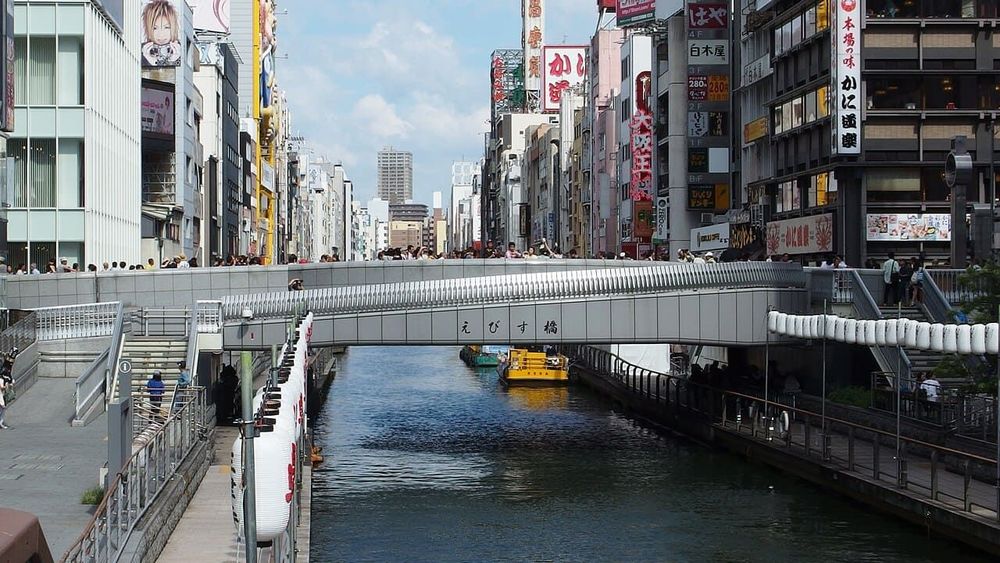
©Mc681 BY-SA 4.0 <https://creativecommons.org/licenses/by-sa/4.0/deed.fr>via Wikipedia Commons
The Osaka audio-guided tour takes you onto Ebisubashi, the most famous bridge of Dōtonbori. Linking the districts of Shinsaibashi and Namba above the canal, it has been for decades the most popular meeting point of the city.
Facing the bridge stands the most iconic image of the district: the Glico Man sign, that runner with raised arms who has dominated the bank since 1935 and has become the unofficial symbol of the city. Every evening, about half an hour after sunset, the neon lights come on and transform the landscape into a scene of light reflected in the water. Visitors then gather to reproduce the pose of the Glico Man, a ritual that has become almost obligatory. The bridge is also linked to a famous episode of local baseball, in 1985, when the supporters of the Hanshin Tigers, jubilant, celebrated their title in an atmosphere that has remained legendary.
From the bridge, one is at the exact centre of the energy of Osaka: crowds of visitors, bright signs, street musicians and the constant flow of passers-by create an almost permanent festive atmosphere. It is the ideal place to admire the Glico Man, photograph the reflections of the neon lights on the canal and watch the ballet of the cruise boats passing below.
The Ebisubashi bridge spans the Dōtonbori canal, between Shinsaibashi and Namba, in Osaka. It can be crossed freely on foot at all hours and on the level. The atmosphere and the lighting of the neon signs are particularly spectacular about half an hour after sunset.
An advertising sign representing a runner with raised arms, present since 1935 and become the unofficial symbol of Osaka.
It is the most popular meeting point of Dōtonbori, facing the Glico Man, in the heart of the nocturnal energy of Osaka.
Aucun avis pour le moment
