






Walk
The Echo of the Temples in the Ancient Capital
Kyoto, Japan
Walk
The Echo of the Temples in the Ancient Capital
Kyoto, Japan
5.4 km
Distance
2h15
Durée
25
Audios
Loop
Parcours
Shutterstock
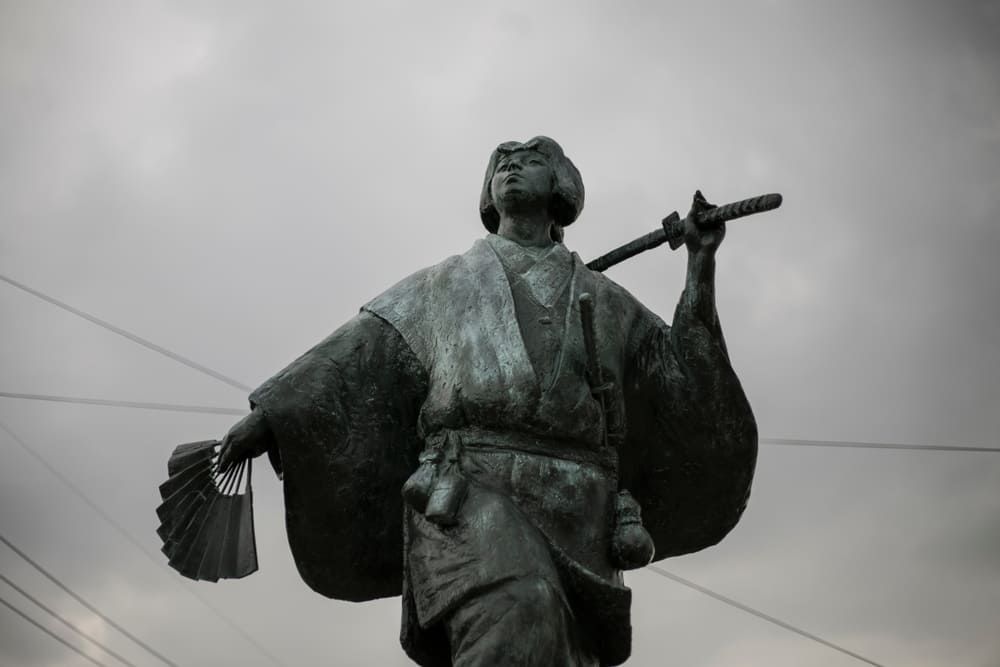
Near the Kamo River, a statue pays tribute to Izumo-no-Okuni, the woman who gave birth to kabuki, one of the great arts of Japan. A priestess of a Shinto shrine, she revolutionised performance in Kyoto. The Kyoto audio-guided tour stops here to evoke this pioneering figure and the birth of an art that became an emblem of Japanese culture.
Izumo-no-Okuni, a priestess of a Shinto shrine born towards the end of the sixteenth century, arrived in Kyoto where she created a new form of dance and performance. Considered the founder of kabuki, she opened the way to one of Japan's most emblematic arts. The statue, installed in the early 2000s in the Pontochō district, celebrates this bold creator, long left in the shadows.
The statue, expressive, represents Izumo-no-Okuni in a dancing posture, evoking the energy of the first kabuki performances. Set near the Kamo River, facing the theatre district, it is discovered during a walk. It is a stop for those interested in traditional Japanese arts and the often-overlooked role of women in their birth.
The statue of Izumo-no-Okuni lies near the Kamo River, close to the Pontochō district and the Minami-za theatre, in the centre of Kyoto, reachable on foot. It is an open-air work, freely visible at all times, with no ticket office. On the level, it is discovered during a walk along the river.
A Shinto priestess born towards the end of the sixteenth century, considered the founder of kabuki theatre, which she created in Kyoto.
Near the Kamo River, close to the Pontochō district and the Minami-za theatre, in the centre of Kyoto.
Aucun avis pour le moment
