



Walk
The rebellious city on the water
Valladolid, Mexico
Walk
The rebellious city on the water
Valladolid, Mexico
4.6 km
Distance
2h00
Durée
17
Audios
Loop
Parcours
Shutterstock
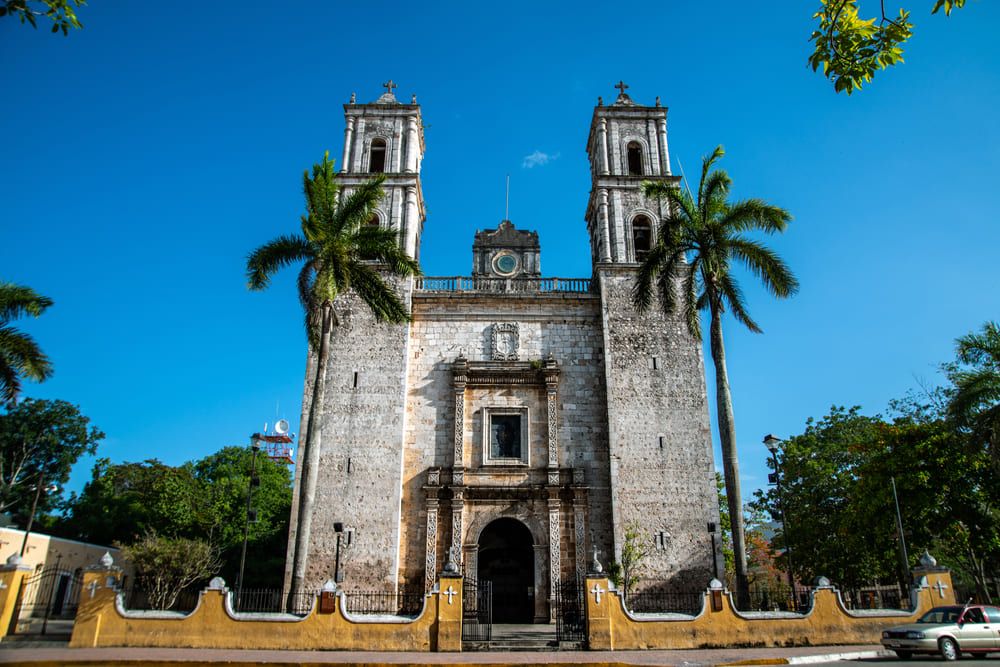
How could you miss the Cathedral of San Gervasio rising impressively before you? Its façade, richly decorated with geometric patterns and a finely carved coat of arms, reflects the remarkable skill of the sculptors, who seem to have created a lacework of stone. Yet behind these elegant ornaments lies a structure designed with defense in mind, as shown by its thick walls and the arrow slits visible on its two towers.
However, its most intriguing feature is its orientation toward the north, a real anomaly for a Catholic church, which traditionally faces west. This unusual layout is the result of a dramatic event that took place in 1703, known as the “Crime of the Mayors.” That year, Osorno, the mayor of Valladolid, known for his reputation as a notorious seducer, turned his attention to the wife of an influential citizen. Driven by jealousy, the man organized a political campaign to remove Osorno and his deputy from office so he could take control of the city government.
Fearing for their lives, the two officials took refuge in the sacristy of the church, believing they would be safe within sacred ground. But on July 12, 1703, a group of eight men led by the new mayor and his accomplice entered the church, dragged the fugitives from their refuge, and beat them to death in front of the church portal. Such an act of violence caused outrage throughout Yucatán.
The viceroy ordered the governor dismissed, and the two perpetrators were arrested, sentenced to death, and hanged in Mérida. But the punishment did not end there. Bishop Don Pedro de los Reyes Ríos declared that the church had been profaned by the double murder committed within its walls.
He ordered it to be partially demolished and rebuilt, with a strong symbolic requirement: the new main façade would face north, a direction associated with penance in Catholic tradition, as a sign of atonement for the sacrilege that had taken place. The cathedral later witnessed other chapters of Yucatán’s history. During the Caste War, Valladolid changed hands several times before being retaken by government forces in 1848.
The cannons used during this reconquest are still preserved inside the church, reminders of that turbulent period and symbols of the eventful history of Valladolid.
Aucun avis pour le moment