





Walk
The rebellious city on the water
Valladolid, Mexico
Walk
The rebellious city on the water
Valladolid, Mexico
4.6 km
Distance
2h00
Durée
17
Audios
Loop
Parcours
Shutterstock
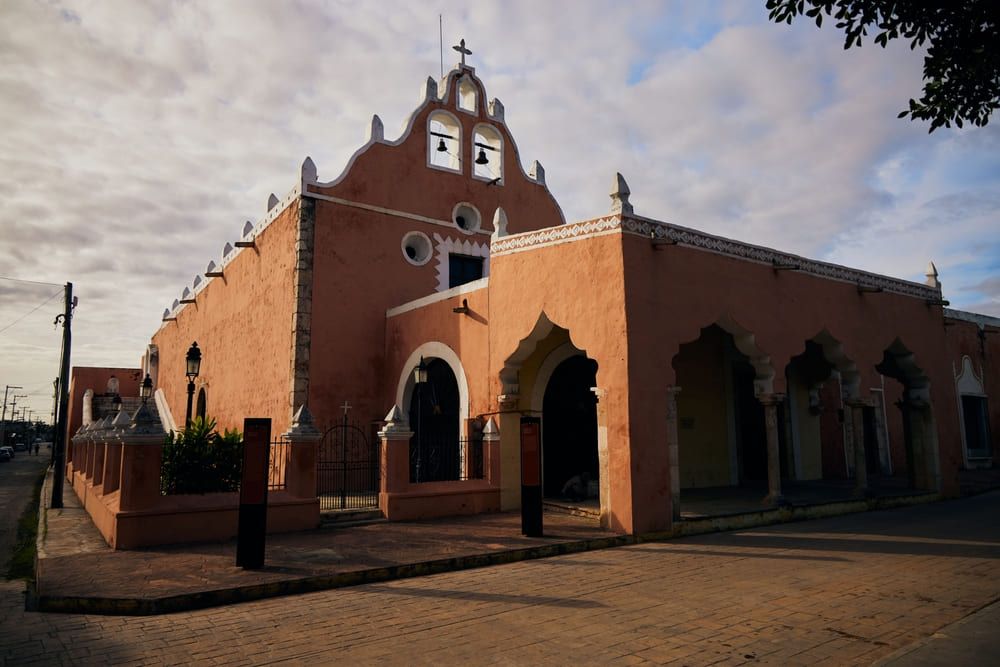
This beautiful orange-colored church dates back to the 18th century and replaced a more modest earlier chapel. It stands out for its three-arched portico inspired by Moorish architecture, quite rare in the region, as well as for its single nave and its bell tower with three bells that are still rung by rope. The church is dedicated to Virgen de la Candelaria, one of the patron saints of Valladolid.
She is usually depicted holding the Child Jesus in one arm and a lit candle in the other, a symbol of light and purity. But devotion to Candelaria did not begin in Mexico. It traces its origins to the Canary Islands at the end of the 14th century, when a statue was said to have been discovered on a beach in Tenerife by the Guanche inhabitants, long before the Spanish conquest.
At first it was venerated as a local sacred figure, but after the arrival of the Spanish it was identified as the Virgin Mary. The devotion later crossed the Atlantic with settlers from the Canary Islands and took root in the Americas, particularly in Yucatán, where it gained a special significance. In Valladolid, several popular stories surround the Virgin.
The most well-known legend is linked to a smallpox epidemic that struck eastern Yucatán around 1907. At that time the disease devastated villages and spread fear throughout the region. According to tradition, a woodcutter walking back to his village saw a woman on the road carrying a child in her arms.
As she passed, the sun was said to darken, a powerful sign in Maya symbolism, where celestial events often signal the presence of the divine. Moved by the vision, he ran to inform the priest of the Church of San Servacio, who later noted that wherever the woman had appeared, the smallpox epidemic had stopped. Since that episode, the Virgen de la Candelaria has been venerated as the protector of Valladolid, and her celebration on February 2 remains one of the most important events in the city.
Aucun avis pour le moment
