



Walk
The rebellious city on the water
Valladolid, Mexico
Walk
The rebellious city on the water
Valladolid, Mexico
4.6 km
Distance
2h00
Durée
17
Audios
Loop
Parcours
Shutterstock
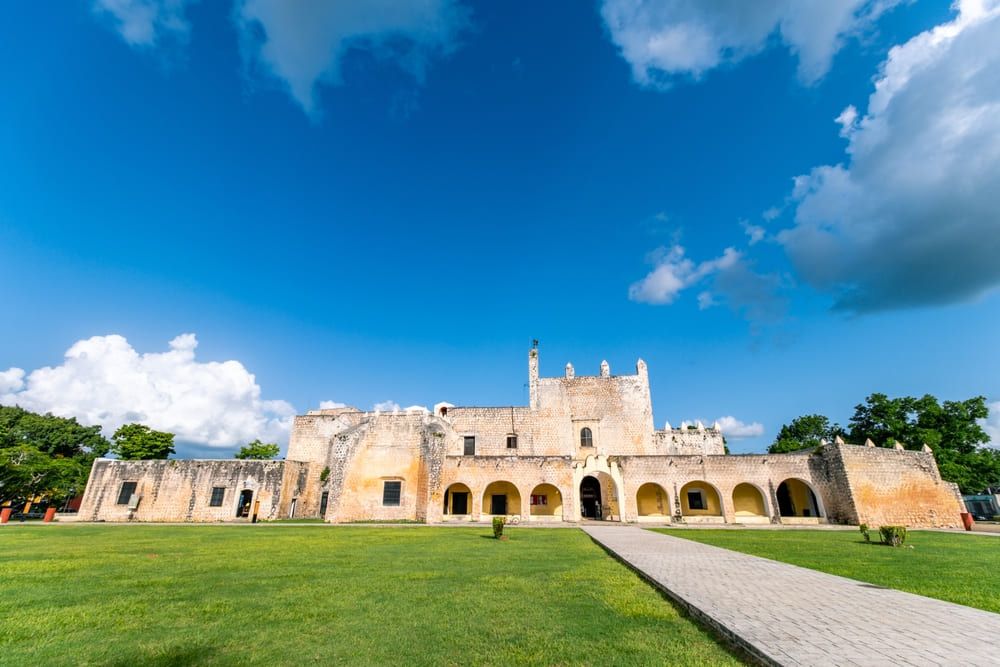
At first glance, it looks like a medieval fortress, but you are actually standing in front of the Convent of San Bernardino of Siena. After the one in Izamal, it is the second largest convent in Yucatán. Its massive appearance, with very thick 16th-century walls and crenellations, is softened by more decorative elements inspired by Renaissance and Baroque styles.
The complex includes a single-nave church, a two-story cloister with pink arcaded galleries, several side chapels, and a large atrium, an open courtyard in front of the church where outdoor ceremonies once took place. Built between 1552 and 1560 by the Franciscans under the direction of Juan de Mérida, the convent was established in the Maya neighborhood of Sisal, west of the Spanish center of Valladolid. Its location away from the main square clearly reflects its original mission: the evangelization of the local Maya population.
But that was not its only role. The convent also served as a school and a hospital, playing an important educational and medical role during a period marked by epidemics. Thanks to its thick walls and direct access to water, it could also function as a military refuge during times of unrest.
It even operated as a largely self-sufficient community, with an orchard, vegetable gardens, and an irrigation system where tropical fruits and vines grew in abundance. Yet you don’t see any rivers or streams here, do you? That is the convent’s special feature.
It was built above an underground cenote. About 24 meters deep, it supplied water to the community through a well and had several natural openings, including one directly in the former kitchen. Chronicles even mention the possibility of catching catfish there and speak of underground connections with other cenotes in the city.
What is certain is that weapons were later found thrown into the cenote, likely to prevent them from falling into enemy hands or simply to dispose of them after battles. Cannons, cannonballs, muskets, and other colonial firearms are now displayed in the convent’s museum. Abandoned and left in ruins in the 19th century, the convent was restored in 1978 and is now one of the must-see landmarks of Valladolid.
And don’t miss the free sound and light show projected onto its façade every evening from Tuesday to Sunday—it’s well worth seeing.
Aucun avis pour le moment