





Walk
A backdrop to Adventure and Legends
Campeche, Mexico
Walk
A backdrop to Adventure and Legends
Campeche, Mexico
4.3 km
Distance
2h00
Durée
22
Audios
Loop
Parcours
Shutterstock
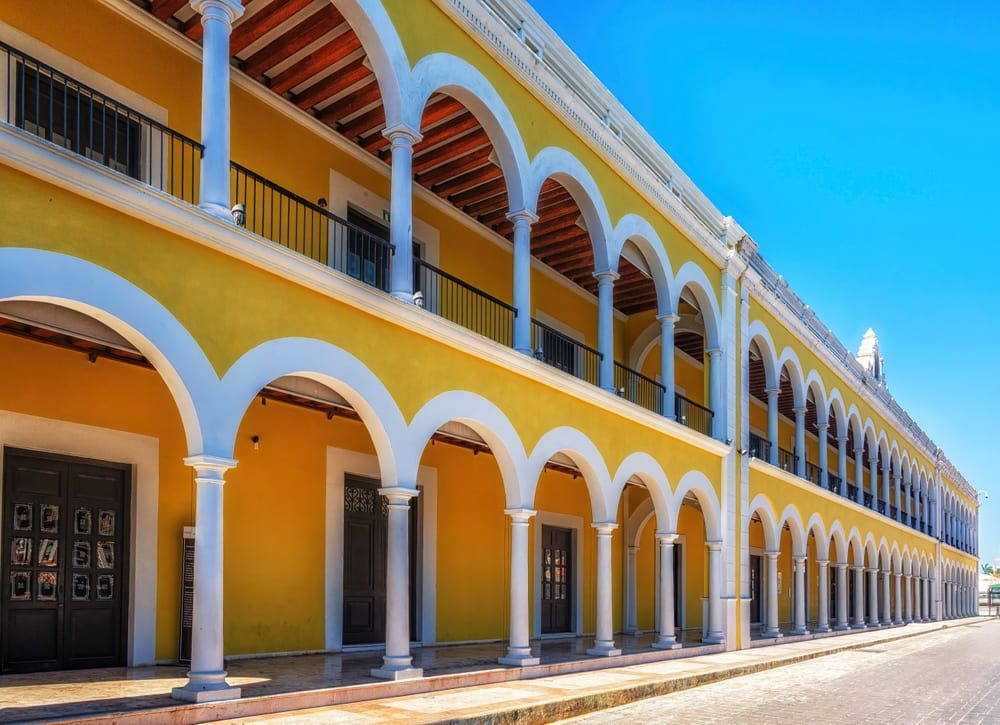
El Palacio is the great yellow building that lines the north side of the Plaza de la Independencia, become a cultural and museum centre. The Campeche audio-guided tour stops here to evoke this place that shelters the Museo de Fortificaciones, Comercio y Navegación, devoted to the history of the port city between the sixteenth and the nineteenth century, from its fortifications to the trade of the precious campeche wood.
Behind the colonial-inspired façade of El Palacio, the great yellow construction on the north side of the square, hide in reality two museums, devoted to the history of the city and to the contemporary artistic creation of the region. The first is the Museo de Fortificaciones, Comercio y Navegación, dedicated to the history of Campeche between the sixteenth and the nineteenth century. The current building dates from the year 2000, but it rises on the site of important former colonial buildings, notably the customs house and the palace of the government. The museum retraces the history of this port city, long a major commercial centre of the gulf of Mexico. Its rooms evoke the fortifications built to protect the city from pirates, the importance of the trade of the campeche wood, much sought in Europe for the dyeing of fabrics, as well as the navigation and the maritime life of the colonial era, through ship models and old maps. The campeche wood is a small tropical tree with a dark red sap, native to Mexico and Central America; it owes its name to the port of Campeche, from which it was massively exported to Europe from the seventeenth century, its dyeing properties making it a resource of considerable value.
Here you visit, in the great yellow building of the main square, the Museo de Fortificaciones, Comercio y Navegación, that retraces the history of Campeche from the sixteenth to the nineteenth century: fortifications against pirates, trade of the campeche wood sought in Europe, navigation and maritime life, through models and old maps. El Palacio tells the great port history of Campeche. It is a fine stop, to be explored on foot.
El Palacio lies on the north side of the Plaza de la Independencia, in the heart of the historic centre of Campeche, reachable on foot. It is a cultural and museum centre whose access is often free; the hours vary. It is best to enquire before coming.
The Museo de Fortificaciones, Comercio y Navegación retraces the history of Campeche between the sixteenth and the nineteenth century: the fortifications built against pirates, the trade of the campeche wood sought in Europe for the dyeing of fabrics, and maritime life, through ship models and old maps; the building rises on the site of the former customs house and the palace of the government.
On the north side of the Plaza de la Independencia, in the heart of the historic centre of Campeche, in Mexico.
Aucun avis pour le moment
