




Walk
The rebellious city on the water
Valladolid, Mexico
Walk
The rebellious city on the water
Valladolid, Mexico
4.6 km
Distance
2h00
Durée
17
Audios
Loop
Parcours
Shutterstock
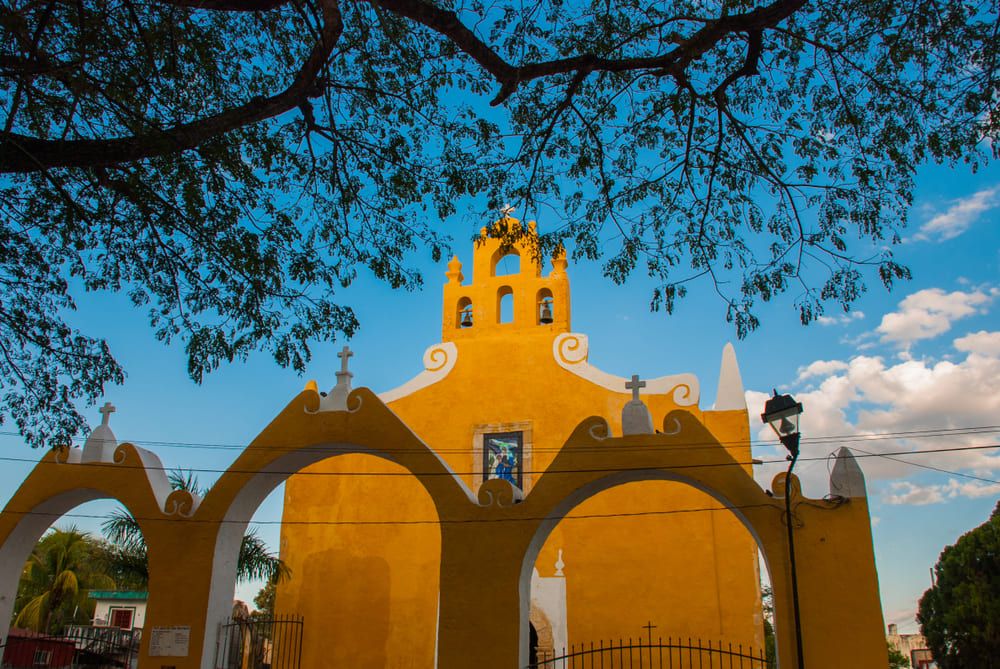
This small and peaceful square actually sits at the crossroads of three major moments in history. First, look at the Church of Santa Ana, the yellow building to your left. Built in the 16th century, it is one of the six colonial churches represented on Valladolid’s official coat of arms.
It was the first church reserved exclusively for the indigenous Maya population of the city. Religious services were conducted in the Maya language, except for the mass itself, which remained in Latin. Modest in appearance, the church holds a rare relic inside: the chest containing the funerary ark of the Cristo del Amor.
Now turn around and look at the white semicircular monument. This Monument to the Niños Héroes honors six cadets who died during the Mexican–American War. After clashes between American and Mexican troops in 1846, the United States declared war on Mexico and invaded the country.
U.S. forces quickly advanced toward Mexico City. On September 13, 1847, they attacked Chapultepec Castle, which at the time housed the Military Academy.
Six young Mexican cadets, between about 13 and 19 years old, refused to retreat despite the order to withdraw. They stayed behind to defend the position against a much larger army, and all were killed during the assault. According to the most famous version of the story, one of them, Juan Escutia, wrapped himself in the Mexican flag and jumped from the ramparts to prevent it from falling into enemy hands, a gesture that later became a powerful symbol of Mexican patriotism.
Santa Ana Park is also the starting point of the Caste War of Yucatán, the longest indigenous rebellion in Mexican history. What is particularly fascinating is that these two events took place in the same year, 1847, only a few weeks apart. After more than three centuries of exploitation and inequality, three Maya leaders joined forces to organize a general uprising.
However, one of them, Manuel Antonio Ay, was betrayed, arrested, and hanged right here in this square where you are now standing, an event that triggered the full-scale rebellion. The insurgents quickly captured many towns, including Valladolid in January 1848, and soon controlled almost all of Yucatán, leaving only Mérida and a few coastal villages under government authority. The war was marked by massacres, the destruction of haciendas, and violent reprisals.
Yet an unexpected turn of events changed the situation. The rainy season arrived, bringing with it the need to plant corn to feed the families of the Maya warriors, forcing them to temporarily abandon the fighting. Mexico used this unexpected pause to send troops and financial support, which eventually allowed Yucatán to be reintegrated into the country in August 1848.
This conflict, long known as the “Caste War,” was in fact a multiethnic social uprising against economic and political oppression. Today, many historians prefer the term “Maya Social War,” and in 2021 Mexico and Guatemala officially asked forgiveness from the Maya people for the crimes committed against them.
Aucun avis pour le moment
