





Walk
The City that rose from the sea
Alesund, Norway
Walk
The City that rose from the sea
Alesund, Norway
3.6 km
Distance
1h50
Durée
18
Audios
Loop
Parcours
Shutterstock
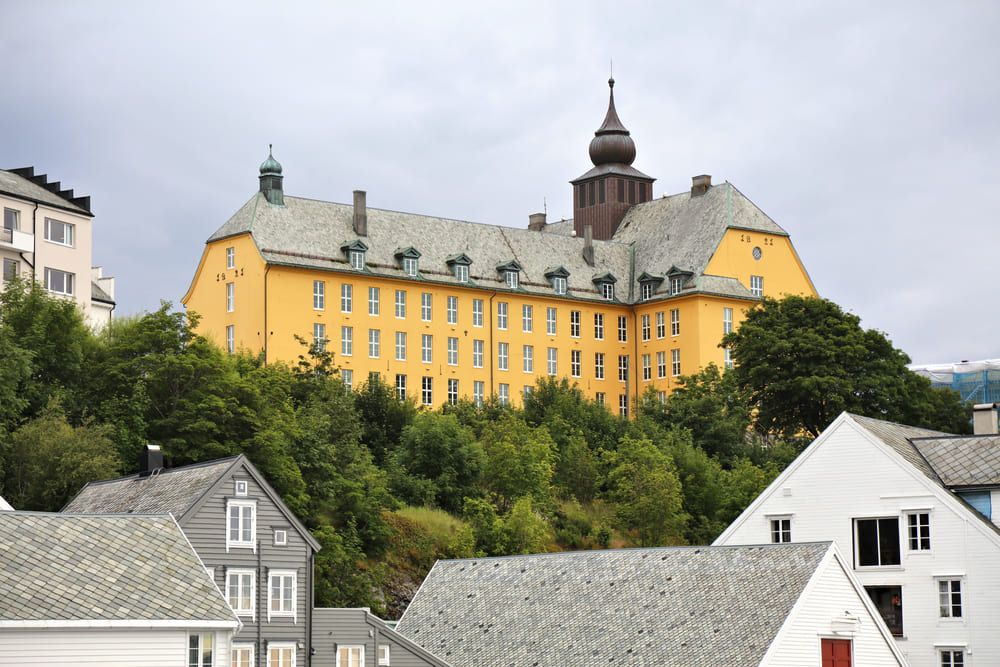
The Aspøy skole is the primary school of Ålesund, a large yellow building bearing the inscription Anno 1921 and the coat of arms of the town. The Ålesund audio-guided tour stops here to evoke this building, a witness of the architecture of the beginning of the twentieth century and of Norwegian society.
This large yellow building, which bears the inscription Anno 1921 and the official coat of arms of Ålesund, is none other than the primary school of the town, the Aspøy skole. This barneskole, the Norwegian name of the primary school, welcomes children from six to thirteen years old in a setting that very clearly reflects the values of current Norwegian society: open, egalitarian and concerned with the well-being of the child. Built at the beginning of the 1920s, in the decades that followed the reconstruction of the town after the fire of 1904, the building testifies to the importance given to education and youth in the Norway of the time. Its fine colourful façade, its careful architecture and its coat of arms make it a remarkable element of the urban heritage. Still in activity, the school continues to play its role in the heart of the local life, transmitting knowledge to the new generations. A witness of the history and the values of Ålesund, the Aspøy skole is an interesting stop of the discovery of the town.
You admire the large yellow building bearing the inscription Anno 1921 and the coat of arms of Ålesund, the primary school of the town, built at the beginning of the 1920s after the reconstruction that followed the fire of 1904, with a fine colourful façade and careful architecture, which welcomes children from six to thirteen years old, a reflection of the values of Norwegian society. The Aspøy skole is a witness of the heritage of Ålesund. It is a stop to be discovered, to be explored on foot.
The Aspøy skole lies in the heart of Ålesund, reachable on foot. It is a school in activity, whose exterior you admire from the street. You discover it during a walk in the centre.
The primary school of the town, a large yellow building bearing the inscription Anno 1921 and the coat of arms of Ålesund; this barneskole welcomes children from six to thirteen years old and was built at the beginning of the 1920s, after the reconstruction that followed the fire of 1904.
In the heart of Ålesund, in Norway.
Aucun avis pour le moment
