





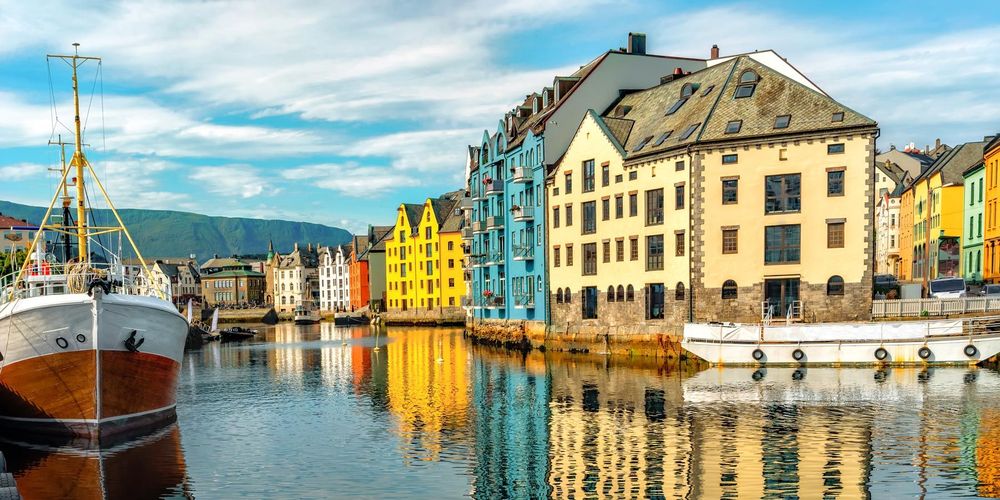
Walk
The City that rose from the sea
Alesund, Norway
Walk
The City that rose from the sea
Alesund, Norway
3.6 km
Distance
1h50
Durée
18
Audios
Loop
Parcours
Shutterstock
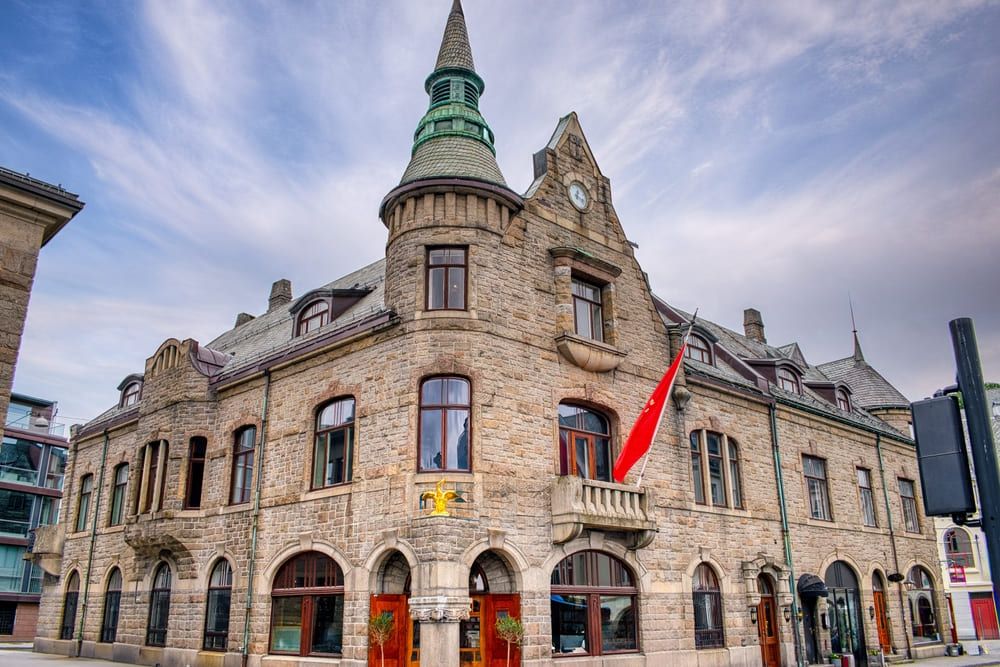
The Jugendstilsenteret is the Art Nouveau centre of Ålesund, installed in a former pharmacy with sumptuous decor. The Ålesund audio-guided tour stops here to evoke this unique museum, dedicated to the Jugendstil that made the town reborn after the great fire of 1904.
Passing in the Apotekergata street, you could almost walk past this place without knowing that one of the most surprising interiors of Ålesund is hidden there. The name of the street already gives a clue: apotek means pharmacy in Norwegian. It is here that one of the best-known pharmacies of the town was formerly located, the Swan Pharmacy, whose swan shining above the door cannot be missed. The building today shelters the Jugendstilsenteret, the Art Nouveau centre, a museum entirely devoted to the Jugendstil, the style that characterises the town. There you discover a magnificently preserved period interior, with its decors, its furniture, its lighting and its refined ornaments, as well as exhibitions that tell the history of the reconstruction of Ålesund after the terrible fire of 1904, which ravaged the town. The museum explains how the town was reborn from its ashes in this style then in vogue. A setting and a conservatory of Art Nouveau, the Jugendstilsenteret is a must-see stop of the discovery of Ålesund.
Here you discover the Art Nouveau museum installed in the former Swan Pharmacy, recognisable by the swan above the door, with its magnificently preserved period interior, its decors, furniture and refined ornaments, and its exhibitions on the reconstruction of Ålesund in Jugendstil style after the fire of 1904. The Jugendstilsenteret is the conservatory of Art Nouveau of Ålesund. It is a must-see stop, to be explored on foot.
The Jugendstilsenteret lies in the Apotekergata street, in the heart of Ålesund, reachable on foot. The visit follows its own hours and conditions, which vary with the season. It is best to check the arrangements before coming.
The Art Nouveau centre of Ålesund, a museum devoted to the Jugendstil installed in the former Swan Pharmacy; it presents a preserved period interior and exhibitions on the reconstruction of the town in Art Nouveau style after the great fire of 1904.
In the Apotekergata street, in the heart of Ålesund, in Norway.
Aucun avis pour le moment
