





Walk
The City that rose from the sea
Alesund, Norway
Walk
The City that rose from the sea
Alesund, Norway
3.6 km
Distance
1h50
Durée
18
Audios
Loop
Parcours
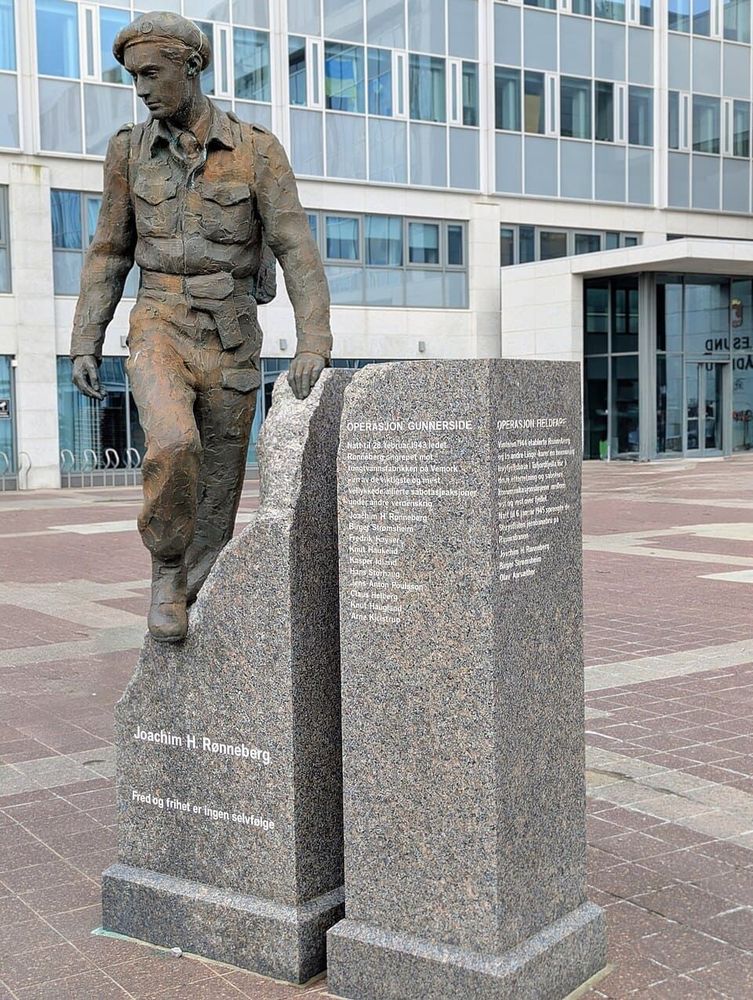
©Back ache, CC BY-SA 3.0
The Town Hall square of Ålesund hosts the statue of Joachim Rønneberg, Norwegian hero of the Second World War. The Ålesund audio-guided tour stops here, with respect, to evoke this tribute to a child of the town, a figure of the Resistance, inaugurated by Princess Astrid.
It is Princess Astrid in person, elder sister of King Harald V of Norway, who officially proceeded to the inauguration of the statue that stands here, in tribute to Joachim Rønneberg. This child of Ålesund, born on 30 August 1919, is a hero of the Second World War. During the occupation of Norway by Nazi Germany, he led one of the most famous and most daring sabotage operations of the war: with a small group of resistance fighters, he managed to destroy the heavy water plant of Vemork, in Norway, thus depriving the Nazi regime of a crucial element for its research, without making a victim. This feat, carried out in extreme conditions in the heart of winter, made him a major figure of the Norwegian Resistance and a national hero. The statue honours his memory, his courage and his commitment to freedom. A place of memory and tribute, the Town Hall square and the statue of Joachim Rønneberg are discovered with respect.
Here you discover, with respect, the statue inaugurated by Princess Astrid in tribute to Joachim Rønneberg, child of Ålesund born in 1919 and hero of the Second World War, who led the famous sabotage of the heavy water plant of Vemork against the Nazi occupier, a major figure of the Norwegian Resistance. The Town Hall square honours the hero of Ålesund. It is a stop to be discovered with respect.
The Town Hall square and the statue of Joachim Rønneberg lie in the heart of Ålesund, reachable on foot. It is a public space and an open-air statue, freely accessible, where you observe the respect due to the memory of the hero. You discover them during a walk in the centre.
A child of Ålesund born in 1919, hero of the Second World War; he led the famous sabotage of the heavy water plant of Vemork against the Nazi occupier, without making a victim, becoming a major figure of the Norwegian Resistance; his statue was inaugurated by Princess Astrid.
On the Town Hall square, in the heart of Ålesund, in Norway.
Aucun avis pour le moment
