



Walk
The Navel of the World
Cusco, Pérou
Walk
The Navel of the World
Cusco, Pérou
5.1 km
Distance
2h20
Durée
23
Audios
Loop
Parcours
Shutterstock
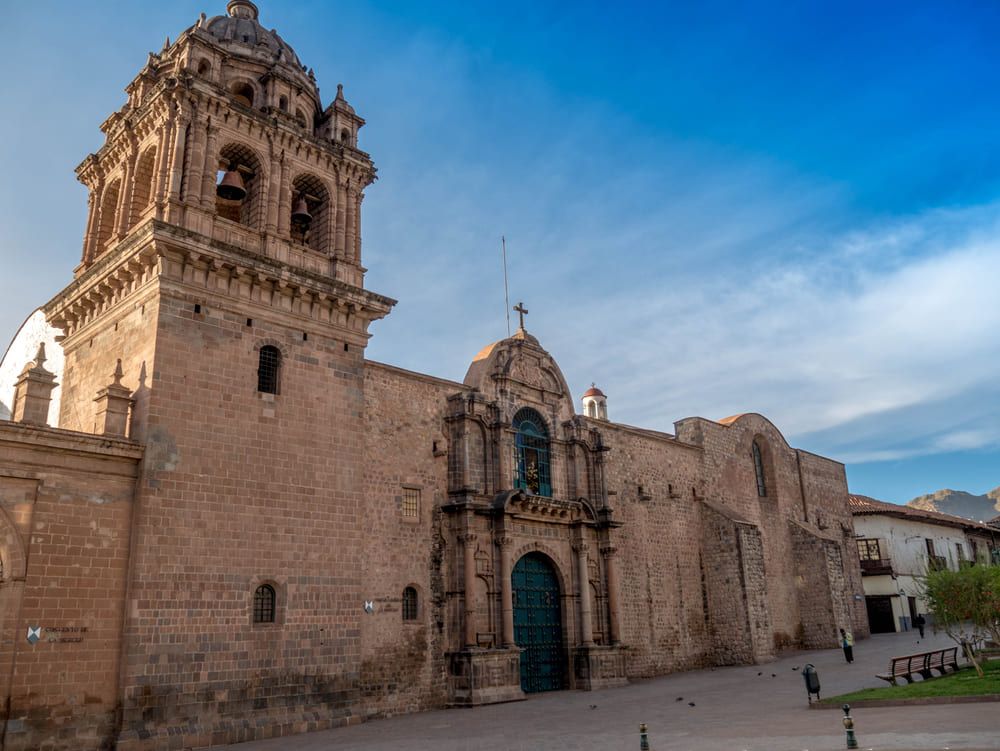
You’re standing in front of La Merced Church, the mother house of the Mercedarian Order in South America. It rises along Calle Mantas, which follows part of the ancient Inca imperial road. Built from dark volcanic stone, the church’s magnificent Baroque façade, with its twisting columns, was reconstructed after the great earthquake of 1650.
If you step inside the monastery museum, there’s one place you absolutely shouldn’t miss: the sacristy. That’s where you’ll find the famous Custodia de La Merced, or La Merced Monstrance, one of the most precious liturgical objects in all of South America. Created in the 17th century, this pure-gold masterpiece is also set with diamonds, pearls, rubies, and emeralds.
Its value is almost impossible to measure, and even today, it is carried through the streets of Cusco each year during the Corpus Christi celebrations. But La Merced’s real secret lies beneath your feet. In the crypt below the main altar rest three major figures from the Spanish conquest: Diego de Almagro the Elder, his son Almagro the Younger, and Gonzalo Pizarro.
The story connecting them reads almost like a dark novel. Almagro the Elder, the longtime associate of Francisco Pizarro—the “discoverer” and conqueror of Peru—eventually went to war against him for control of Cusco. Defeated, Almagro was beheaded on the Plaza de Armas in 1538.
Four years later, his son tried to avenge him, only to meet exactly the same fate on the very same square. And then came Gonzalo Pizarro, brother of the famous conqueror, who was also executed in the same way after rebelling against the Spanish Crown. So after fighting one another over gold and power and ending up beheaded in public, fathers, sons, and rivals now rest together for eternity beneath the same altar.
History does have a sense of irony.
Aucun avis pour le moment