





Walk
The Volcanic City
Arequipa, Pérou
Walk
The Volcanic City
Arequipa, Pérou
3.9 km
Distance
1h45
Durée
15
Audios
Loop
Parcours
Shutterstock
You’ll often hear that Arequipa was founded right here in the heart of San Lázaro—but that’s actually a bit of a historical myth. Long before the Spanish arrived, this area was already home to the pre-Columbian Yarabaya people. These early inhabitants of the Chili River valley belonged to the Puquina world, an important Andean culture that existed well before the Incas.
The Yarabaya spoke Puquina, a language so ancient that some researchers believe it may even have given Arequipa its name—and that it was the famous secret language of the Inca elite. When conquistadors loyal to Pizarro arrived in 1539, one year before the city was officially founded on the Plaza de Armas, they settled here. Over the centuries, through Inca rule, the Spanish conquest, epidemics, and cultural mixing, the Yarabaya identity gradually blended into the local population.
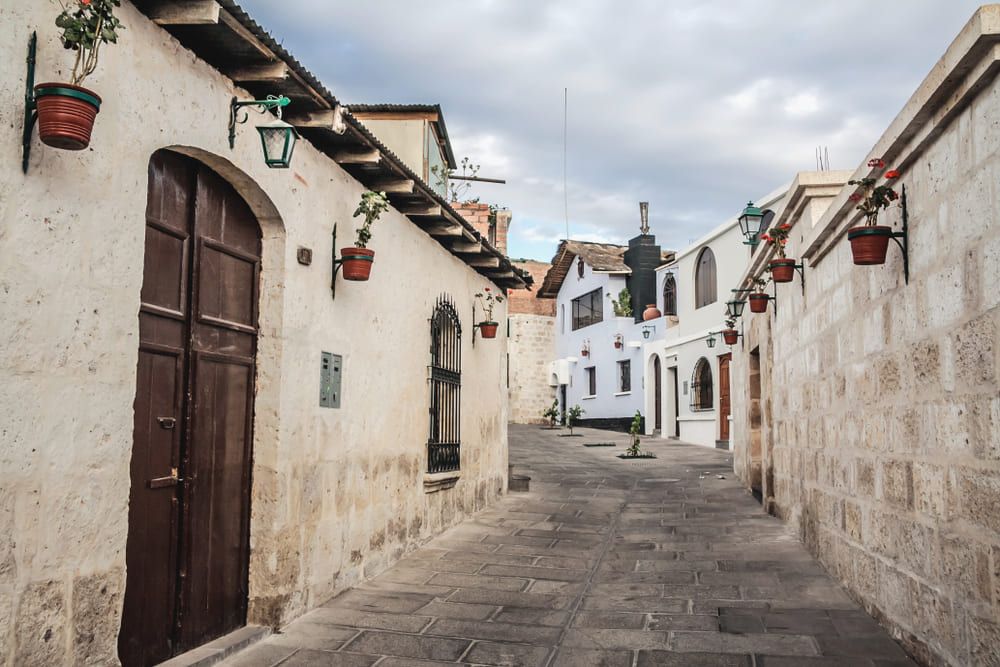
The ethnic group itself has disappeared, but its ancestry still lives on among the people of Arequipa. As you wander through the neighborhood, you’ll immediately notice that San Lázaro feels very different from the rest of the historic center. While Arequipa follows a strict colonial grid, this district holds onto its winding, irregular streets—a legacy of ancient pre-Hispanic paths preserved through the centuries, each carrying its own stories.
Right beside you, the Callejón de la Bayoneta certainly lives up to its name: it’s so narrow that, according to the joke, a single bayonet would be enough to make anyone approaching from the opposite direction back away. Today, San Lázaro is a place where Arequipa’s culture and cuisine really come into their own. Benigno Ballón Farfán, one of the region’s most celebrated musicians, was born here, and the neighborhood is also the birthplace of pan Ripacha, a traditional wheat bread that pairs perfectly with adobo.
San Lázaro is also full of traditional picanterías, local eateries where Andean and Spanish flavors come together. Arequipa has no fewer than 194 officially recorded dishes, and the picanterías follow one sacred rule: each day of the week has its own traditional specialty. Monday is for chaque, Tuesday for chairo, Wednesday for chochoca, Thursday for chuño negro, and Friday for the famous chupe de viernes.
So, what are you having today?
Aucun avis pour le moment
