





Walk
The Capital of the Island of Flowers
Funchal, Portugal
Walk
The Capital of the Island of Flowers
Funchal, Portugal
3.7 km
Distance
1h30
Durée
27
Audios
Loop
Parcours
Shutterstock
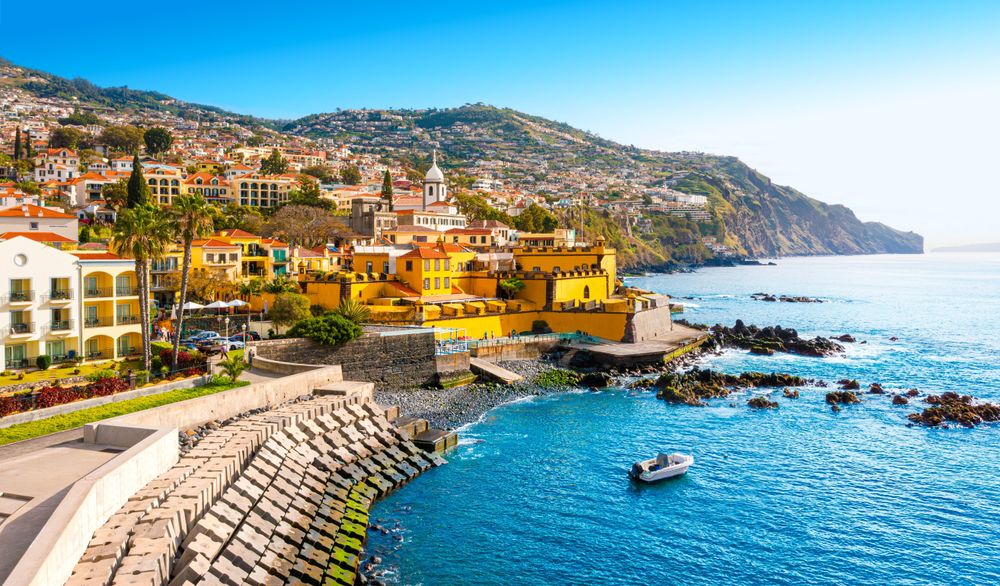
As you stroll along the peaceful Funchal Promenade, let me take you on a journey through the rich and fascinating history of Madeira and its capital. Feel free to sit and soak in the ocean breeze while you listen. This island, nestled off the African coast, has been around for millions of years, born from the powerful eruptions of underwater volcanoes that pushed land up through the sea.
The first official mention of Madeira appears in documents dating back to 1351, but it’s very likely that other peoples had set foot here long before, leaving no trace behind. The island’s documented history truly begins in 1418, when Portuguese explorers João Gonçalves Zarco and Tristão Vaz Teixeira arrived on Porto Santo, the smallest inhabited island in the archipelago. Shortly after, they reached Madeira—the island you're standing on—and founded the towns of Funchal and Machico.
They quickly claimed the territory for Portugal, marking the beginning of the great Age of Discovery. Under the guidance of Prince Henry the Navigator, Portugal launched a series of explorations that would span decades and shape the world map. The discovery of Madeira was one of the very first and most important chapters in that story.
The new settlers were quick to recognize the land’s incredible fertility. Agriculture flourished, with sugar cane and grapevines becoming major crops. Madeira became a crucial stop for sailors heading to distant lands, including none other than Christopher Columbus, who stayed on the island and even married a Madeiran woman.
But with the sugar industry came a darker chapter: slavery. For decades, black slaves were brought to the island to work the fields, as Madeira rose to become Europe’s top sugar producer. Eventually, Brazil took the lead, and Madeira shifted its focus to wine—another success story that still defines the island’s identity today.
In 1580, after the death of the last heir to the Portuguese throne, the King of Spain took power and Madeira fell under Spanish rule for 60 years. In 1662, the island was briefly under British control, before being returned to Portugal in 1668 by the Treaty of Lisbon. Still, strong British influence remained—especially in the wine trade, with English merchants exporting Madeira wine to the Americas.
Many English settlers established themselves here, adding a new layer to the island’s cultural fabric. During the Napoleonic Wars, Portugal allied with Britain, which sent troops to protect Madeira. Some stayed on after the conflict, further embedding British presence.
The 19th century, however, brought its share of hardship: revolts, crop diseases, cholera outbreaks, and economic troubles. But by 1890, Madeira began to reinvent itself as a tourist destination. European aristocrats were drawn by its stunning landscapes, gentle climate, and rich cuisine.
In 1910, Portugal became a republic, and despite the turbulence of World War I—including a naval attack on Funchal’s port in 1916—the island continued to grow. A military coup in 1926 brought an end to the republic and ushered in a dictatorship under Salazar, which lasted until 1974. Even under this strict regime, Madeira developed steadily, with tourism becoming an increasingly vital part of the economy.
In 1976, just two years after the dictatorship fell, Madeira gained autonomy, allowing for greater self-governance while remaining part of Portugal. Today, known as the Island of Flowers, Madeira is a beloved destination for travelers from all over the world. Its beauty, heritage, and hospitality make it a highlight of many European cruises, and a place that continues to captivate all who visit.
So if you're just beginning your stay here, rest assured—your adventure is only getting started. Now that you know its story, let’s step into the heart of the old city and see what wonders await.
Aucun avis pour le moment
